
The Fed kept interest rates unchanged at 3.5-3.75%, and a rare split emerged ahead of the transition of power.
Jerome Powell's final meeting as Fed Chairman saw significant disagreement over the interest rate path, while he announced he would remain on the Board of Governors after his term.
The US Federal Reserve (Fed) decided to keep the federal funds rate unchanged at 3.5-3.75% at its policy meeting concluding on April 29th. This development was not unexpected by the market; however, deep divisions within the Federal Open Market Committee (FOMC) regarding the future monetary policy path have emerged.
Disagreement is rare within the FOMC.
The FOMC vote revealed a scenario rarely seen during Jerome Powell's tenure: only eight members supported keeping interest rates unchanged, one member opposed it, and three others expressed dissatisfaction with the wording in the joint statement. Specifically, these three members objected to the phrase "additional adjustment," which implies the possibility that the Fed will continue to lower interest rates based on cuts from 2024 and 2025.
According to CNBC data, the last time the FOMC saw four members disagree was in October 1992. This division reflects pressure from inflation, which has remained above 3% since the end of 2023, along with conflicting signals from the labor market and economic growth.
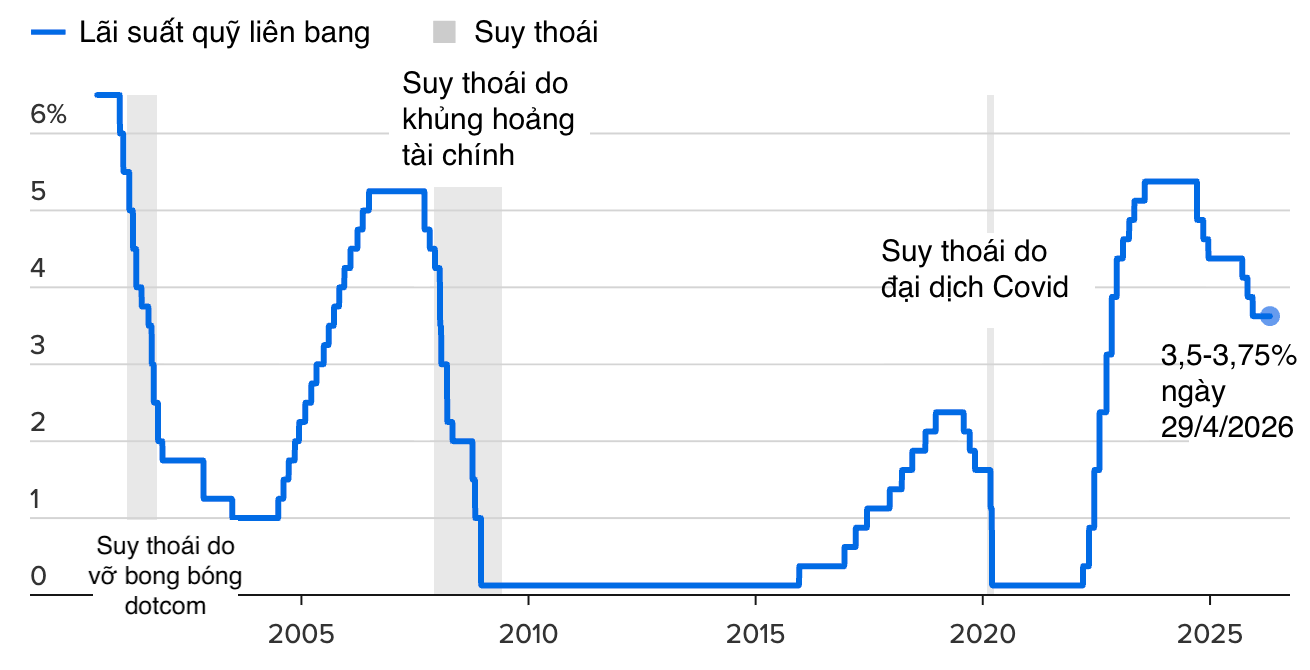
In light of these developments, futures market traders have shifted their expectations. Currently, the market is no longer betting on the Fed lowering interest rates this year; in fact, it predicts the agency will wait until 2027 for the next adjustment to bring interest rates back to a neutral level of around 3.1%.
Jerome Powell signals he will remain on the Board of Governors.
Although Jerome Powell's term as Fed Chairman will end in mid-May, he has signaled that he will remain on the Fed's Board of Governors. He said he would wait until the investigation into the renovation project of the agency's headquarters is fully concluded with transparent results.
Powell's term as governor runs until January 2028. If he does remain, this would be the first instance of an outgoing chairman not leaving the Board of Governors since 1948 (the case of Marriner Eccles). Analysts believe this decision aims to protect the Fed's independence from political pressure, especially as the US government is pushing for lower interest rates to reduce the burden of interest payments on its $39 trillion national debt.
Challenges from inflation and the transition process
Current inflationary pressures stem not only from rising global energy prices but also from tariff policies. While the Fed often overlooks temporary shocks, the sustained price increases are raising concerns about their long-term impact on consumer prices.
Meanwhile, the transition of power is beginning as the Senate Banking Committee has confirmed Kevin Warsh as Fed Chairman. Despite the leadership change, Powell's continued presence on the Board of Governors could maintain a balance of influence among the factions at the FOMC, preventing abrupt shifts in monetary policy in the short term.
Key US economic data:
- Federal fund interest rate:3.5-3.75% (unchanged)
- Non-farm employment growth in March:178,000 jobs
- Unemployment rate:4.3%
- Inflationary:Maintain above 3%
- US public debt:39 trillion USD


