
Nearly 35 hectares of VTNA2 rice crop have been burned to ashes for unknown reasons.
(Baonghean.vn) - Currently, in Hung Hoa commune, Vinh City, more than 35 hectares of spring rice, mainly the VTNA2 variety, are suffering from drought, yellowing, and poor development. Nearly a month later, authorities have yet to determine the cause, and farmers remain confused and struggling to save their crops.
For the past five years, since the commune decided to promote the use of VTNA2 rice to replace the long-duration IR 1820 rice variety, the family of Mr. Chu Sy Dung in Khanh Hau hamlet, Hung Hoa commune, Vinh city, has regularly planted this rice variety on their 21 sao (approximately 0.21 hectares) of rice fields.
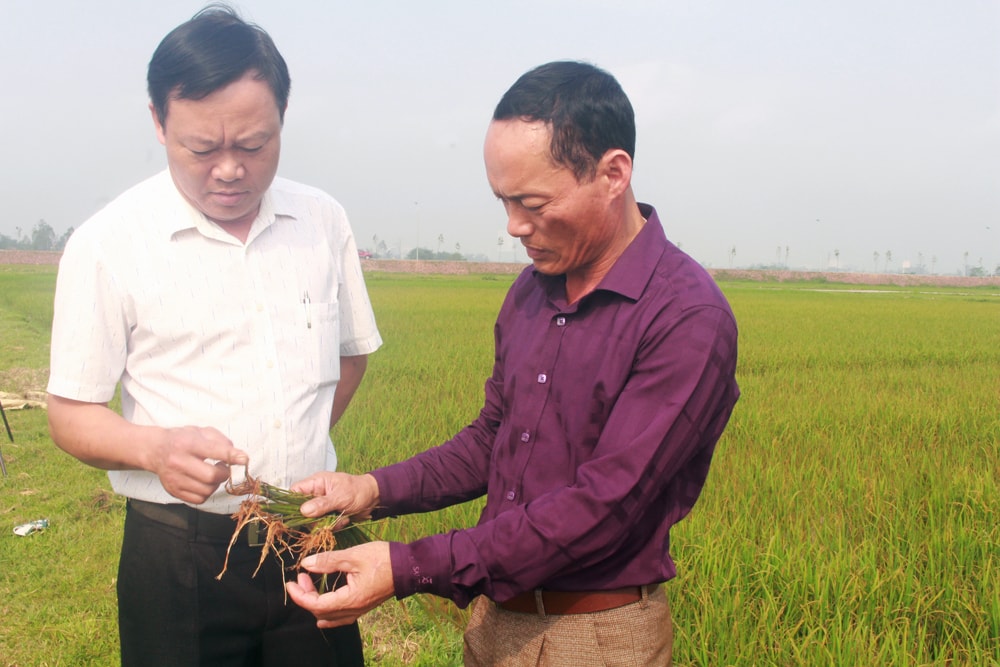 |
| Officials from Khanh Hau Cooperative inspect a diseased rice field. Photo: Phu Huong |
“In the spring of 2017, some of my family's rice fields were affected like this, with yields dropping from 250 kg/sao to 50-70 kg/sao, although the affected area was small. This year, I sowed rice at the beginning of December 2017 (lunar calendar). After more than 1.5 months, when the rice plants were tillering vigorously, the disease appeared. I pulled up the rice plants and took them to a pesticide store for inspection, then bought and sprayed pesticides to control blast, root rot, and root nematodes. When one type didn't work, I switched to another. But the disease didn't improve; it got worse. Nearly 15 sao of rice have turned bright yellow, withered, and the roots are black. I'm very worried and don't know how to cure the rice. If this continues, the rice will not yield any harvest,” Mr. Dung worried.
To date, Hung Hoa commune has 35 hectares affected by this "strange disease." The head of the commune's Agriculture Committee, Mr. Duong Xuan Tham, expressed concern: Of the five cooperatives in the commune, only the area of rice sown later, requiring replanting due to the cold weather and still being immature, belonging to Hong Quang Cooperative, remains unaffected.
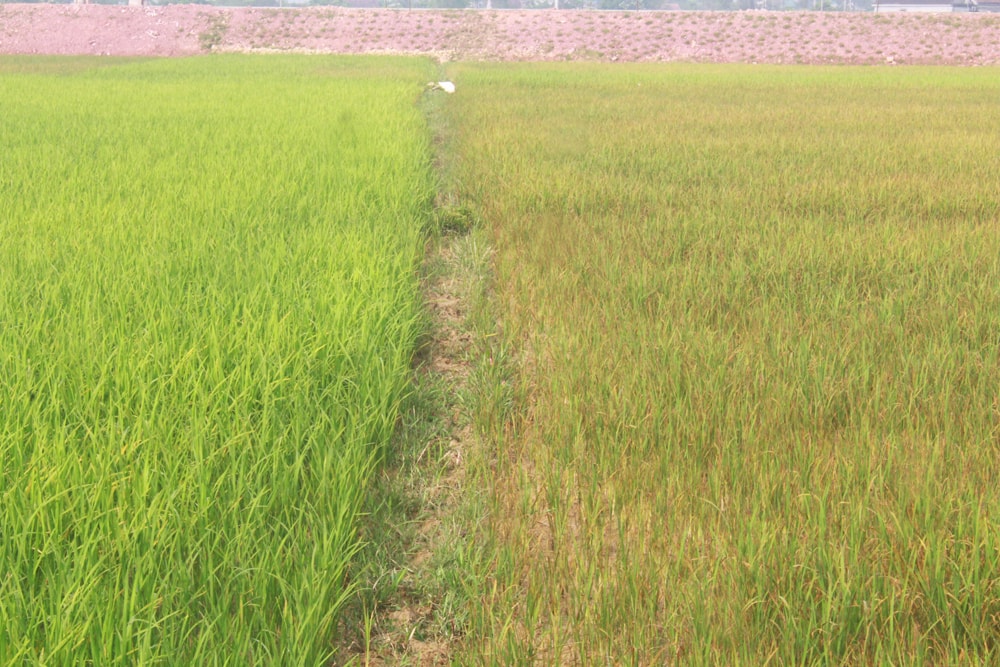 |
| Two rice fields, one affected by disease and the other unaffected, are located next to each other. Photo: Phu Huong |
In the commune, the VTNA2 rice variety has been continuously cultivated since 2015. This spring, this rice variety is also included in the city's target variety group, so we continue to use it, covering over 200 hectares out of a total of 402 hectares of rice in Hung Hoa. The area affected by disease is increasing rapidly, especially in fields located on high ground and acidic soil. After spraying various pesticides to treat root nematodes, blast, root rot, etc., without success, we are currently advising farmers to spray nutrient-rich pesticides to help the rice grow, as there are no more feasible solutions yet.
According to Mr. Trinh Thach Lam, Head of the Crop Production Department of the Provincial Crop Production and Plant Protection Sub-Department, this is the second time this "strange disease" has appeared in Nghe An province. In the spring of 2017, the disease also appeared in Hung Hoa commune, but the area and extent of damage were insignificant. Currently, only the rice in Hung Hoa commune is affected, and the disease only appears in rice fields using the VTNA2 variety.
To date, the cause and type of disease remain undetermined; however, infectious microbial causes have been initially ruled out due to the lack of typical symptoms. The Sub-Department has collected samples of diseased rice plants for replanting and monitoring. Simultaneously, farmers are being advised to increase fertilization and foliar application of phosphorus fertilizer to promote rice growth, enhance resistance to disease, and control common pests and diseases such as blast and root nematodes.


