
Gemini 3.0 Pro: A Silent Upgrade and a Multimodal Advancement
Google is reportedly quietly rolling out Gemini 3.0 Pro in Gemini Advanced, improving programming, UI creation, multimodal reasoning, and geared towards Workspace development.
A notification appeared with some users stating they had been “upgraded from the previous model to 3.0 Pro, the smartest model ever” within Gemini Advanced, suggesting Google may be quietly rolling out a new generation of models. Based on initial tests and leaks, Gemini 3.0 Pro is expected to significantly improve programming, user interface creation, and multimodal reasoning; and will likely play a central role in Gemini Advanced, Google Workspace (Docs, Gmail, Slides), and Gemini for Enterprise.
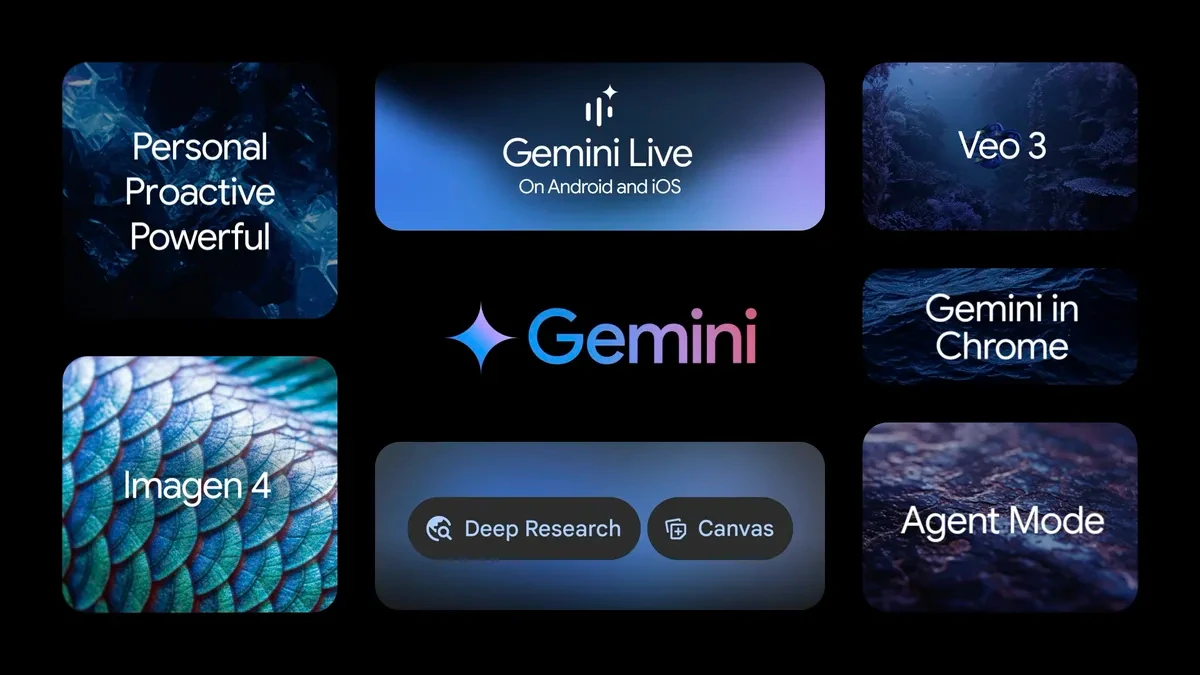
What has been revealed from the early user channel.
The most significant indicator lies in the user experience itself: some accounts saw the upgrade message to “3.0 Pro” in the Gemini Advanced interface. This is described as Google’s “smartest” model to date. This approach is consistent with Google’s history of “silent rollout” for the Gemini line, which occurred with Gemini 1.5 Pro before any blog posts or official announcements.
The goal of a quiet release strategy is to measure performance under real-world conditions, gather feedback, and make adjustments before setting a launch date. In the context of increasingly complex AI models, including a portion of users in an extensive testing phase helps vendors control risk and improve stability.
| Category | Available information |
|---|---|
| Deployment status | A 3.0 Pro upgrade notification has appeared in Gemini Advanced for some users. |
| Release format | Quietly, before the official announcement. |
| Scope of improvement | Programming, creating user interfaces, multimodal reasoning |
| Technical highlights | Generates more accurate SVG code compared to previous models. |
| planned integration | Gemini Advanced; Gemini for Workspace (Docs, Gmail, Slides); Gemini for Enterprise |
| Compare competitors | It is unclear whether it compares to the Claude 4.5 Sonnet or the GPT-5 Codex. |
What might lie beneath the "multimodal advance"?
Leaked information suggests that 3.0 Pro improves multimodal reasoning, meaning it can work more efficiently with data in various input formats (text, images, etc.) within the same task. From an application perspective, this is demonstrated through three mentioned competency areas: programming, user interface creation, and SVG code generation.
What does generating a more accurate SVG code tell us?
SVG is a structured vector graphics; generating “correct” SVG code requires the model to understand geometric relationships, group hierarchies, display attributes, and layout constraints. Therefore, progress in SVG signals a positive outlook for the model's structural inference and formal constraint compliance capabilities—abilities that are often more difficult to achieve than with plain text generation.
UI creation and programming productivity.
Improvements in user interface creation often involve the ability to describe layout structures, capture component conventions, and define interaction constraints. Meanwhile, programming capabilities are tied to syntactic accuracy, logical coherence, and test coverage. These improvements, if widely validated, would be highly significant when integrated into Docs, Gmail, Slides, and enterprise workflows where process automation is a priority.
Technical benefits and deployment value
- Higher output quality in structured tasks: SVG and UI are two useful indicators of syntactic accuracy and constraint thinking.
- Ecosystem synchronization: Version 3.0 Pro is expected to be the core of Gemini Advanced and Workspace, optimizing a seamless experience between chat tools and office applications.
- Agent platform for businesses: If acting as the "brain" for Gemini for Enterprise, the model can support the creation of customized processes, accelerate automation, and assist humans in repetitive tasks.
- Secure deployment through silent release: Gather feedback early, reduce the risk of widespread disruption.
Barriers and challenges to monitor.
- Version transparency: Silent releases can make it difficult to fix versions in the testing process, especially for organizations requiring strict control.
- Regression risk: There is no systematic comparison with competitors (Claude 4.5 Sonnet, GPT-5 Codex) and stability across different task domains is unclear.
- Governance and Compliance: As the model becomes core to Workspace and enterprise environments, requirements for auditing, logging, and authorization become crucial.
- User experience: Changes in model quality can impact expectations and workflows; a rapid feedback mechanism and clear support channels are needed.
Placing the 3.0 Pro in the competitive landscape and roadmap.
Based on available data, it's too early to conclude whether 3.0 Pro is superior or inferior to Claude 4.5 Sonnet or GPT-5 Codex in benchmark metrics. However, the anticipated role of 3.0 Pro as a model infrastructure for Gemini Advanced, Workspace, and Enterprise suggests that Google's focus is on large-scale deployment readiness and deep integration into existing products.
The repetition of the “deploy first, announce later” strategy (previously applied with Gemini 1.5 Pro) reveals Google's priority: prioritizing real-world operational data to fine-tune the model before widespread communication. As the official launch date approaches, key points to watch include: stability across versions, public ratings for programming and multimodal performance, and the scope of API integration and enterprise tools.
Conclusion: From early signs to infrastructure capacity
What has been observed suggests that Gemini 3.0 Pro could be a significant step forward, particularly in tasks requiring structural compliance like SVG, in addition to UI creation and programming capabilities. The silent deployment optimizes quality before scaling, while placing the model at the center of the product ecosystem. Until official announcements and independent benchmarks are available, the picture remains open; however, the trajectory of deep integration into Gemini Advanced, Workspace, and Enterprise demonstrates the infrastructure role of 3.0 Pro in Google's AI strategy.


