
Coffee prices today, October 29, 2025: The nightmare of fake coffee due to high prices.
Coffee prices today, October 29, 2025: Domestic coffee prices decreased by 1200 to 1500 VND/kg compared to yesterday. Many small shops have to mix in lower-quality ingredients.
Domestic coffee price update
Surveys show that coffee prices in the Central Highlands region today decreased by 1200 to 1500 VND/kg compared to yesterday, fluctuating between 114,500 and 115,500 VND/kg.
| Market | Medium | Change |
| Dak Lak | 115,700 | -1300 |
| Lam Dong | 114,500 | -1200 |
| Gia Lai | 115,300 | -1200 |
| Boeing Nong | 115,500 | -1500 |
Specifically, in Lam Dong province, the prices in Di Linh, Bao Loc, and Lam Ha decreased by 1200 VND/kg compared to yesterday, trading at the same level of 114,500 VND/kg.
In Dak Lak province, the Cu M'gar area is currently buying coffee at 115,700 VND/kg, a decrease of 1,300 VND/kg compared to yesterday. Meanwhile, the Ea H'leo and Buon Ho areas are trading at 115,600 VND/kg.
In Dak Nong (Lam Dong province), traders in Gia Nghia and Dak R'lap significantly reduced prices by 1500 VND/kg compared to yesterday, trading at 115,500 and 115,400 VND/kg respectively.
In Gia Lai province, the Chu Prong area is trading at 115,300 VND/kg, while Pleiku and La Grai are at 115,200 VND/kg, a decrease of 1,200 VND/kg compared to yesterday.

The current high price of pure coffee beans has forced many small cafes to mix in other ingredients to reduce costs. This has significantly reduced the quality of the coffee, making it difficult for consumers to distinguish between truly pure and fake products. The main reason stems from an unprofessional and poorly controlled production chain.
Many small processing facilities lack sufficient capital and technology, forcing them to purchase low-quality raw materials, or even discarded parts, for roasting, grinding, and blending. This practice increases their short-term profits but negatively impacts the long-term reputation of the Vietnamese coffee industry.
According to regulations, standard coffee must contain at least 1% caffeine. However, many products on the market still list only 0.4–0.7% caffeine on the packaging. Consumers need to carefully read the information when buying to avoid choosing low-quality products.
Experts believe that manufacturers must be responsible for the information on the packaging. If the caffeine content is not as stated, the product may be considered counterfeit. Only with proper and transparent production processes can the Vietnamese coffee market regain consumer trust.
World coffee price update
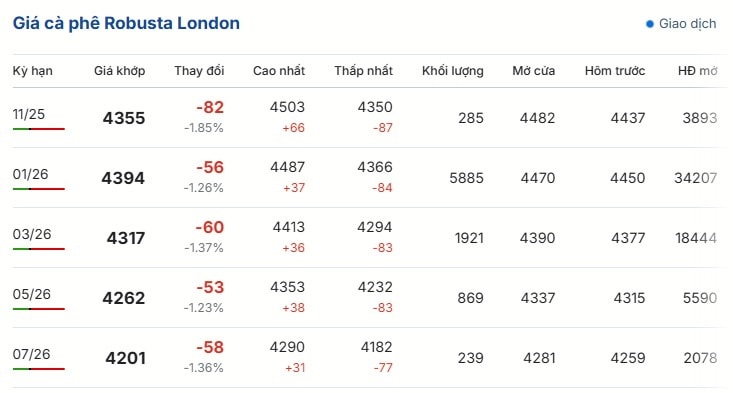
On the London exchange, online robusta coffee futures contracts for November 2025 delivery closed on October 28th at $4,355 per ton, down 1.85% ($82 per ton) from yesterday. The January 2026 contract fell 1.26% ($56 per ton), reaching $4,394 per ton.
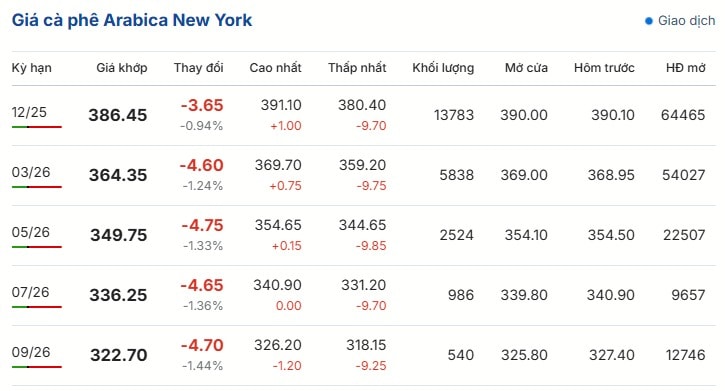
Similarly, the price of Arabica coffee futures for December 2025 delivery on the New York Stock Exchange fell 0.94% (3.65 US cents/pound) yesterday, reaching 386.45 US cents/pound. The March 2026 contract decreased 1.24% (4.6 US cents/pound), reaching 364.35 US cents/pound.
Coffee prices are falling sharply as the US continues to sign new trade agreements with many countries, including major coffee exporters. Currently, the US imposes very high import tariffs on coffee: 50% with Brazil, 20% with Vietnam, 19% with Indonesia, and 10% with Colombia.
Due to high tariffs, Brazilian coffee exports to the US have fallen sharply, while supplies from other countries such as Vietnam and Indonesia have increased. This shift has made coffee more expensive in the US, increasing pressure on consumers and roasting businesses.
In light of this situation, coffee associations and export businesses are working with the US government to propose that coffee be included in the list of goods exempt from tariffs, as it is a product that the US cannot produce domestically. If approved, import costs would be significantly reduced.
According to experts, when import tariffs are lowered to 0%, coffee prices could cool down quickly. At that point, American businesses are likely to return to importing heavily from Brazil – their traditional and most stable source of supply.


