
Rubber prices today, January 20th: International market continues to decline, supply from Malaysia drops sharply.
On January 20th, global rubber prices uniformly adjusted downwards across key exchanges, while production in Malaysia fell by nearly 50% compared to the same period last year.
World rubber prices on January 20th continued their downward trend in key markets. This was attributed to cautious investor sentiment awaiting clearer signals regarding global demand and crude oil price fluctuations. Meanwhile, raw latex prices in the Vietnamese market remained stable.
Trends in world rubber prices
In China, at the close of trading, the price of March 2026 rubber futures on the Shanghai exchange fell 0.1% (equivalent to 15 yuan), to 15,870 yuan/tonne. In Japan, the market also recorded a slight decrease of 1 yen for the February 2026 contract, closing at 347 yen/kg.
Contrary to the downward trend, in Thailand, the price of rubber futures for February 2026 remained unchanged at 62.8 Baht/kg. This divergence indicates that selling pressure still exists on major exchanges, but support in the producing regions remains quite strong.
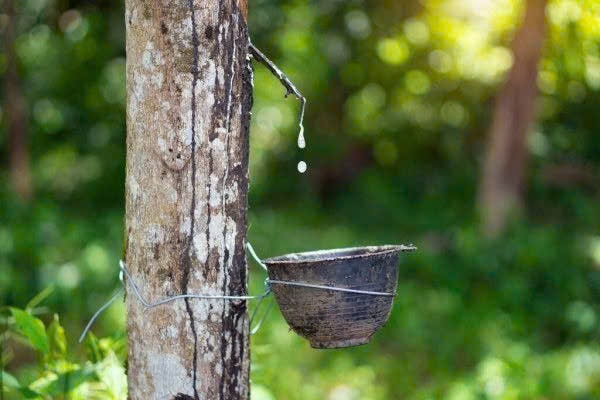
Supply in Malaysia has dropped significantly.
Data from the Department of Statistics Malaysia (DOSM) paints a worrying picture regarding supply. Natural rubber production in November 2025 reached only 20,891 tonnes, down 29.6% from October 2025 and a sharp decline of 48.2% compared to the same period in 2024. Notably, smallholder farmers remain the dominant force, accounting for 83.3% of total national production.
In addition to production, Malaysia's rubber inventory also decreased by 17.3%, from 145,422 tonnes to 120,208 tonnes. Exports in November 2025 also fell by nearly 30%, with China remaining the largest partner, consuming more than half of the country's rubber exports.
Domestic rubber prices remain stable.
Contrary to the downward trend in the international market, raw rubber prices at major enterprises in Vietnam remained stable today. Steady purchasing demand from processing plants helped prevent the domestic market from being swept along by the global price decline.
Below is a table of purchase prices at some typical businesses:
| Company | Type of latex | Purchase price (VND) |
|---|---|---|
| Binh Long Rubber | Latex (at the factory) | 440 VND/degree TSC |
| Ba Ria Rubber | Latex (25 - 30 TSC) | 415 VND/degree TSC |
| Ba Ria Rubber | DRC latex (35 – 44%) | 13,900 VND/kg |
| Phu Rieng Rubber | Latex | 420 VND/degree TSC |
| Phu Rieng Rubber | Mixed latex | 390 VND/DRC |
| MangYang Rubber | Latex | 403 – 408 VND/TSC |
From a downstream perspective, the tire industry is witnessing new shifts. A prime example is the recent commissioning of a factory in Cambodia by Wanli Tire Group (China), with a capacity of 6 million passenger car tires per year in the first phase. This move is expected to stimulate rubber consumption in the medium term, although it is not yet strong enough to reverse short-term price trends.


