
The family of composer Văn Cao is upset about the licensing process for the dissemination of the 'National Anthem'.
Poet and painter Van Thao, son of the late musician Van Cao, said that his family is not concerned about the recent announcement of the song "Tien Quan Ca" (Marching Song) being popularized because it has long been in the hearts of the Vietnamese people.
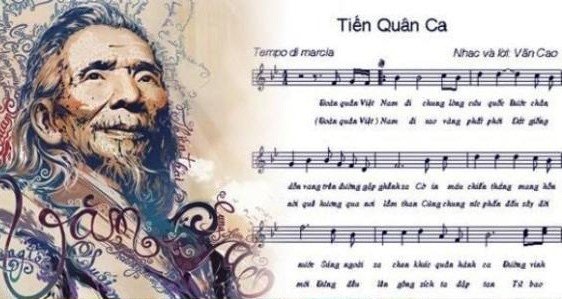
Recently, the Department of Performing Arts updated and supplemented the list of 324 widely popular songs, the majority of which are revolutionary songs very familiar to the public. Among these 324 widely popular songs is "Tiến quân ca" – the national anthem of Vietnam, composed by musician Văn Cao.
This information is causing much controversy and conflicting opinions, with some music lovers even saying it's "ridiculous." After all, "Tiến quân ca" (Marching Song) is the national anthem, approved by the National Assembly. Therefore, the document from the Department of Performing Arts granting permission for its widespread dissemination has inadvertently become a laughingstock for many.
 |
Following this move by the Department of Performing Arts, poet and painter Van Thao - son of the late musician Van Cao - stated that his family is not concerned about whether the Department decides to license or widely disseminate the "Marching Song" because the song has already been donated to the State by the family.
"I'm not surprised by this at all. Since the beginning of the year, the Department has done many things that have angered the people. My family doesn't care about this anymore; let the people speak for themselves. People have been singing Van Cao's works for so many years, and now they're going to popularize and license them, and even misspell his name. In general, I'm very disappointed," shared poet and painter Van Thao.
Previously, in August 2015, a debate also arose regarding whether to collect royalties for the song "Tien Quan Ca" (Marching Song), when the Vietnam Copyright Protection Center for Music called for the collection of royalties. Following this, the Ministry of Culture, Sports and Tourism suggested that the Vietnam Copyright Protection Center for Music cease collecting royalties, citing the reason that Mrs. Nghiem Thuy Bang (wife of the late composer Van Cao) had donated the song "Tien Quan Ca" to the public, the Party, the National Assembly, and the State. This was also the wish of the late composer Van Cao during his lifetime.
In 1946, the song "Tiến quân ca" (Marching Song) was chosen as the national anthem by the National Assembly of the Democratic Republic of Vietnam. After the reunification of the country in 1975, there was a campaign to compose a new national anthem, but the National Assembly still decided that "Tiến quân ca" would remain the national anthem. On July 15, 2016, in Hanoi, the National Assembly Office, in coordination with the Ministry of Culture, Sports and Tourism, held a ceremony to receive the song "Tiến quân ca" (Marching Song) and posthumously award the Ho Chi Minh Order from the President of Vietnam to the late composer Văn Cao, and a Certificate of Merit from the Prime Minister to Mrs. Nghiêm Thúy Băng (wife of the late composer Văn Cao). |
According to Vietnamnet


