
Gia Lai develops 2,340 hectares of specialty coffee, Robusta ranks among the top 3 in the world.
Farmers in Gia Lai are shifting from a quantity-oriented mindset to a value-oriented one, focusing on producing high-quality Robusta coffee with a CQI score of 87.5 and aiming for 2,340 hectares by 2030.
In Gia Lai, a segment of farming households are proactively shifting from conventional coffee production to high-quality coffee, focusing on Robusta. This shift focuses on harvesting and processing to meet the stringent standards of the specialty coffee market.
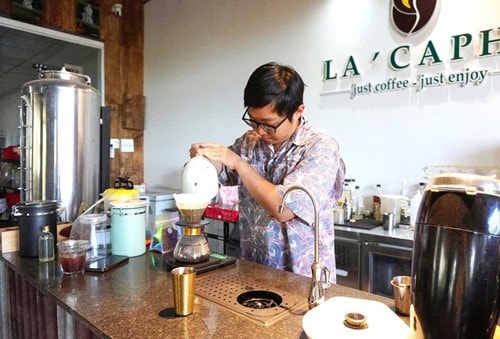
Affirming the position of Gia Lai Robusta on the world map.
High-quality Robusta coffee (Fine Robusta) from Gia Lai is gradually establishing its position thanks to its unique identity and consistent quality. Notably, in 2025, a batch of Gia Lai Robusta coffee achieved 87.5 points on the Coffee Quality Institute (CQI) rating scale, ranking among the top 3 in the world. This result has become an important driving force encouraging local farmers to shift towards more specialized production.
Ms. Nguyen Thi Nga, Deputy Director of Nam Yang Agricultural and Service Cooperative, said that the local high-quality Robusta coffee beans are now not only consumed domestically but also have expanding export opportunities. Customers particularly favor them due to their high caffeine content and distinctive sweet aftertaste. The cooperative is currently gradually developing a specialized Robusta coffee growing area through production linkages with its members.
A rigorous production process starting from the fields.
Producing specialty coffee is a lengthy process requiring synchronization from cultivation to logistics. Mr. Phan Huu Duong, a farmer in Ia Ly commune, shared that this trend has only become truly evident in the last 3-4 years. With 4.5 hectares of cultivated land, his family harvests about 12 tons of green coffee beans annually, all of which are picked when fully ripe and dried on racks.
Currently, common processing methods include: dry processing (Natural), honey processing, and anaerobic fermentation. Mr. Duong emphasized that the quality of Robusta coffee depends on many factors such as the age of the plantation (over 10 years), climate, and strict adherence to the fermentation process. The final product is aimed at customers who prefer chocolate aromas, a thick crema, a rich flavor, and a sweet aftertaste.
Investment Challenges and Directions for 2030
Despite bringing high added value, the shift to high-quality coffee faces numerous challenges. Nguyen Nhat Tin (Ia Hru commune) noted that processing specialty Robusta coffee requires significant investment in labor and equipment such as color sorting machines and drying racks. If the market is unstable, farmers could easily revert to the traditional commercial coffee production model.
According to the regional development plan, Gia Lai province aims to develop over 2,340 hectares of specialty coffee by 2030. The current market demands not only purity but also transparency regarding origin, plant variety, processing methods, and roasting levels. This core information constitutes the value of specialty coffee products in the modern market.


