
Rice prices today, April 3, 2026: Slightly increased, exports reach peak.
Rice price fluctuations today, April 3, 2026, reflect new changes in both domestic and international markets.
Surveys in the Mekong Delta region show a slight increase in prices for some types of raw rice. At the same time, on international exchanges, the price of Vietnamese export rice has climbed to high levels due to increasingly scarce domestic supply.
Updated domestic rice prices in the Mekong Delta.
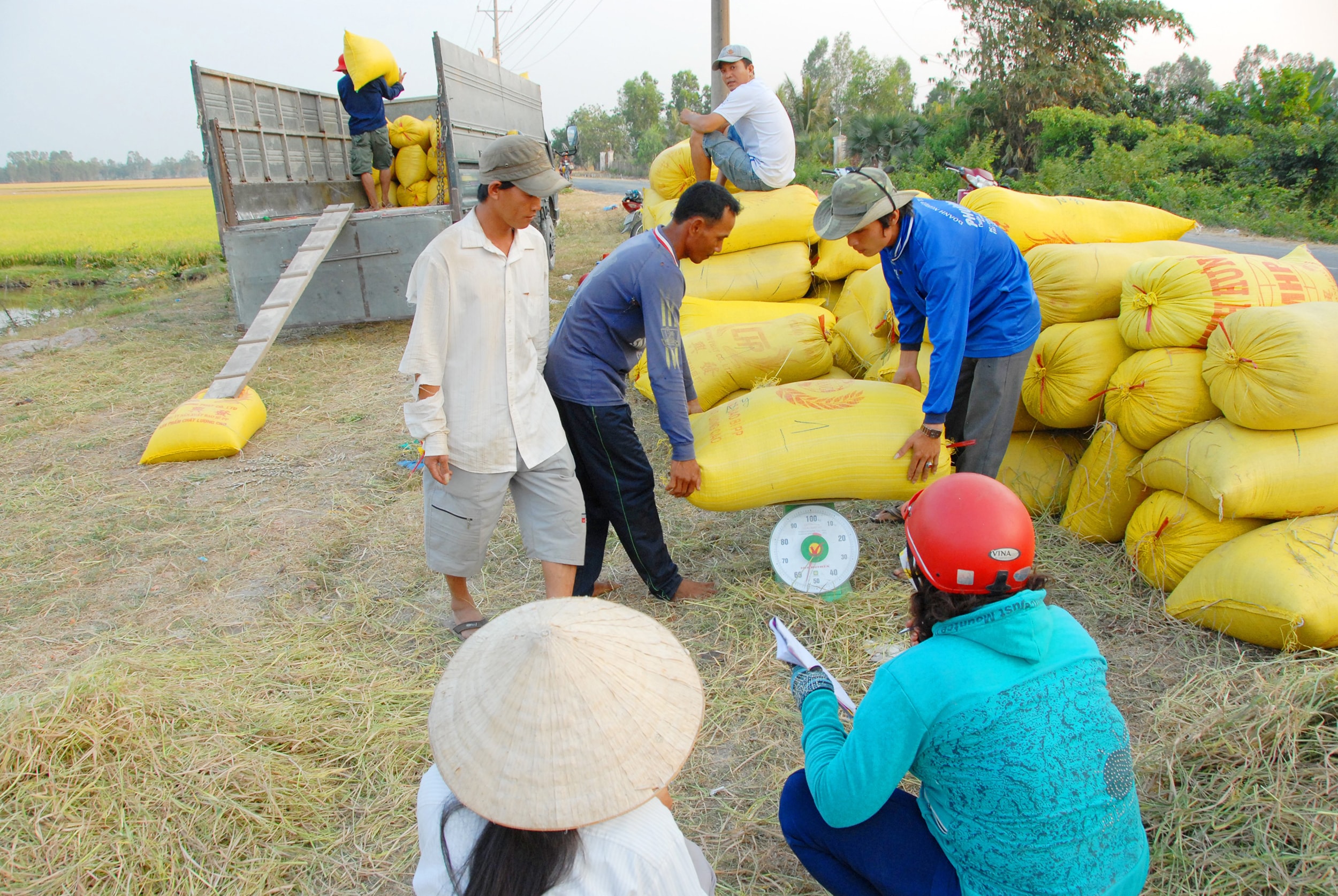
According to the latest statistics, the domestic wholesale market is showing an upward trend. Raw rice prices have uniformly increased by 50 VND/kg. Specifically, CL 555 raw rice is trading at 7,950 – 8,100 VND/kg. OM 5451 raw rice has also risen to 8,450 – 8,550 VND/kg.
Detailed price list for fresh rice and by-products.
For by-products, the price of IR 504 steel sheets remained stable at 7,600 – 7,700 VND/kg. Notably, the price of rice bran reversed its trend and decreased by 50 VND/kg, falling to 6,850 – 7,050 VND/kg.
Regarding fresh rice, the Department of Agriculture and Rural Development of An Giang province has updated the specific purchase prices at the fields as follows:
- OM 18 rice:5,700 - 5,800 VND/kg.
- Dai Thom 8 rice:5,700 - 5,750 VND/kg.
- OM 5451 rice:5,400 - 5,600 VND/kg.
- IR 50404 rice:5,400 - 5,500 VND/kg.
- OM 34 rice:5,100 - 5,200 VND/kg.
Trends in global export rice prices
The global export market this week shows a clear divergence. India continues to maintain stable prices as demand declines, driven by rising freight costs and volatile exchange rates. Indian parboiled rice with 5% broken grains is offered at $341–$348 per ton, while white rice with 5% broken grains ranges from $336–$341 per ton. Buyers from Africa are currently slowing down due to escalating transportation costs.
In contrast to India, the export price of 5% broken rice from Vietnam surged to US$375/ton (as of April 2nd), significantly higher than the US$350–355/ton of the previous week. Traders said the winter-spring harvest is nearing its end, leading to a shortage of supply. Furthermore, sharply increased fuel, transportation, and processing costs due to tensions in the Middle East have directly driven up prices.
In the Thai market, 5% broken rice also rose to $370–375 per ton due to scattered demand from Europe and Asia. Separately, the Bangladeshi market remained high despite a good harvest, putting significant pressure on the cost of living for consumers.
Price control policies in the Philippine market
In response to escalating prices, Philippine President Ferdinand “Bongbong” Marcos Jr. announced he will soon issue an order imposing a price cap of 50 pesos per kilogram on imported milled rice. The decision comes after the Department of Agriculture noted that retailers were pushing prices up to 55-58 pesos per kilogram, citing the global oil price shock.
To protect consumers, the Philippine government is working to expand its program of supplying cheap rice at 20 pesos/kg to 627 retail outlets nationwide, while also launching price-stabilized rice packages at 45-48 pesos/kg in many traditional markets.


