
Pepper prices today, December 2nd, 2025: A sharp decline.
Pepper prices today, December 2nd, 2025: Domestic pepper prices have reversed course and fallen sharply by 1000 to 2000 VND/kg. Prices are forecast to increase towards the end of 2025 due to high demand.
Domestic pepper prices today, December 2, 2025
Specifically, the price of pepper in Dak Lak is being purchased at 150,000 VND/kg, a decrease of 1,000 VND/kg compared to yesterday. The price of pepper in Chu Se (Gia Lai) is being purchased at 148,500 VND/kg, a sharp decrease of 2,000 VND/kg compared to yesterday. The price of pepper in Dak Nong today is recorded at 150,000 VND/kg, a decrease of 1,000 VND/kg compared to yesterday.
In the Southeast region, the price of pepper in Ba Ria - Vung Tau is currently 149,000 VND/kg, down 1,000 VND/kg compared to yesterday; in Binh Phuoc, the price of pepper today is also 149,000 VND/kg, down 1,000 VND/kg compared to yesterday.
| Province (survey area) | Purchase price (Unit: VND/kg) | Change (Unit: VND/kg) |
| Dak Lak | 150,000 | -1000 |
| Gia Lai | 148,500 | -2000 |
| Boeing Nong | 150,000 | -1000 |
| Ba Ria - Vung Tau | 149,000 | -1000 |
| Binh Phuoc | 149,000 | -1000 |
| Dong Nai | 149,000 | -1000 |
Experts predict that the end of 2025 will be a positive period for the pepper market, with prices likely to rise and demand returning. This presents an opportunity for the Vietnamese pepper industry to optimize cultivation area, enhance export capacity, and develop long-term strategies to maintain its position in the global market.
According to the International Pepper Association, global pepper production for the 2025-2026 season is likely to increase slightly to around 533,000 tons if weather conditions remain stable and replanting programs continue. In Vietnam, production is projected to increase by about 10% compared to the previous season, reaching 190,000-193,000 tons under normal natural conditions.
VPSA believes that supply and demand remain balanced; however, factors such as tariffs and technical barriers will strongly impact market strategies. From now until the end of 2025, prices and import demand are forecast to continue increasing. Entering 2026, when production may recover, pepper prices will face downward pressure, especially given the difficulty in expanding cultivated area as most land has already been exploited to its maximum capacity.
VPSA recommends that businesses proactively manage inventory and supply, utilizing reserves effectively to meet increased demand at the end of the year and boost transactions. Strategic factors such as export taxes, shipping costs, and rules of origin are expected to reshape the global market share structure. Despite facing many fluctuations, Vietnam maintains its advantage thanks to stable quality and a long-standing export system.
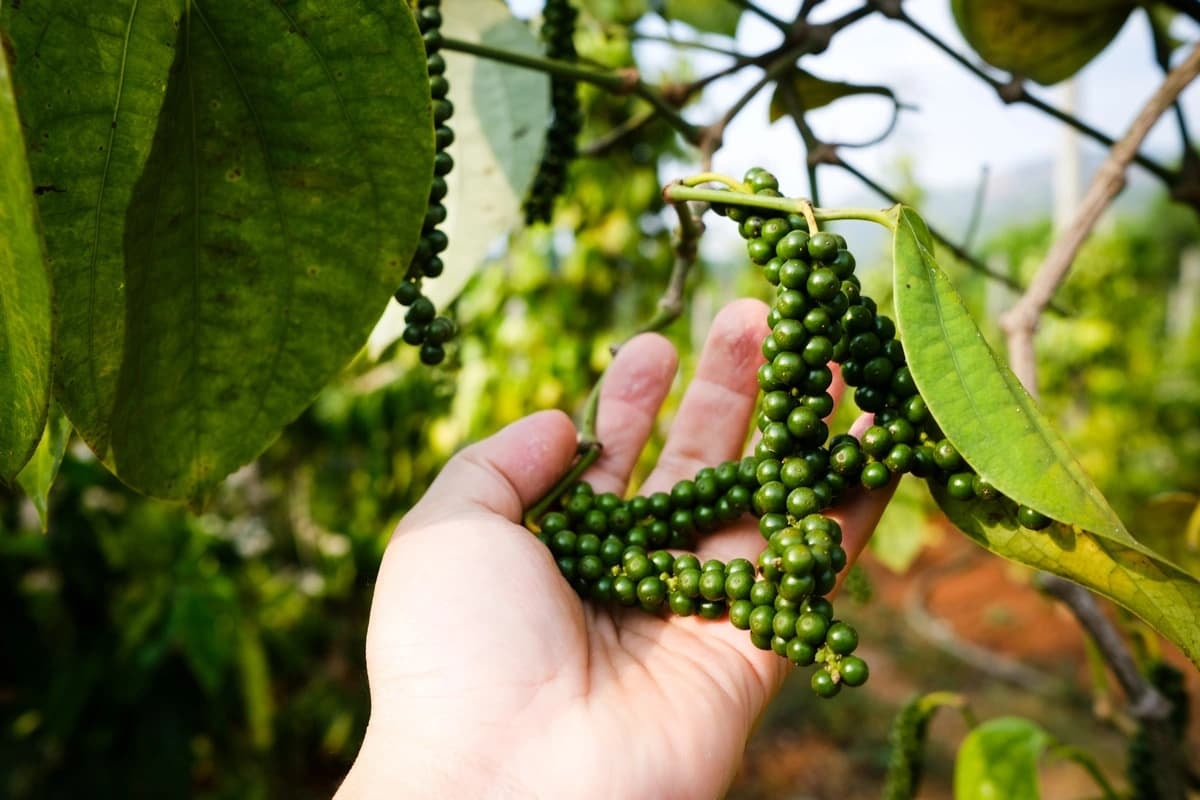
Today's world pepper prices
According to the International Pepper Association (IPC), at the close of the most recent trading session, the IPC listed Indonesian Lampung black pepper at US$7,136/ton and Muntok white pepper at US$9,717/ton.
Brazilian ASTA 570 black pepper is priced at US$6,175/ton. Malaysian ASTA black pepper remains stable at US$9,200/ton; Malaysian ASTA white pepper is priced at US$12,300/ton.
Today, Vietnamese black pepper is trading at US$6,500/ton for the 500 g/l variety; US$6,700/ton for the 550 g/l variety; and white pepper at US$9,250/ton.
A new report by Nedspice indicates that the global pepper market is experiencing a prolonged shortage, with global production falling by more than 30% over seven years to around 430,000 tons. While Brazil continues to expand its planted area, major producing countries such as Vietnam, India, and Indonesia have all recorded declines, indicating a clear contraction in supply.
Global demand for pepper weakened this year, particularly from the US, which fell by about 30%. This trend led to a 6% decrease in Vietnam's pepper exports in the first 10 months. However, the US's exemption of reciprocal tariffs on non-domestically grown spices from November 13, 2025, may help demand recover in the near future.
Vietnam is increasingly having to increase imports to meet re-export demands, with imports rising 32% to 38,000 tons, including a doubling of imports from Brazil. However, inventories are still declining as both production and imports are lower than exports. The forecast for Vietnam's new crop is only 153,000 tons due to unfavorable weather conditions, continuing the decline seen in 2025 when production reached only 172,000 tons, nearly half of the peak period of 2018–2019.
On the international market, Brazil is expected to harvest around 89,000 tons of pepper in 2025 despite labor shortages, while Indonesia is projected to harvest around 36,000 tons due to reduced inventories following strong exports in 2024. These factors, along with weak demand, VAT issues, and farmers' tendency to hoard their stock, have significantly impacted domestic pepper prices recently.


