
Decoding the record-breaking parachute jump from an altitude of 7,600 meters.
Luke Aikins landed precisely in the net thanks to his helmet-mounted locator, ground-based signaling systems, and extensive skydiving experience.
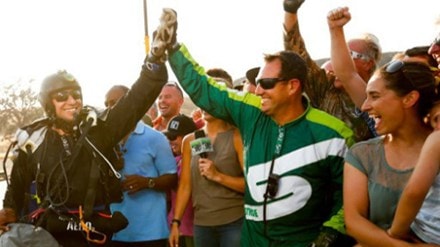 |
| Luke Aikins (in the blue shirt) celebrates after successfully completing the jump. Photo: AFP. |
Luke Aikins, a 42-year-old American, jumped from an airplane at an altitude of 7,600 meters on July 30th without a parachute and landed safely in a net near Simi Valley, California. Aikins spent nearly two years preparing and months training for this jump.
According to Inverse, the 30x30 meter net was erected to a height equivalent to a 20-story building. To test the net's strength, Aikins' support team used a dummy weighing approximately 90 kg as a simulation. Through repeated tests, the net was perfectly balanced, ensuring it was high enough to prevent Aikins from being thrown up or punctured upon landing.
After jumping, Aikins removed his oxygen mask at an altitude of 5,400 meters. Because the air thins with altitude, Aikins fell at a speed of approximately 240 km/h at the start of the jump. At lower altitudes, his speed decreased to about 190 km/h. During the fall, Aikins constantly battled the ever-changing winds. In the final moments, Aikins flipped over so his back was facing the ground and released himself into a net.
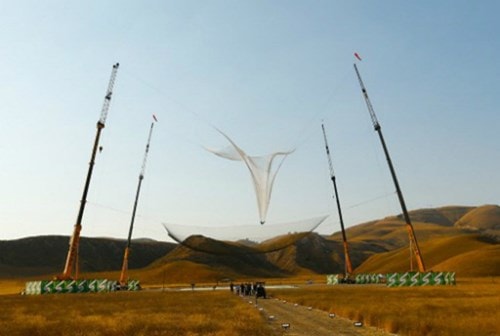 |
| Aikins called the net a "passive parachute". Photo: AFP |
During the jump, Aikins was escorted by three other people, all carrying parachutes. Their roles included filming, releasing smoke to help the audience below observe Aikins' descent, and holding an oxygen mask for Aikins when he no longer needed it.
They then deployed their parachutes while Aikins continued to fall and landed in a net.
Aikins was able to land precisely in the net thanks to a GPS tracking system mounted on his helmet and a sophisticated ground-based lighting system, visible from an altitude of 7,600 meters, according to Chris Talley, Aikins' friend, as reported by AP. If Aikins deviated from the course, the lights would turn red, while if he landed correctly, the lights would be white.
"They're similar to the lights pilots see when landing at an airport," Talley said.
Aikins can change his descent with just small adjustments to his hands, Talley said, adding that experienced skydivers have an "incredible" ability to control where they land.
According to the U.S. Parachute Association, the standard altitude for deploying a parachute is approximately 760 meters. The net that Aikins called a "passive parachute" was positioned at an altitude of about 60 meters. This 700-meter difference required Aikins to obtain a special permit to perform the jump, despite his two decades of parachute jumping experience.
Aikins has performed 18,000 jumps and is a safety consultant and trainer for the American Parachute Association. He is also a stunt performer, notably in the film Iron Man 3. With his performance on July 30th, Aikins became the first person to jump from mid-troposphere and land safely without a parachute.
According to VNE
| RELATED NEWS |
|---|


