
What is the solution for Russia and the US?
(Baonghean) - International public opinion is paying close attention to the latest developments in the Middle East, including the deployment of a squadron of F-15C aircraft carrying air-to-air missiles by the US to the region. Baonghean newspaper conducted an interview with Associate Professor, Major General Le Van Cuong - former Director of the Institute for Strategic Studies of the Ministry of Public Security - on this issue.
Reporter:General, regarding the context before the latest US action, some argue that Russia's airstrikes against ISIS in Syria have put the US in a passive position, even altering the nature and dynamics of the region. What is your assessment of this?
Major General Le Van Cuong:First and foremost, it must be stated that the US was taken by surprise by Russia's airstrikes in Syria, in three respects: the timing, the scale, and the effectiveness of the airstrikes.
In terms of scale, the aircraft deployed by Russia in this operation were highly advanced stealth fighters, and the frequency of bombing and shelling targets in Syrian territory was relatively high. In terms of effectiveness, there is no doubt that Russia's air campaign was far more effective than the war waged by the US-led international coalition over the past 15 months.
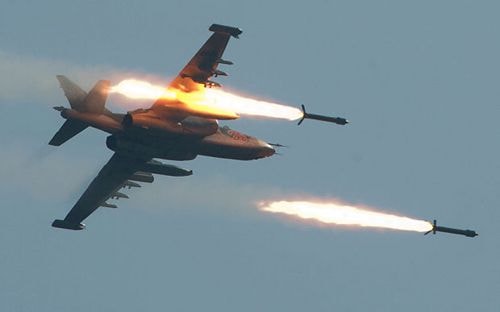 |
| Russia has conducted numerous airstrikes against ISIS in Syria. Photo: Telegraph |
Russia's presence has forced the US to adjust its strategy in the region. This includes three specific adjustments:
First, from rejecting Iran's role, the US has had to accept the country's involvement in resolving regional issues.
Secondly, the US deployed 50 staff officers to support the opposition forces fighting against al-Bassad's government – which is backed by Russia and is gaining an advantage thanks to Russian airstrikes.
Third, the U.S. must proactively offer cooperation with Russia to find a solution to the conflict in Syria.
For these reasons, I agree with the view that Russia's airstrikes in Syria have put the US on the defensive. Whether the nature and dynamics of the situation in Syria have changed requires a review of the entire conflict that has unfolded in the country since March 2011.
The Syrian conflict has gone through three phases, each with its own characteristics.
Phase 1 (March 2011 - July 2014) was characterized by a civil war between al-Assad's government and opposition forces and ISIS.
Phase 2 (August 2014 - September 2015) was marked by the US launching the war against IS, establishing an international coalition to conduct airstrikes in Iraq and Syria, and providing training and support to moderate opposition forces fighting against the al-Assad regime. Between these two phases, there was a significant shift: from a civil war to a localized war, intertwined with counter-terrorism efforts, and involving the intervention of foreign forces (the US and the West).
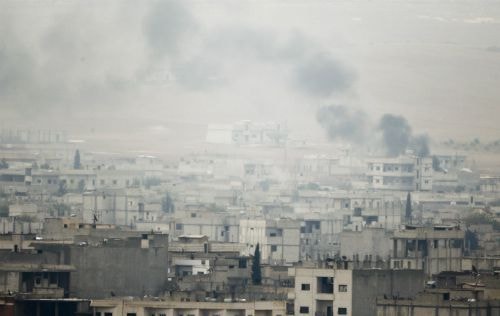 |
| The town of Kobani, Syria, has been subjected to numerous airstrikes targeting ISIS by the US and its allies. Photo: Reuters |
Phase 3 of the Syrian conflict began on September 30, 2015, when Russia launched airstrikes against terrorist targets in Syria.
Thus, the nature of the Syrian conflict is further complicated by the conflicting and opposing forces vying for common goals and interests. On the one hand, Russia and the United States share the same objective of combating the terrorist organization ISIS – although they do not openly cooperate with each other.
On the other hand, returning to the core of the conflict in Syria – a civil war – the US and Russia have chosen two opposing sides. One side supports the al-Assad regime, the other backs the opposition forces. Thus, another conflict has inadvertently emerged on this battlefield: the conflict between Russia and the US, with an extremely high risk of military conflict as both have directly entered the fighting.
Thus, it can be concluded that the nature of the conflict in Syria has changed and entered a completely new phase since Russia's airstrikes in Syria.
Reporter:Although the US has announced the deployment of F-15C aircraft to Türkiye to protect its ally, international opinion is concerned about the risk of aerial conflict between Russia and the US. What are your thoughts on this matter, General?
Major General Le Van Cuong:I'm afraid the US explanation for protecting its ally Türkiye from stray aircraft is unconvincing. F-15C aircraft carry air-to-air missiles solely for aerial combat, shooting down enemy aircraft, and have no value in attacking ground targets. Meanwhile, ISIS and other terrorist organizations don't possess aircraft, so what was the US objective? Although they didn't say it explicitly, the whole world implicitly understood it was a Russian aircraft.
The reasons why the US did this are extremely easy to understand. First, it sends a deterrent message to Russia not to go too far in conducting airstrikes in Syria, that the US is always "on its flank," ready to respond promptly and proportionally to any Russian actions. Second, it suppresses and strengthens the confidence of allies in the region, regaining the US's position and role in the process of resolving conflicts in the Middle East, preventing Russia from gaining the upper hand.
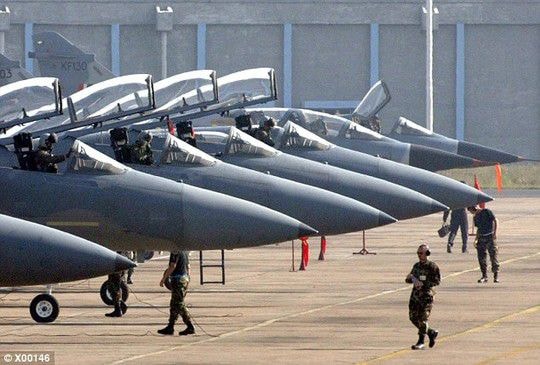 |
| US fighter jets have been deployed to the Turkish-Syrian border region. Photo: Daily Mail |
In short, deploying aircraft carrying air-to-air missiles to Türkiye, near the Syrian border, is more of a political than a military move. However, international opinion is concerned about a direct conflict between Russia and the United States, given the high concentration of state-of-the-art military weapons in Syria and the region.
But I personally think that possibility is very low. The US and Russia are concentrating their forces in the heart of Syria to put pressure on their opponents, but they wouldn't be foolish enough to engage in a full-blown, internecine conflict there. The Syrian "pie" is hard to ignore, which is why they've persisted in this region from the beginning of the conflict until now. But is it worth openly attacking each other?
It seems unlikely that Syria is significant enough to push the US and Russia into a hot war. Especially in the context of escalating terrorism and China's expanding power, such a scenario would only provide these powers with an opportunity to reap the benefits.
ReporterAnother issue that has attracted considerable public attention recently is the crash of a Russian A-321 aircraft over the Sinai Peninsula. According to the Major General, what impact will this event have on the Kremlin's strategy in the Middle East? What are the Major General's predictions regarding future developments in the region?
Major General Le Van Cuong:I believe Russia will shift towards strengthening its defenses against attacks from ISIS and other terrorist organizations, essentially boosting its "defensive" capabilities. As for airstrikes, there's no reason for Russia to stop; in fact, they will likely intensify.
To date, there is still no definitive conclusion regarding the cause of the plane crash, but experts believe there is a 90% chance it was caused by a terrorist bomb. Therefore, the A-321 crash could also be considered a very convincing pretext if Russia takes a tougher stance in Syria and other areas related to Russian interests.
Overall, recent developments such as Iran's entry into the conflict and the US deployment of F-15C aircraft show that the conflict in Syria has yet to find a "cooling point," and I believe this situation will continue at least until the end of 2015.
First and foremost, it is necessary to address the issue of terrorist organizations intertwined with the political conflict between Russia, the US, the al-Assad regime's alliance, and Iran. It is highly likely that in the coming period, the parties will focus on pushing back and containing the expansion of ISIS. Only then will there be space and opportunity to find a political solution to the nearly five-year-long conflict in Syria.
Reporter:Thank you, Major General, for the conversation!
Thuc Anh
| RELATED NEWS |
|---|


