
Solutions for developing voluntary social insurance
(Baonghean) - Voluntary Social Insurance is a form of insurance with many advantages, helping self-employed workers and people in rural areas reduce difficulties and risks in old age. To develop this type of insurance, the provincial Social Insurance agency has implemented various methods to disseminate new regulations and supplement preferential policies for those participating in voluntary social insurance to the public.
Voluntary social insurance is a type of social insurance that workers voluntarily participate in, choosing the contribution level and payment method that suits their income in order to receive benefits as prescribed. The target group for voluntary social insurance is very broad; any Vietnamese citizen aged 15 and above who is not participating in compulsory social insurance can participate.
As of March 31, 2016, Nghe An province had 21,765 people participating in voluntary social insurance, reaching 73.58% of the target set by Vietnam Social Insurance, accounting for approximately 30% of the total number of people participating in social insurance on a voluntary basis. Because it was the first province in the country to implement social insurance for farmers and later transferred it to the provincial social insurance agency, Nghe An has a relatively large number of voluntary social insurance participants. Some districts achieved high participation rates, such as Thai Hoa, Nghia Dan, Do Luong, and Yen Thanh.
 |
Trade union officials from the Southeast Economic Zone raise questions about the Social Insurance Law. at a training course. |
According to Ms. Tran Thi Ha, Deputy Head of the Revenue Management Department of the Provincial Social Insurance Agency, people participating in voluntary social insurance have many benefits. These include: receiving a pension according to regulations when they meet the age requirements and have contributed to social insurance for 20 years or more; receiving a health insurance card from the social insurance agency upon retirement and enjoying the same medical examination and treatment benefits as those participating in mandatory social insurance and receiving a pension; and receiving survivor benefits…
Mr. Le Xuan Tho, residing in Quan Bau ward (Vinh city), was formerly a worker at a mechanical engineering company in Vinh Phuc. During that time, his employer paid his social insurance contributions in full. Two years ago, due to family circumstances, he quit his job and returned to his hometown to open a workshop. After consulting with a social insurance agent in his ward, he switched to voluntary social insurance. Since then, even though he has become a self-employed worker, he can rest assured knowing he is still fully covered by insurance. Mr. Tho shared: "Before, I thought only those working for the government or in businesses could have social insurance and receive a pension. But now, self-employed workers also have that opportunity. This is a blessing for us, helping us worry less about reaching retirement age."
However, currently, the development of voluntary social insurance participation still faces many difficulties. Nghe An is considered a locality with a relatively high number of voluntary social insurance participants, but compared to the actual labor force of the province, it is still quite low. Most districts, towns, and cities have people participating in voluntary social insurance, but they are concentrated in economically developed areas, while many localities have low participation rates such as Anh Son, Tuong Duong, and Que Phong…
Ms. Tran Thi Ha stated: "In the past, the dissemination, promotion, and implementation of social insurance policies have not been carried out extensively or consistently. As a result, most workers and the general public have not fully understood the content, meaning, and importance of social insurance policies, as well as the procedures for registering for voluntary social insurance. Furthermore, Nghe An province has a large, diverse, and complex geographical area, and the majority of those eligible for voluntary social insurance are located in rural, mountainous, and coastal areas with low economic conditions and difficult living standards, making them unsuitable for participation."
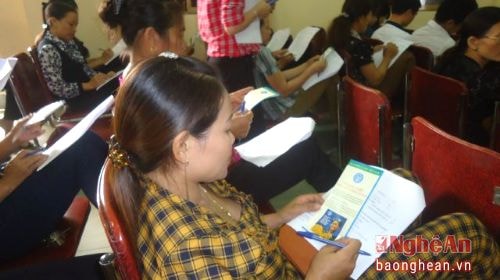 |
| Residents of Ha Huy Tap ward (Vinh city) learn about voluntary social insurance policies through leaflets. |
Furthermore, due to limited local budgets, there is no policy to provide additional support to eligible groups as stipulated by law. Although the voluntary social insurance contribution rate varies according to the contributor's ability, the current minimum rate is 22% (meaning participants must pay at least 154,000 VND/month), which is a significant amount for self-employed workers and rural workers in the province.
From January 1, 2016, the amended Social Insurance Law includes many new regulations on voluntary social insurance that partially overcome difficulties for participants. These include the removal of the age limit for voluntary social insurance participation and the elimination of the regulation requiring the minimum income for voluntary social insurance contributions to be equal to the general minimum wage (now the base wage). Instead, the regulation now stipulates that "the minimum monthly income chosen by the voluntary social insurance participant must be equal to the poverty line standard for rural areas" to better suit the participation capacity of the people.
Furthermore, the law also stipulates that participants can choose a flexible method of paying voluntary social insurance contributions, either paying a lump sum for several years in advance or a lump sum for the remaining years to receive voluntary social insurance benefits. These policies will contribute to expanding the number of participants in voluntary social insurance, ensuring social security, and reducing the burden on the budget in the future.
From April 2016, Law No. 58/2014/QH13 on Social Insurance expanded the method of paying social insurance contributions for people who have reached retirement age but still lack sufficient working time (not exceeding 10 years). They can make a one-time voluntary social insurance contribution to receive a pension, with the pension payment date calculated from the 1st day of the month following the month in which the full amount for the remaining years is paid.
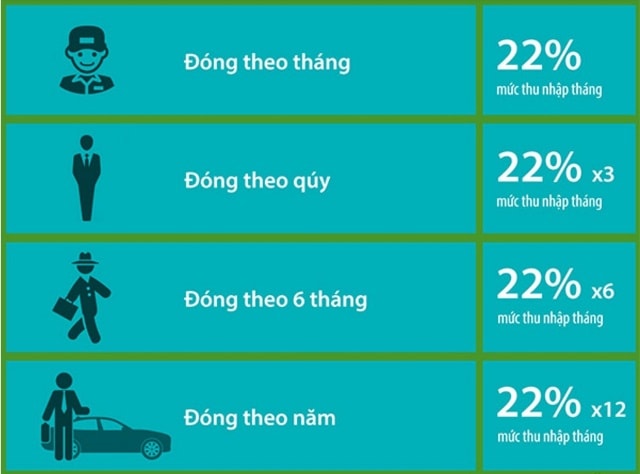 |
| Voluntary social insurance contribution rates. |
According to Ms. Le Thi Dung, Deputy Director of the Provincial Social Insurance Agency, after Circular 01/2016/TT-BLDTBXH dated February 18, 2016, issued by the Ministry of Labor, Invalids and Social Affairs, detailing and guiding the implementation of some articles of the Law on Social Insurance regarding voluntary social insurance, which came into effect on April 4, 2016, the Social Insurance Agency advised the People's Committees of districts, cities, and towns to direct departments, agencies, mass organizations, units, and the People's Committees of communes, wards, and towns, as well as social insurance and health insurance collection agents in the area, to disseminate information about voluntary social insurance policies to all segments of the population. Based on the budget allocated by the Provincial People's Committee and the Provincial Social Insurance Agency, the Social Insurance agencies of districts, cities, and towns allocate budgets to collection agents, assigning responsibility to these agents in developing the number of participants in voluntary social insurance.
In addition, based on the data managed on the software for managing the operational activities of the Vietnam Social Security sector, the Social Security offices in districts, cities, and towns proactively review the number of people participating in voluntary social insurance. If the participants meet the eligibility criteria (women aged 55 and over and men aged 60 and over with social insurance contribution periods of 10 to less than 20 years), they notify the collection agents of the list of eligible individuals.
For cases where participants register directly at the district social insurance office and request payment for the remaining months needed to receive retirement benefits as of May 2016, the district social insurance office will promptly collect the payments and process the retirement benefit applications for these participants.
On the other hand, the social insurance sector will continue to effectively implement information technology applications in the work of expanding coverage and resolving social insurance benefits; accelerate administrative procedure reforms, and promptly and fully resolve social insurance benefits and policies for participants.
| From April 2016, Law No. 58/2014/QH13 on Social Insurance expanded the method of paying social insurance contributions for people who have reached retirement age but still lack sufficient working time (not exceeding 10 years). They can make a one-time voluntary social insurance contribution to receive a pension, with the pension payment date calculated from the 1st day of the month following the month in which the full amount for the remaining years is paid. |
Minh Quan


