
Resolving conflicts in educational reform
((Baonghean) - One of the strategic tasks outlined in the Draft Political Report to the 12th National Congress of the Party is: "Fundamentally and comprehensively reforming education and training; developing human resources."
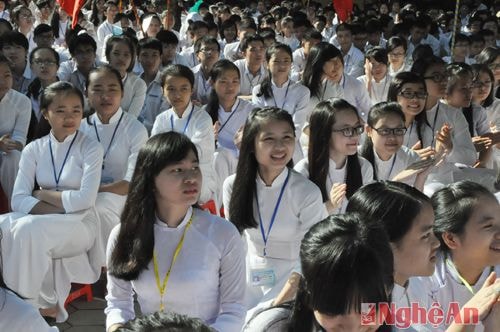 |
| Students of Phan Boi Chau Specialized High School during the opening ceremony of the new school year. Photo: HN |
Based on a general assessment of the current state of education and training development, highlighting existing limitations and weaknesses, the Draft Political Report identifies the general direction and six key tasks for fundamental and comprehensive reform of education and training in the coming years. These contents were already outlined in Resolution No. 29-NQ/TW dated November 4, 2013, at the 8th Plenum of the 11th Central Committee on education and training reform. However, with a length of only 3 pages (from page 35 to page 37), this section is presented simply and does not address the existing contradictions within the current education system. In our opinion, the Draft Political Report needs to clearly state the following contradictions in order to find solutions:
Firstly, there is a conflict between equipping students with knowledge and developing their qualities and abilities. The draft Political Report clearly states: "Continue to strongly and comprehensively innovate the basic elements of education and training in the direction of prioritizing the development of learners' qualities and abilities." This viewpoint stems from the reality that the Vietnamese education system focuses only on equipping students with knowledge, without paying enough attention to developing their qualities and abilities. In education, developing students' qualities and abilities must be based on equipping them with knowledge. However, due to the current outdated educational methods, the equipping of knowledge is in conflict with the development of qualities and abilities. For example, educating students about patriotism and national pride is a requirement to improve their qualities. But with the current methods of teaching history, coupled with making this subject an elective in examinations, students are increasingly less knowledgeable about national traditions and find it difficult to enhance their patriotic spirit.
In other subjects, the rote memorization of knowledge leads to a disconnect from character development and fails to foster the growth of qualities and abilities. The conflict between knowledge acquisition and the development of qualities and abilities manifests in various ways: focusing solely on theory without practical skills training; rote learning of exam subjects while neglecting others; prioritizing natural sciences over social sciences, especially history; and teaching methods that rely on rote memorization, failing to stimulate independent thinking. The prevalence of extra tutoring, excessive workload, and lack of time for recreation and leisure activities hinders students' intellectual and personal development. While students appear to possess a wealth of knowledge, this lacks the foundation for developing qualities and abilities. To overcome this conflict, a radical reform of the current outdated educational methods is necessary, adopting advanced approaches that link knowledge acquisition with the development of qualities and abilities.
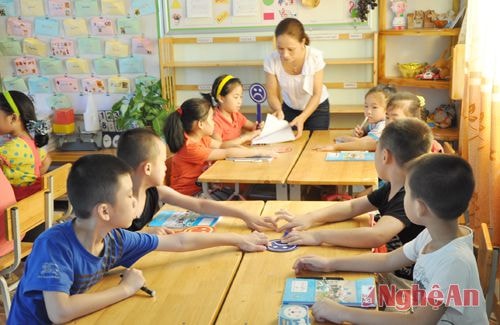 |
| Students at Hoa Hieu Ward Primary School, Thai Hoa Town, are learning using the VNEN method. Photo by Huu Nghia. |
Secondly, there is a conflict between open education and improving the quality of education. The draft Political Report clearly states: "Improving the national education system towards an open education system, lifelong learning, and building a learning society." Building an open education system is an essential requirement in the process of industrialization and modernization of the country, creating conditions for the development of a knowledge-based economy. However, open education poses a severe challenge to improving the quality of education.
The reality over the years has shown that as education is no longer confined to formal schools but is socialized with many diverse forms of training (in-service training, distance learning, joint training, self-study, etc.), the quality is increasingly declining. From vocational schools and colleges to universities and training centers, in-service training programs are flourishing, making quality control impossible. Open education will create opportunities for lifelong learning, but how will we build a learning society when the quality of formal education and in-service training are increasingly diverging, to the point that many localities do not recruit graduates from in-service universities?
The current unemployment of hundreds of thousands of university graduates (both full-time and part-time) reflects a reality: the quality of education does not meet societal demands. Building a learning society will lack motivation when hundreds of thousands of graduates are unemployed. The conflict between developing an open education system and improving the quality of education is a reality that needs to be acknowledged in order to find solutions.
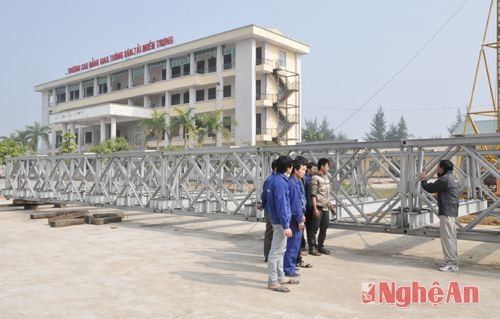 |
| Students from the Central Vietnam College of Transport and Communications conduct practical research on steel beam structures. Photo by Huu Nghia. |
Thirdly, there is a conflict between examinations and the assessment of educational quality. Examinations are a form of assessing learning quality. However, with millions of students attending school today, the assessment of learning quality through examinations is becoming increasingly inaccurate. For many years, the education sector has maintained a dense examination system: tests, course tests, semester exams, end-of-year exams, entrance exams, graduation exams, university and college entrance exams, and entrance exams for specialized schools and classes. Most of these forms of examination do not accurately assess the quality of students.
The graduation rate does not reflect the quality of learning but has become a measure of achievement-oriented behavior. To overcome this contradiction, the education sector has continuously improved examination methods, making them simpler and more convenient. One "revolution" in examinations is the merging of the high school graduation exam with the university entrance exam into a single national exam that both assesses student quality and serves as a basis for university and college admissions.
The simplification of examinations has received widespread public support, but experts are questioning the basis for evaluating student quality without exam (or test) scores. Assessment based on academic results must be based on report cards, which still include grades and teacher comments. Are the grades recorded in report cards accurate enough to measure student ability? Are teacher comments in report cards objective and comprehensive enough to accurately assess student qualities? It seems that, despite improvements, examinations are still at odds with the assessment of educational quality. To resolve this conflict, further reforms are needed, following a process of learning from experience and making timely adjustments. The goal is to ensure that examination results accurately reflect students' academic performance.
In our opinion, the Draft Political Report should comprehensively address the aforementioned contradictions and propose practical solutions for fundamental and comprehensive reform of education and training.
TRAN HONG CO


