
Tax reductions lead to significant price drops for domestically produced cars.
It is likely that many imported automotive components will benefit from preferential import tax rates for a period of 5 years (from 2018 to the end of 2022). If excise tax and corporate income tax are further reduced, the prospect of domestically produced cars being cheaper than imported cars could become a reality.
Reduce import tax on component kits.
The Ministry of Finance is seeking feedback from relevant agencies and businesses on a proposed revision to the import tax policy on automobile components and spare parts before submitting it to the Government.
Specifically, many imported automotive components will enjoy preferential import tax rates for a period of 5 years (from the beginning of 2018 to the end of 2022). To benefit from this preferential rate, automotive manufacturing and assembly companies must register for the 5-year import tax incentive program, for the period 2018-2022.
However, to qualify for import tax rates of 0% or 10%, depending on the component, businesses must commit to three criteria: achieving a minimum overall production volume and a minimum specific production volume for the committed vehicle model; achieving the localization rate for the committed vehicle model according to the roadmap; and the committed vehicle model here refers to passenger cars with fewer than 9 seats, engine displacement of 2,000 cc or less, fuel consumption below 7 liters/100km, and trucks with a payload of 5 tons or less.
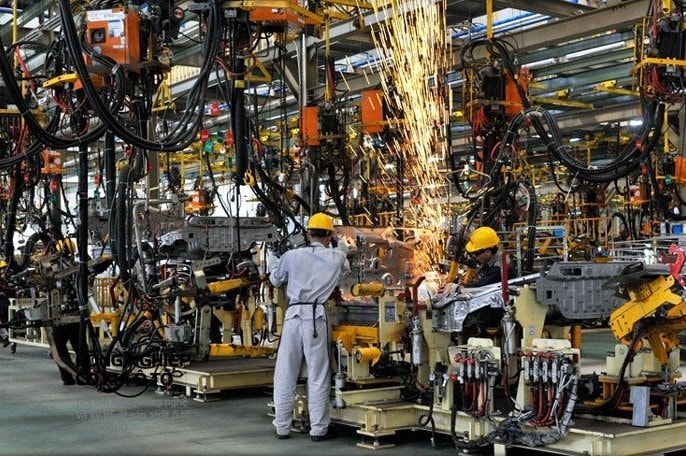 |
| To qualify for reduced taxes on components, businesses must meet several standards regarding vehicle production volume and localization rate. |
All vehicle models must meet emission standards level 4 for the period 2018-2021 and level 5 for the period 2022.
Specifically, for passenger cars with fewer than 9 seats, businesses must achieve an overall production volume of 34,000 vehicles in 2018, 40,000 vehicles in 2019, 46,000 vehicles in 2020, 53,000 vehicles in 2021, and 61,000 vehicles in 2022, totaling 234,000 vehicles over 5 years.
With the committed production volume and localization rate for each vehicle model, the figures were 20,000 and 20% in 2018, 23,000 and 25% in 2019, 27,000 and 30% in 2020, 31,000 and 35% in 2021, and 36,000 and 40% in 2022. The total production volume is 137,000 vehicles.
For trucks, the overall production target is 8,000 vehicles in 2018, 9,000 in 2019, 11,000 in 2020, 13,000 in 2021, and 15,000 in 2022. The total overall production target is 56,000 vehicles after 5 years.
With a target production volume and localization rate of 4,000 vehicles and 15% in 2018, 5,000 vehicles and 20% in 2019, 6,000 vehicles and 25% in 2020, 7,000 vehicles and 35% in 2021, and 8,000 vehicles and 40% in 2022, the total target production volume will reach 30,000 vehicles after 5 years.
If the overall production volume, individual production volume, and localization rate do not reach the minimum of 40% by December 31, 2022, the customs authorities will collect the full amount of import tax for 5 years (from 2018-2022) on all imported automotive components that previously enjoyed preferential tax treatment.
If they meet the requirements, businesses will be reimbursed the back taxes collected for the years they did not meet the criteria, based on the results of the annual audit.
The Ministry of Finance requests feedback from relevant agencies and businesses to finalize and submit the draft to the Government.
Domestic car prices will decrease.
However, according to some automotive businesses, with such conditions, without other accompanying preferential policies, it is still not attractive enough for manufacturing and assembly activities. This is because from January 1, 2018, completely assembled cars imported from ASEAN to Vietnam enjoy a 0% tariff rate, provided they achieve a 40% intra-regional localization rate.
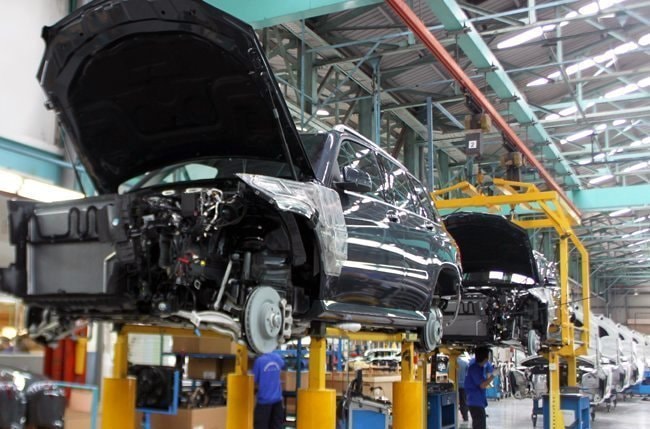 |
| The price of domestically assembled cars will be cheaper starting in 2018. |
Currently, import tax rates on many types of automotive components from ASEAN to Vietnam have been reduced to low levels. Therefore, even if import taxes on all components were reduced to 0%, the price of domestically manufactured and assembled cars would only decrease by about 3-4% in 2018.
Meanwhile, imported cars will be about 15-20% cheaper than domestically produced cars. Therefore, additional incentives are needed to bridge the gap between domestically assembled and imported cars, commented the director of a foreign-invested automobile company.
"We understand that the Ministry of Industry and Trade has proposed exempting domestically sourced components from excise tax, reducing income tax for automobile manufacturing and assembly businesses, and providing other support in terms of infrastructure and bank loans... Only then will domestically manufactured and assembled cars be able to compete with imported vehicles," said a representative of an automobile manufacturing company.
A domestic automobile manufacturing and assembly company calculated that by 2018, a car with an engine capacity under 1.5L, imported from ASEAN to Vietnam, would cost approximately US$7,500, subject to 0% import tax, 35% special consumption tax, and 10% VAT, selling for VND 350 million or more. If a similar domestically produced car enjoyed the same incentives, its price would be VND 330 million or less, making it competitive with imported cars.
According to VNN
| RELATED NEWS |
|---|


