
The arduous journey to Truong Sa
(Baonghean.vn) - The trip to Truong Sa, to meet the officers, soldiers, and people who are living and protecting this sacred archipelago of the Fatherland day and night, is truly a great honor and source of pride that we have had the opportunity to experience.
"Riding the waves" out to sea
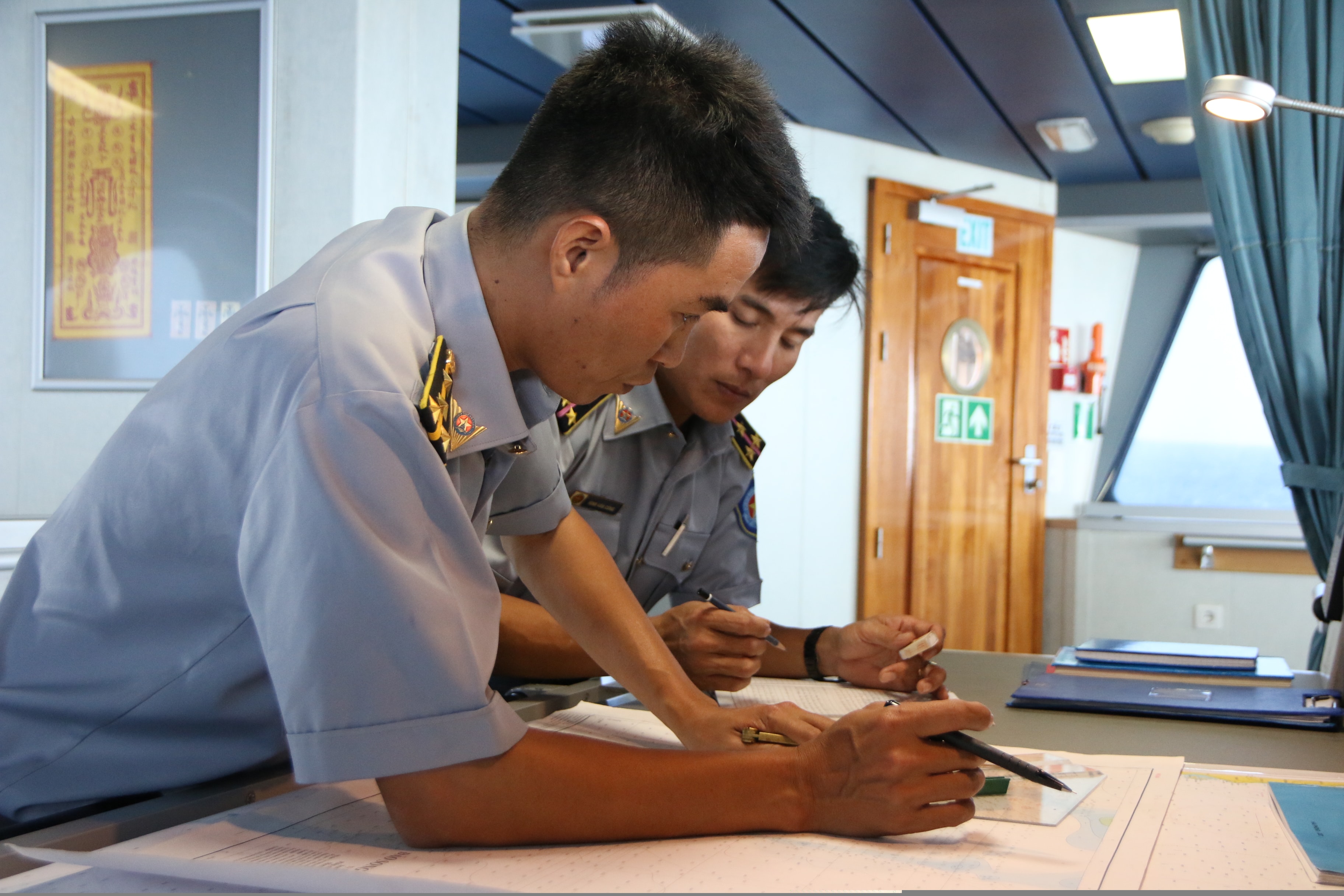 |
Working at the control tower. Photo: Tien Dong |
According to the schedule, ships 490 and 561 carried a delegation of nearly 100 reporters and many officers and soldiers to extend New Year greetings to the military and civilians at 21 islands and islets and 33 military outposts of the Vietnam People's Army in the Truong Sa archipelago. Reporters from Nghe An Newspaper were arranged to travel on ship 490 to visit the northern islands, including Song Tu Tay, Da Nam, Len Dao, Co Lin, and Sinh Ton.
At Cam Ranh naval port, after the 4th Naval Region Command held a farewell ceremony for the delegation heading to Truong Sa, at exactly 4:30 PM, the ships simultaneously sounded three farewell horns and successively weighed anchor and left the port. All members of the delegation lined up neatly on the ship's deck, waving goodbye to the mainland. Everyone was tearful.
At this time, while the ship was still in the bay, the reporters gathered on deck, hastily writing news articles and photos to send back to the editorial office. Once the ship had moved away from the mainland, the waves began to crash violently. Waves as high as 5 meters pounded against both sides of the ship, causing it to shake violently. Night fell, and everything around us was pitch black, with only the sound of the engine, the crashing waves, and the wind whistling through the cracks in the doors. The ship continued to brave the waves, heading straight towards Truong Sa.
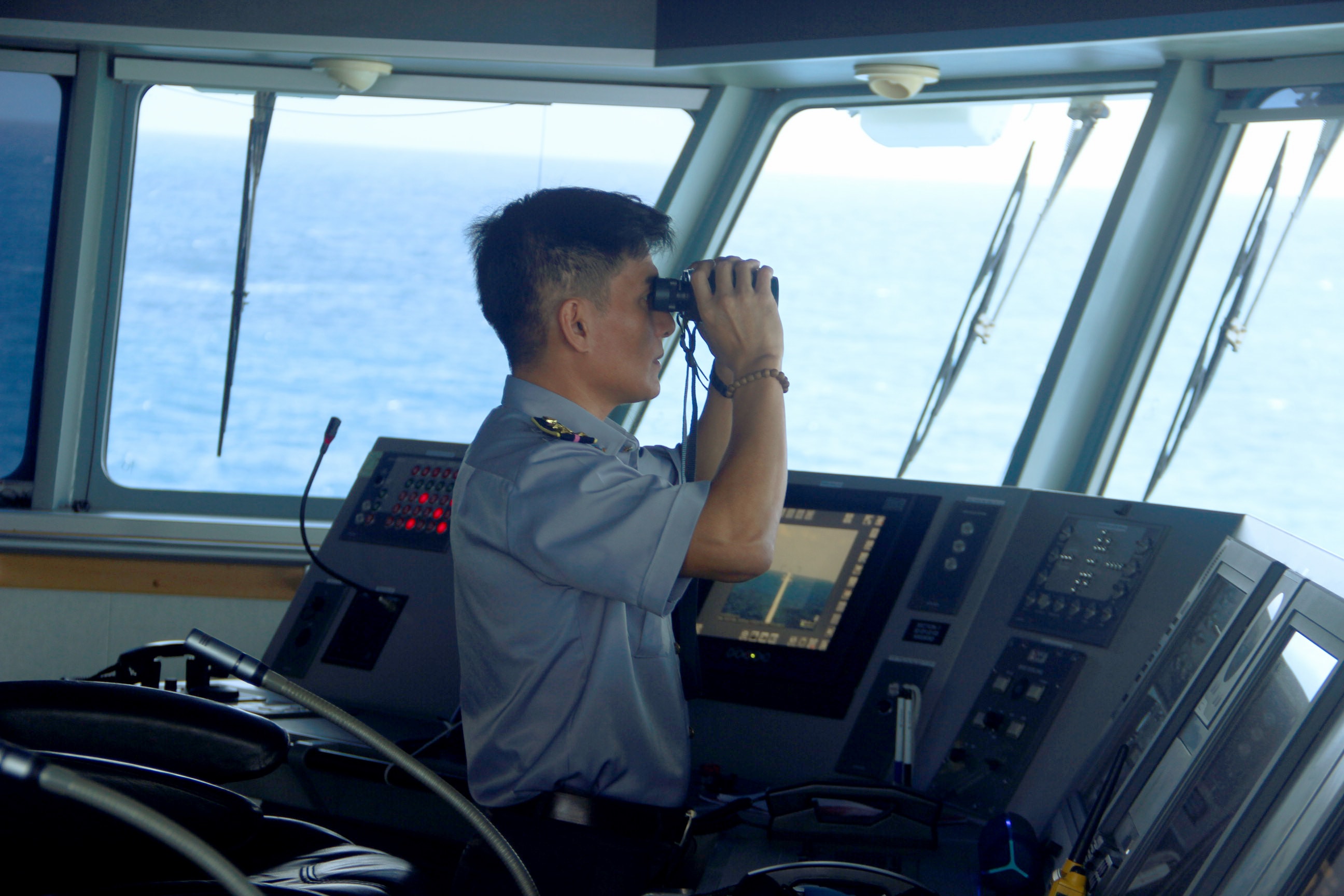 |
The soldiers on board the ship are monitoring the sea route. Photo: Quang An |
For those of them, venturing out to sea for the first time, they seemed to sense the harshness of the vast ocean waves. The relentless waves, brought on by the sudden northeast monsoon, caused seasickness to set in much faster than many expected. At the first dinner on board, the group of 50 reporters from various news agencies and newspapers was missing by more than half, especially the female reporters. Seasickness prevented them from leaving their beds. Some could only sustain themselves with a little plain rice porridge or dried rations they had brought along. For many, the first night at sea was truly an unforgettable experience.
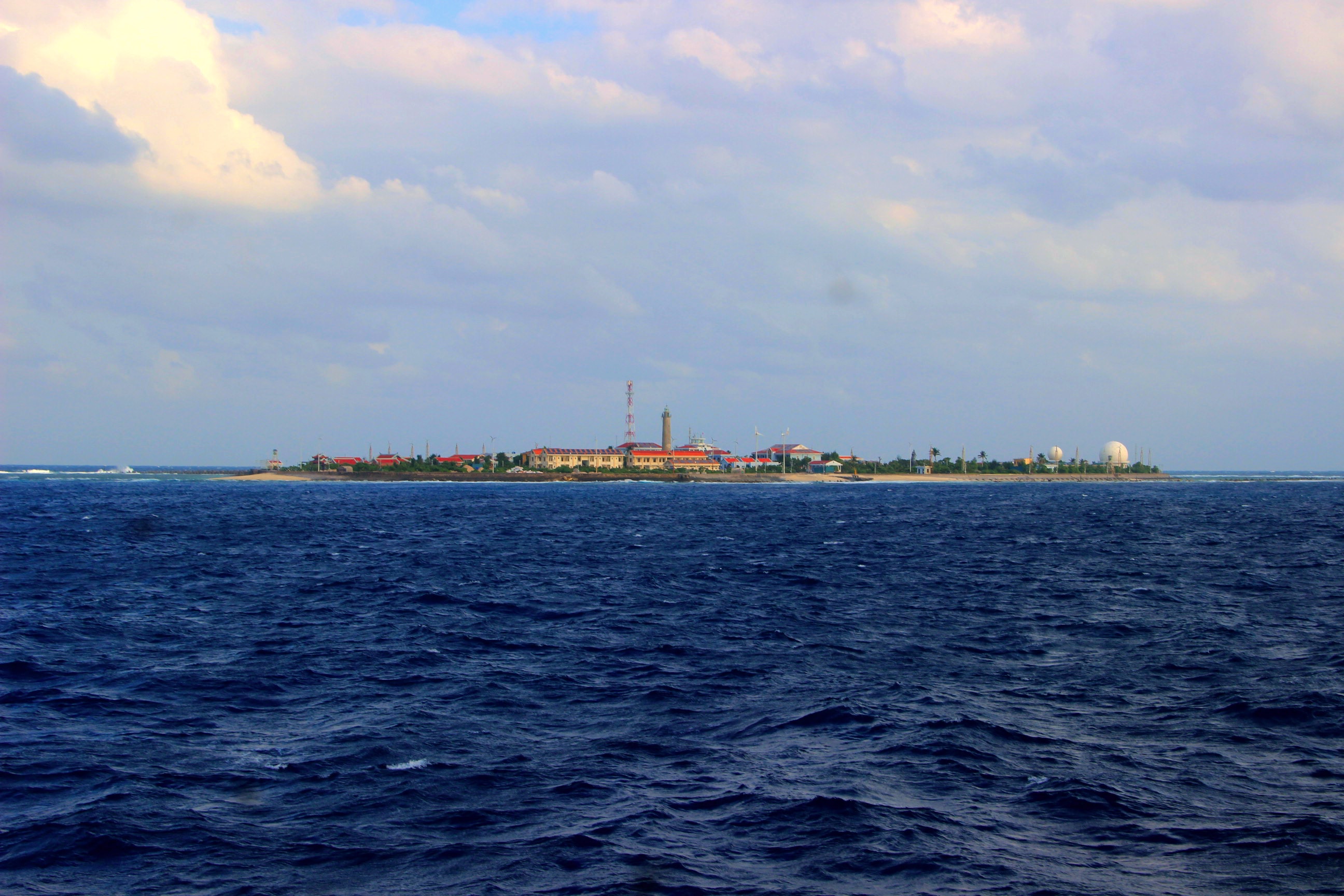 |
Survival Island in the Spratly Islands. Photo: Tien Dong |
On the second day, as seasickness subsided, the reporters began exploring the ship and getting acquainted with the officers and soldiers. The cheerful stories and heartfelt conversations made the journey seem shorter. Hundreds of officers and soldiers were on board, heading to Truong Sa for duty. Some were only eighteen or twenty years old, visiting the remote islands for the first time. Others had been to the islands many times before, and were once again braving the waves to reinforce Truong Sa. Whether it was their first time or their first, they all shared a passionate love for their homeland's sea and islands. They were eager to go to Truong Sa to share the hardships with their comrades and the people who were stationed there day and night.
A meeting of people from Nghe An
From the reporters' lounge, we arrived at the ship's command center. From here, all we could see was the vast expanse of the sea. Only by monitoring the screens and radar signals could we determine the ship's position in the South China Sea. It was an honor to speak with Captain Tran Van Nhat, from Quynh Ngoc commune, Quynh Luu district, who has served in the military for 15 years, not including his training at the Naval Academy. This was the fourth ship he had the privilege of serving on. Besides his duties at sea, as Captain, he is constantly involved with the ship, leading and directing the unit in maintaining machinery and hull, organizing training, and preserving technical equipment.
Sharing his experiences on missions in the Spratly Islands, Captain Tran Van Nhat said that for long voyages, there is usually a need for aThey work both maritime and propulsion shifts. In addition to fulfilling their professional duties, the ships often participate in search and rescue missions, especially during the rainy and stormy season. Sometimes, upon hearing news of fishermen in distress, the crew members immediately rush from their duty stations, braving the waves to arrive at the scene as quickly as possible.
Captain Nhat recounted that the last time the ship participated in a rescue operation was in 2020, when a fishing boat from Quang Ngai sank near Da Nam Island. After receiving the distress signal, the ship took about 6 hours to reach the location of the fishermen in distress. Subsequently, they successfully rescued 6 fishermen and brought them safely aboard.
“When fishing vessels are in distress, they usually send out a distress signal. After receiving the distress signal, the shore station will immediately notify nearby rescue forces so they can arrive in time to provide assistance. However, because the distress signal can only be transmitted for a short time, right before the ship sinks, rescue forces must rely on wind and currents to reach the last signal transmission location as quickly as possible. During the rescue operation, a plan must be drawn up on nautical charts, identifying the search area. The vessels will divide the area and use radar to approach the rescue location. Because if the rescue is delayed, the fishermen will face many dangers,” Captain Tran Van Nhat shared.
During this journey, we also had the opportunity to meet and interact with many officers and soldiers from Nghe An province who were serving in Truong Sa. Captain Nguyen Ngoc Duong, originally from Nghi Phong commune, Nghi Loc district, works at Brigade 146. Having served in the military for 25 years, he spent five years serving on Truong Sa and Phan Vinh islands. This time, he was deployed to reinforce Sinh Ton Dong island. Having become accustomed to the rough seas of Truong Sa, he would go down to the kitchen to help the cooks prepare meals before each meal. Captain Duong said that sitting on the ship was difficult, but cooking on board was even more arduous. Many times, the food and soup were already prepared on the table, but a single wave tilted the ship, and all the hard work of the crew was wasted. To cook a meal for everyone, the crew often had to hold onto the railing with one hand and the other with the other.They carried pots and pans around. Despite the difficulties, the team always remained cheerful and united to complete their assigned tasks.
Despite having visited the islands many times, including 33 different locations, Captain Nguyen Ngoc Duong always feels indescribable emotions whenever he comes to Truong Sa. For him, dedicating his youthful years to Truong Sa, to the sacred archipelago of the Fatherland, is an honor and a source of pride that he will surely never forget.
After a day and two nights at sea, the ship 490 brought our delegation closer to Song Tu Tay Island. However, due to rough seas reaching levels 8 and 9, approaching the island proved very difficult. The head of the delegation announced over the loudspeaker that landing on the island might require waiting one to two days until the sea calmed down. Everyone was saddened by this news. We could only encourage each other with the song, "Truong Sa is not far away / Truong Sa is not far away / Still close to me because Truong Sa is always with you…".


