
Preserving the beauty of the Mother Goddess worship tradition.
(Baonghean) - "The practice of the Tam Phu Mother Goddess worship of the Vietnamese people" has been honored by UNESCO as a representative intangible cultural heritage of humanity. To preserve, protect, and promote the value of this heritage, it is necessary to promptly correct and eliminate any deviations, undesirable aspects, and unsightly behaviors.
Honoring the Mother Goddess Religion
The worship of Mother Goddess is a purely Vietnamese folk belief dating back to prehistoric times, evolving and adapting to societal changes. From the very beginning, the Vietnamese people have revered, worshipped, and entrusted their faith to the image of the mother. The mother is also nature itself. Over time, the image of the Mother Goddess has tended to become "historicized," "localized," and "personified," gradually becoming associated with many legends of those who contributed to the nation, loved the people, and even with real historical figures.
The Mother Goddess worship tradition focuses on life and belief in reality, with aspirations for health, wealth, and good fortune for all social classes. While worshipping human deities, the Mother Goddess worship also honors patriotic traditions, the spirit of returning to one's roots, embodying the principle of "drinking water, remember the source; eating fruit, remember the one who planted the tree"; it honors the spirit of unity and community consciousness through the imagery of "spirit mediums"; and it celebrates the beauty of Vietnamese women in tradition.
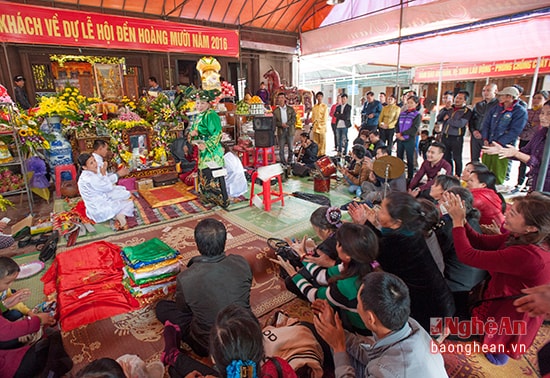 |
| The spirit medium ritual at the Ông Hoàng Mười temple. |
Throughout its formation and evolution, the Vietnamese tradition of worshipping the Mother Goddess has integrated unique cultural and artistic values. A prime example is the ritualistic performance of spirit possession (Hau Dong). Hau Dong incorporates many art forms, among which the unique style of chanted verses stands out.
This style of singing makes the shamanic ritual vibrant and captivating thanks to the sounds of stringed instruments, drums, and musical accompaniment, along with lyrics that recall the legends and achievements of the saints, and the way the characters and scenes are decorated directly impacts the viewers, conveying the unique traditional cultural values of the Vietnamese people.
In our country, the practice of Mother Goddess worship was once banned. The reason was that in many places, the spirit medium rituals were distorted into superstition; many people exploited the Mother Goddess religion to "sell divine favors." In the years following the Doi Moi (Renovation) period and the building of a socialist culture rich in national identity, the Mother Goddess religion has been restored and developed rapidly and strongly.
The reason why the Mother Goddess religion has flourished is because it is a purely Vietnamese belief stemming from spiritual needs. However, both before and after the UNESCO recognition of "The Practice of the Three-Realm Mother Goddess Worship of the Vietnamese People," the Mother Goddess religion has faced, is facing, and will continue to face the risk of not being properly protected and its values not being promoted.
| On December 1st, "The Practice of the Tam Phu Mother Goddess Worship of the Vietnamese People" was inscribed on the UNESCO List of Representative Intangible Cultural Heritage of Humanity. "The Practice of the Tam Phu Mother Goddess Worship of the Vietnamese People" is the 10th Vietnamese heritage recognized by UNESCO, following Nha Nhac - Court Music of the Nguyen Dynasty (2003), the Gong Culture Space of the Central Highlands (2005), Ca Tru Singing of the Vietnamese People (2009), Quan Ho Folk Songs (2009), Giong Festival at Soc Temple and Phu Dong Temple (2010), Xoan Singing of Phu Tho (2011), Hung King Worship in Phu Tho (2012), Southern Vietnamese Traditional Music (2013), Vi and Giam Folk Songs of Nghe Tinh (2014), and the Tug-of-War Ritual and Game (2015). |
Rectify the situation to preserve the heritage.
Located far from the central provinces and temples of the Northern region, the people of Nghe An have highly valued the worship of the Mother Goddess since very early times. Along the geographical axis, from Hoang Mai to Vinh city, from Cua Lo to Ky Son, there are temples and shrines dedicated to the Mother Goddess everywhere. These include Corn Temple, Hoang Muoi Temple, Hong Son Temple, Cua Temple, Ngoc Dien Temple, Pu Nha Thau Temple, etc.
Currently, there are no statistics on the number of places of worship, but according to the late Associate Professor Ninh Viet Giao, in Quynh Luu district alone there are more than 30 places of worship dedicated to the Four Holy Mothers.
Compared to other Mother Goddess temples in the province, the Ong Hoang Muoi Temple (Hung Nguyen district) is the most famous. During major festivals such as the beginning of the year, the full moon of the third lunar month, and the tenth day of the tenth lunar month, tens of thousands of people come to the Ong Hoang Muoi Temple to offer incense, pray, and practice the Mother Goddess worship.
According to the management board of Hoang Muoi Temple, each year the temple welcomes about 400-500 groups of mediums (spirit mediums) to practice their faith, mainly from the northern provinces. Some groups include female and male mediums, while others do not.
Although also dedicated to Quan Hoang Muoi, Hong Son Temple attracts fewer visitors, perhaps due to its limited landscape and space suitable for religious practice.
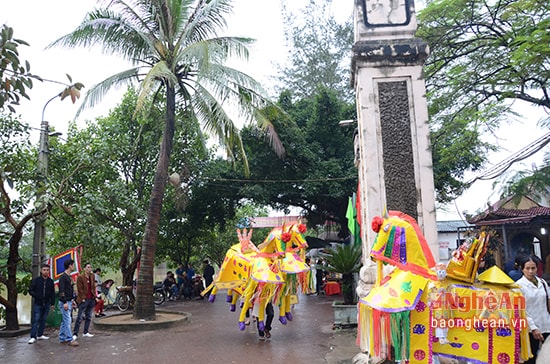 |
| Many people who come to the temple to practice their faith bring too much votive paper, incense, and candles. |
However, religious practices at Ong Hoang Muoi Temple and Hong Son Temple currently exhibit many deviations and offensive behaviors: overcrowding while praying for blessings; excessive burning of votive paper causing environmental pollution; many people being overly extravagant with incense, candles, and offerings, making wishes that are immoral and contrary to the Mother Goddess worship which requires simple, sincere offerings; some spirit medium rituals, in the blessing part, have been distorted by replacing symbolic incense and flowers with money and gold, thus deviating from the original positive meaning.
Mr. Nguyen Kim Khanh, Deputy Head of the Ong Hoang Muoi Temple Management Board, acknowledged the situation: "Before the local community and temple started performing the spirit medium ritual, the temple management board had reminded them, but it hadn't been effective. In reality, it's very difficult to manage strictly because religious beliefs are very delicate and sensitive matters."
To preserve and promote the positive values of the Mother Goddess worship practice, much needs to be done. Specific regulations and standardized procedures for conducting rituals are necessary. Furthermore, the responsibility of cultural management agencies, especially at the local level, needs to be strengthened.
Furthermore, it is necessary to further promote education so that everyone understands and appreciates religious heritage, thereby behaving appropriately - especially those directly practicing the faith - in praising the good aspects and condemning actions that distort or exploit it, and applying and promoting its value in artistic life...
Regarding the "sensitive" aspects of managing places of worship, Professor To Ngoc Thanh, President of the Vietnam Folk Arts Association, suggested: "Managing activities related to the worship of Mother Goddesses at temples and shrines is not a new issue. It has been raised for decades, but the relevant authorities have yet to agree on a model and method of management. Since it involves spiritual matters, we need to strictly uphold the customs and standards of our ancestors."
| To curb deviant practices at historical sites in particular and in religious practices in general, the People's Committee of Nghe An province issued Decision No. 18 dated February 16, 2016, promulgating regulations on receiving, managing, and using donations at historical and cultural sites and scenic spots, and Decision No. 60 dated October 10, 2016, promulgating regulations on implementing civilized lifestyles in weddings, funerals, and festivals in Nghe An province to regulate behavior. These regulations clearly state the requirements for ensuring security, order, and traditional customs... However, the management boards of these sites also face many difficulties in implementation. |
Thanh Son
| RELATED NEWS |
|---|