
Discussion Corner: Regarding a photograph that is supposedly a "documentary photo"
For a long time, the photograph depicting a crowd of people surrounding and demonstrating in front of a two-story house has been interpreted as a documentary image of the protest for power that took place in front of the French Consulate in Vinh City on August 21, 1945. However, with the available documents and information, we can certainly question the authenticity of this photograph. Nghe An Newspaper, Radio, and Television would like to present an article by researcher Pham Xuan Can on this issue.
Regarding the August Revolution in Vinh
For ease of reference, in this article I will refer to it as the photograph "The Protest". In terms of composition and context, this photograph is similar to the documentary photograph of the protest to seize power at the Northern Government House (Hanoi) during the August Revolution. The photograph is still displayed at the Vinh City Traditional House. For decades, it has been printed in official history books of Nghe An province and Vinh city, such as "History of Nghe An, Volume I" (National Political Publishing House, 2011); "History of the Vinh City Party Committee" (National Political Publishing House, 2010); and the photo book "Vinh City Past and Present," published by the Vinh City Party Committee, People's Council, and People's Committee in 2003…
At the same time, this image was often used as an illustration in newspapers when writing about the August Revolution in Vinh. It can be said that the image has become a familiar and symbolic representation of the August Revolution of 1945 in Vinh city and also in Nghe An province.
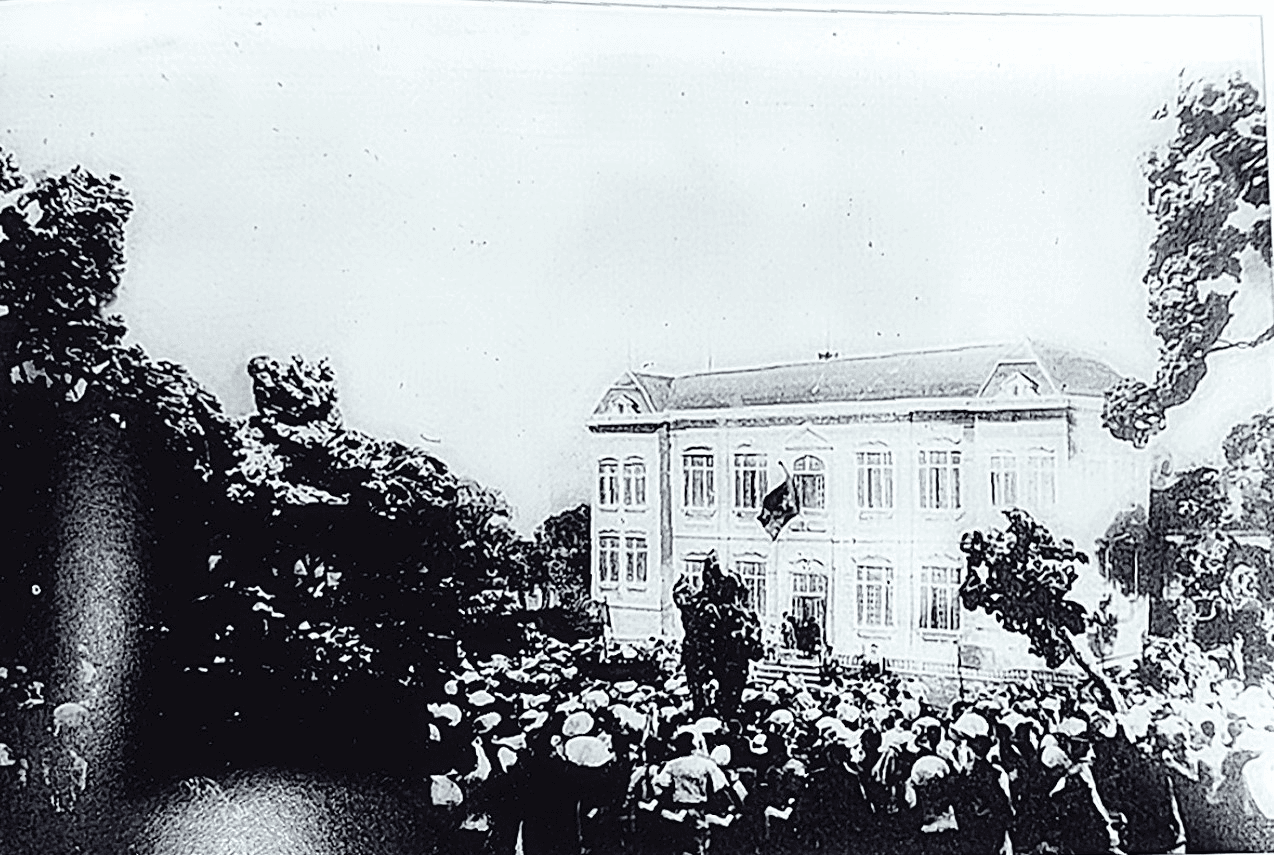
The photograph titled "The Protest" is believed to depict an event taking place at the French Resident's Residence in Vinh. The French Resident's Residence was the workplace of the French Resident in Vinh. This building symbolized the absolute power of France over the region. Built in 1897, the building was designed in the Indochinese architectural style, a blend of French architecture and elements of ancient Vietnamese architecture. This is quite evident in the flared tiled roof and details resembling the curved eaves of traditional Vietnamese temples and pagodas.
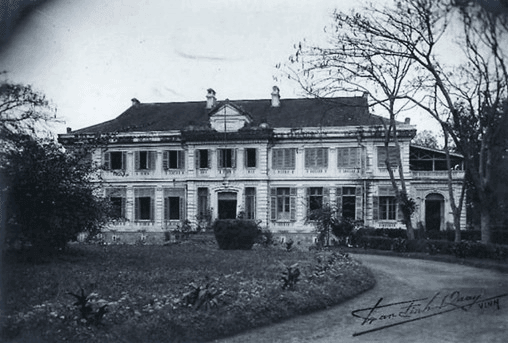
However, when comparing the two photographs—one of the Residency, taken by Tran Dinh Quan in the 1930s, and the other of "The Protest"—we immediately see the difference. Clearly, the building in "The Protest" is completely different from the Residency in Tran Dinh Quan's photograph. This photograph lacks the characteristic features of Indochinese architecture on the roof. The roof doesn't flare out, it doesn't have details like eaves, and the gables face forward, unlike the Residency in Tran Dinh Quan's photograph. Furthermore, while Tran Dinh Quan's photograph shows 11 windows on the front of the building, opening from the corridor to the outdoors, "The Protest" only has 9 windows. In addition, other details on the windows, steps, and veranda on the ground floor also show clear differences.
So, does this mean the building in the "Protest" photo is not the French Consulate in Vinh? Therefore, this photo cannot possibly depict an event taking place there, as we have long understood and believed?
Given the events of the August Revolution in Vinh, one might consider another power building where the event could have taken place: the Governor-General's Palace in Nghe An. However, the Governor-General's Palace in Nghe An Citadel is only a single-story building. Beyond that...Based on the information currently available, the entire city of Vinh, especially government agencies, does not have any buildings with an architectural style similar to the building in the photograph "The Protest".
By tracing the events of the August Revolution in Vinh, we can see:
Following the Japanese coup against the French (March 9, 1945), the French Resident no longer worked at the Resident's Residence. Nominally, Japan had granted independence to the Southern government, so the Governor of Nghe An Province moved his office from the Governor-General's Residence within Nghe An city to the Resident's Residence. At the time of the August Revolution, the Governor of Nghe An Province was Dang Van Huong, a patriotic intellectual who was considered close to the Viet Minh.
Regarding the events of the August Revolution in Vinh, almost all history books of Vinh province and city write quite similarly. According to these accounts, on the morning of August 21, 1945, thousands of people from Vinh city and surrounding areas simultaneously marched on the main streets, then gathered at the city stadium (located outside, southwest of Nghe An citadel). At the same time, the Insurrection Committee sent Nguyen Tai to meet with Wada, the commander of the Japanese army, to inform them of the Viet Minh's purpose and request that they not interfere in the internal affairs of the Vietnamese people. The Japanese accepted the Viet Minh's demands, even promising to provide the revolutionary army with 5,000 guns and 10,000 rounds of ammunition. In reality, the Japanese army did not react. At exactly 12 noon on August 21, 1945, the entire population gathered to surround the Nghe An Provincial Governor's Residence. The Nghe An Provincial Governor, Dang Van Huong, handed over his official seal to the revolution. The Provisional Committee declared the abolition of the old government and the establishment of a revolutionary government.
The memoirs of Mr. Tran Xuan, the team leader of the self-defense fighting unit, the core force of the uprising to seize power in Vinh, provided additional information. According to him, from the afternoon of August 20, 1945, his team was assigned the task of protecting a demonstration, the purpose being to gauge the attitude of the Japanese. “On the afternoon of August 20, I was ordered to attend the demonstration to gauge the Japanese attitude. I was the head of the security team, carrying a gun outside to protect Mr. Nguyen Tai – the leader of the demonstration. The demonstration was quiet, with no reaction whatsoever.”[1]In my opinion, this information is credible, because a demonstration to gauge Japan's attitude toward the General Uprising was essential. "And early the next morning, August 21st, orders were given to assemble at the stadium to prepare for the general uprising"... Here, Mr. Tran Xuan's team was assigned the task of being the teamThe main force moved to seize the Governor Dang Van Huong's residence and the Secret Police headquarters. Neither location encountered any resistance.
Thus, during the August Revolution in Vinh, there was an event where the masses surrounded the Governor's Residence. At that time, the Governor's Residence was actually the building of the French Resident. The photograph titled "The Demonstration..." seems to depict this event. However, unfortunately, the building in the background is not the French Resident's Residence in Vinh, as analyzed above.
In my opinion, it's possible that the photograph "The Protest" isn't a documentary photograph taken somewhere, but rather a reproduction of a painting. To meet the later propaganda demands regarding the August Revolution in Vinh, the artist painted this picture, imitating the composition and atmosphere of a documentary photograph of the power struggle at the Northern Palace (Hanoi). At the time of painting, the Commissioner's Palace had been destroyed during the scorched-earth resistance in 1947, and there were no documentary photographs available for reference. Therefore, the artist may have painted from memory or based on descriptions from others, leading to significant inaccuracies compared to the original building.
In any case, this picture should not be used as "documentary photography," much less considered as a symbolic image of the August Revolution in Vinh.
Currently, only one photograph remains of the August Revolution in Vinh. It's a picture of the Self-Defense Combat Team (later the Phan Dinh Phung National Salvation Youth Team) marching through the streets on August 21, 1945. In the photo, the person leading the flag is Tran Xuan, the team leader. The photograph vividly and realistically portrays the vibrant atmosphere and heroic spirit of the people of Vinh city on the day of the general uprising. Those leading the march were also outstanding and courageous young people who had participated in activities supporting the Viet Minh for a long time, and were the core force in the general uprising to seize power.
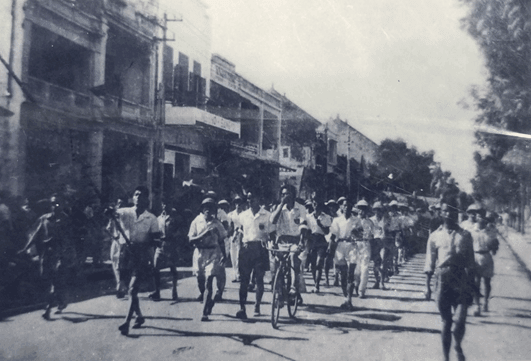
In my opinion, by raising this issue, I hope that those responsible will conduct research and assessment to accurately identify this image. If it is a painting, then it should be used as such. It should not be used as a symbolic "documentary photograph" about the August Revolution in Vinh.
If a documentary photograph is needed to serve as a symbol of the August Revolution in Vinh, given the current availability of documentation, using the photograph of the Self-Defense Combat Team marching through the streets of Vinh on August 21, 1945, is entirely appropriate.
[1]The memoirs of Mr. Tran Xuan, handwritten copy preserved in the family.


