
Greenland, Denmark: Negotiations with the US show positive signs, but the future remains uncertain.
The foreign ministers of Greenland and Denmark said they hoped to resolve the existential threat to both sides posed by U.S. President Donald Trump's desire to take control of the autonomous Arctic territory.
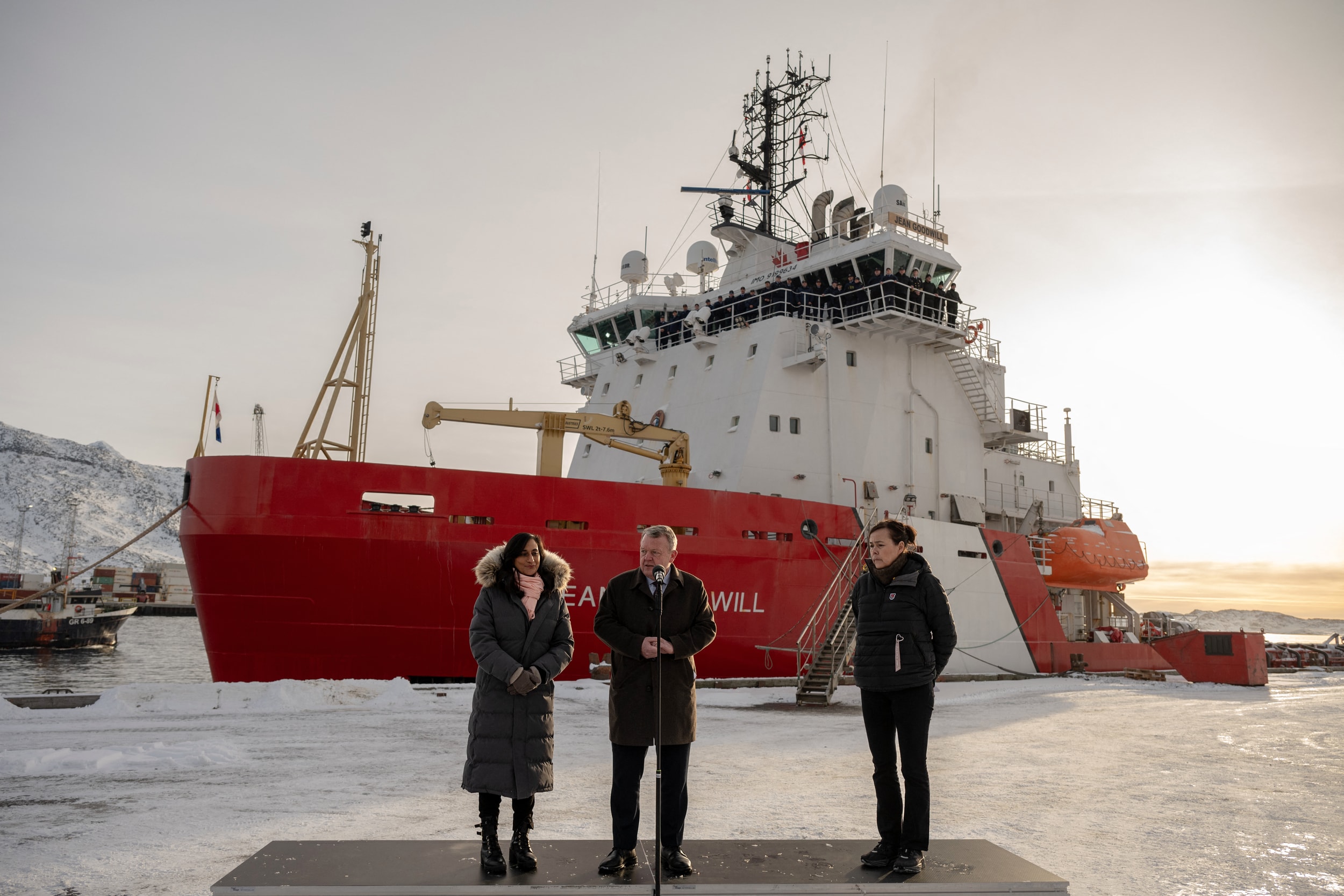
Signals from the meeting in Nuuk
On February 7 (local time), Greenland's Foreign Minister Vivian Motzfeldt described the diplomatic talks with the US that took place that day as "positive." However, she stated that the fate of the autonomous territory of Denmark remains uncertain as US President Donald Trump repeatedly reiterates his desire to possess the island for national security interests.
Speaking at a joint press conference with Danish Foreign Minister Lars Løkke Rasmussen and Canadian Foreign Minister Anita Anand – who had just opened Canada's new consulate in Greenland's capital, Nuuk – Motzfeldt shared: "We are not yet where we want to be. There is a long way to go, so it is too early to say where we will 'land' at the end of this process."
For his part, the Danish Foreign Minister described the situation with similar remarks: "We are not out of crisis and there is no final solution yet." However, he added that "we are in a much better position than we were a few weeks ago."
Remain calm in the face of pressure from Washington.
In Nuuk, Løkke Rasmussen mentioned some past incidents without going into detail, while assuring the press: "There are no threats at the negotiating table, no trade war with Europe."
He said all parties had agreed on a "normal diplomatic" approach to resolving the impasse.
Trump's moves began with mentioning the idea of buying Greenland from Denmark during his first term. Since returning to the White House in January 2025, he has consistently and publicly expressed his desire to gain control of this territory from Denmark – a NATO ally.
Although the U.S. military has the freedom to establish and operate bases in Greenland thanks to a 1951 treaty, Trump insists he can only defend the territory if the U.S. actually owns it, calling it a "psychologically important" step.
His public pronouncements appeared to culminate on January 21st, when he delivered a speech at the World Economic Forum (WEF) in Davos, Switzerland. Standing on the world stage, Trump argued for the U.S. to be granted ownership of the territory, although he did back down on maximum threats of potential military action to realize that vision.
When EU and NATO allies publicly and strongly opposed the idea, Trump threatened to impose heavy punitive tariffs. He later withdrew the threat, although allies remained wary of the American leader.
Why should the US, Greenland, and Denmark meet?
The ongoing negotiations stem from a "framework" agreement that Trump reached with NATO Secretary General Mark Rutte after he alarmed allies with his tariff threats. The new plan would give the U.S. a greater say in Arctic security.
This led to the formation of a joint Danish-Greenland-American working group to address Washington's security concerns. Trump asserted that China and Russia were poised to take over Greenland as Arctic ice melted and new shipping routes opened. Denmark and other NATO allies argued that this was not realistic.
The Danish Foreign Minister said that initial talks had taken place and more meetings would follow. Greenland's Foreign Minister Motzfeldt also welcomed the opportunity to engage in "direct dialogue" with the United States.
Both Denmark and Greenland have publicly stated that they share U.S. security concerns, but insist that Greenland's future must be decided by the Greenlanders themselves.
Both sides also emphatically declared that sovereignty and territorial integrity are absolute "red lines" and are not subjects for discussion.
Noting that this has been made very specific with the American partners, Danish Foreign Minister Rasmussen stated that it is entirely possible to "find a solution while respecting those red lines."
When asked whether the U.S. was respecting the positions of Denmark and Greenland, Rasmussen said: "I don't want to go into detail."


