
Gyokeres' decline at Arsenal raises questions for Arteta.
Viktor Gyokeres's start of 3 goals in 4 games couldn't save him, as he's only managed one more goal in his last 10 Premier League matches and is increasingly "starved of the ball" in Mikel Arteta's system.
Viktor Gyokeres arrived at Arsenal with the expectation of solving their center-forward problem, but recent matches are telling a different story: a once explosive striker is gradually disappearing in Mikel Arteta's possession-based style of play. The problem isn't just about goals, but about Gyokeres's increasingly infrequent appearances in crucial areas of the system.
Alarming figures: from honeymoons to droughts
Gyokeres' start in North London wasn't bad at all: 3 goals in his first 4 games. But that momentum ended quickly. In his last 10 Premier League appearances since mid-September, he has only scored a single additional goal.
December was described as Gyokeres' worst period, with average touches and shots per game significantly lower than the previous four months. Worryingly, this decline was linked to a decrease in overall play, rather than just a few unlucky shots.
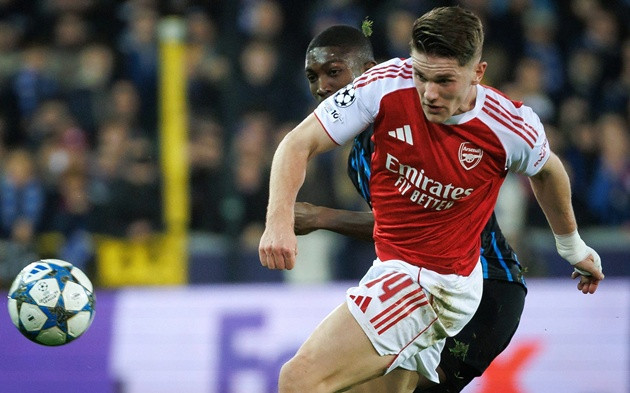
The Wolves match was a snapshot: the striker started but was almost invisible.
Against Wolves, the bottom-of-the-table team, Gyokeres played 81 minutes but only had 15 touches and 1 shot. For a center forward in a title-contending team, this kind of statistic usually reflects two things: either the team isn't getting the ball to the number 9, or the number 9 isn't integrating into the team's rhythm to create opportunities for himself.
A direct comparison further highlights the issue. Gabriel Jesus, coming on as a substitute for just 9 minutes, had 8 touches and created significantly more scoring opportunities. In the same match, the difference in "presence frequency" between the two strikers is starkly clear.
Summary of key facts from the slump
| Category | Gyokeres | Comparison/Context |
|---|---|---|
| Starting at Arsenal | 3 goals in the first 4 matches | Positive honeymoon |
| The last 10 Premier League matches (since mid-September) | 1 table | High drop performance |
| The match against Wolves | Started for 81 minutes, had 15 touches, and took 1 shot. | Their role in the gameplay has been narrowed. |
| In the same match against Wolves | — | Gabriel Jesus played for 9 minutes, with 8 touches of the ball. |
| The style of play is explosive at Sporting Lisbon. | 1.6 quick counter-attacks per match | Take advantage of the open space to charge forward. |
| Arteta's Arsenal | 0.9 quick counter-attacks per match | Similar to last season, the priority is control. |
Tactical mismatch: when the "counter-attacking machine" has to live in a cramped space.
The core issue lies in the conflict between individual style and the system. At Sporting Lisbon, Gyokeres thrived on fast counter-attacks, where he had space to accelerate, surge forward, and finish (averaging 1.6 quick counter-attacks per game).
Arteta's Arsenal, conversely, didn't change to cater to a single individual. The Gunners maintained their tight possession-based style of play, with only 0.9 quick counter-attacks per game, the same as last season. When space was compressed, Gyokeres faced a different test: playing with his back to the goal, short passes, and waiting for the ball in tight spaces. These weren't the skills highlighted in descriptions of his strengths.
When a number 9 is no longer "fed" by space, he is forced to create value by connecting with his teammates. But the touch and shot data from December shows Gyokeres is slipping off that trajectory: less involvement, fewer chances, and therefore more easily judged by the number of goals.
The pressure of competition: Jesus, Havertz, and even Merino.
Gabriel Jesus' impressive return from injury creates a stark contrast. While Jesus moves flexibly, connects with teammates, and disrupts opposing defenses (as seen in matches against Club Brugge and Wolves), Gyokeres is described as sluggish and passive.

Manager Mikel Arteta once admitted he was frustrated by having too many talented number 9s. The competition is even more intense with Mikel Merino playing well when pushed further forward, Jesus experiencing a resurgence, and Kai Havertz – Arteta's favorite – on the verge of returning. In a team soaring at the top of the Premier League table, opportunities don't always come to those still struggling to adapt.
Arsenal still won, but the "patience clock" is ticking.
Gyokeres could argue that he still contributes to Arsenal's overall success. But top-level football doesn't usually wait long for a signing to find their rhythm again, especially in the center forward position, where every touch of the ball is scrutinized through the lens of "making a difference".
The second half of the season is expected to be intense, and Gyokeres' position could be jeopardized if he doesn't quickly regain his confidence and adapt to Arteta's philosophy. With the system unchanged, the remaining challenge lies with the player: how to be more involved in build-up play, before all debate boils down to the simplest question: where are the goals?


