
The US Navy is using neutron beam technology to prevent cracks in nuclear submarines.
Scientists are using neutron beams to penetrate steel welds, helping US nuclear submarines prevent dangerous cracks when operating under extreme pressure at depths.
The U.S. Navy is deploying a new engineering solution using neutron beams to study and prevent weld cracking on the hulls of nuclear submarines. This effort aims to enhance structural strength and ensure the absolute safety of the crew when operating in the harsh environment of the ocean floor.
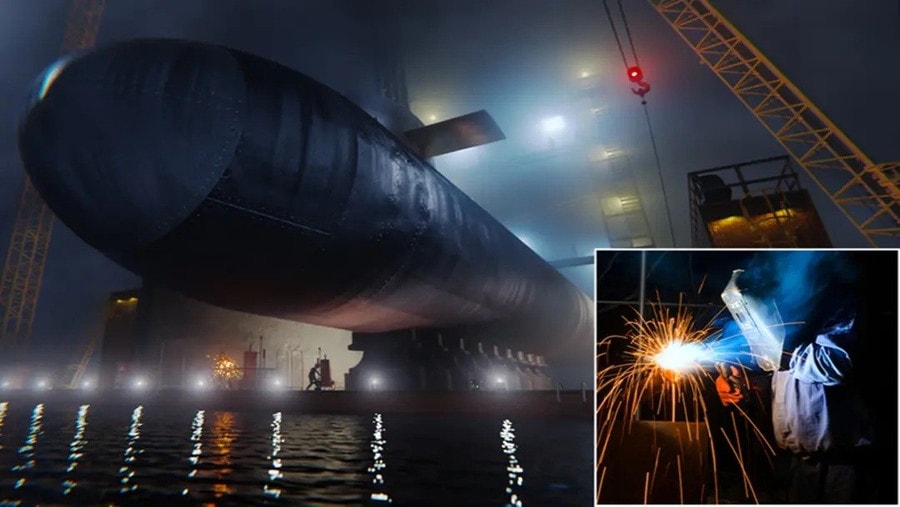
The challenge comes from the immense pressure at a depth of 244 meters.
The pressure hull of a US nuclear submarine is constructed from massive steel plates, approximately 30 meters long, joined together using manual or robotic welding techniques. When the submarine dives deeper than 244 meters, the external pressure acting on the steel hull exceeds 2,390,000 newtons per square meter.
Under these conditions, microscopic cracks in the steel body or weld joint can be disastrous. A common problem identified is ductility dip cracking (DDC). DDC occurs when the weld metal cools and solidifies, creating tiny cracks that tend to grow over time. Even the durable copper-nickel alloy (70:30 ratio) is not immune to this risk.
Neutron X-ray technology replaces X-rays.
To solve the safety problem, the U.S. Navy collaborated with Electric Boat, the University of Connecticut, and Oak Ridge National Laboratory (ORNL) of the U.S. Department of Energy. The research team used neutron scattering techniques on the High Intensity Diffractometer for Residual Stress Analysis (HIDRA) instrument at the HFIR reactor.
Unlike conventional X-rays, neutrons can penetrate deep into thick layers of metal without damaging the structure. Neutron diffraction allows scientists to measure changes in lattice spacing caused by internal stresses generated by heat during welding.
The outstanding advantages of technical analysis.
- High performance:The high-energy neutron source from the reactor allowed the measurements to be completed in just a few hours, instead of weeks as with older methods.
- Non-microstructure analysis:The research focuses on residual stress – a key factor causing DDC cracking that previous techniques have often overlooked.
- Predictive modeling:Experimental data helps build accurate computer models to predict welding conditions that could cause errors, thereby adjusting the manufacturing process.
Establishing new safety standards for submarines.
In addition to neutron technology, the research team also incorporated X-ray testing at Brookhaven National Laboratory to gain the most comprehensive understanding of the physical mechanisms causing cracking. The ultimate goal is to map stresses in the weld material without destroying the sample.
Dr. Lesley Frame from the University of Connecticut stated that understanding and preventing DDC cracking through neutron technology will help the next generation of U.S. Navy submarines operate more safely and extend their service life in strategic missions.


