
US Navy halts frigate Constellation: a lesson in cost.
The US Navy halted the Constellation frigate project because the addition of Aegis, AN/SPY-6(V)3 radar, and COMBATSS-21 increased the cost to $1.1 billion per ship; the plan now only includes two ships.
The U.S. Navy announced it is abandoning the Constellation-class frigate program after expanded equipment configurations pushed costs up to approximately $1.1 billion per ship. The project, based on the European FREMM design, was expected to provide a low-cost, mass-produced class of ships to replace the Oliver Perry class, but was ultimately limited to two ships because the cost was deemed unacceptable relative to their capabilities, according to Reporter.
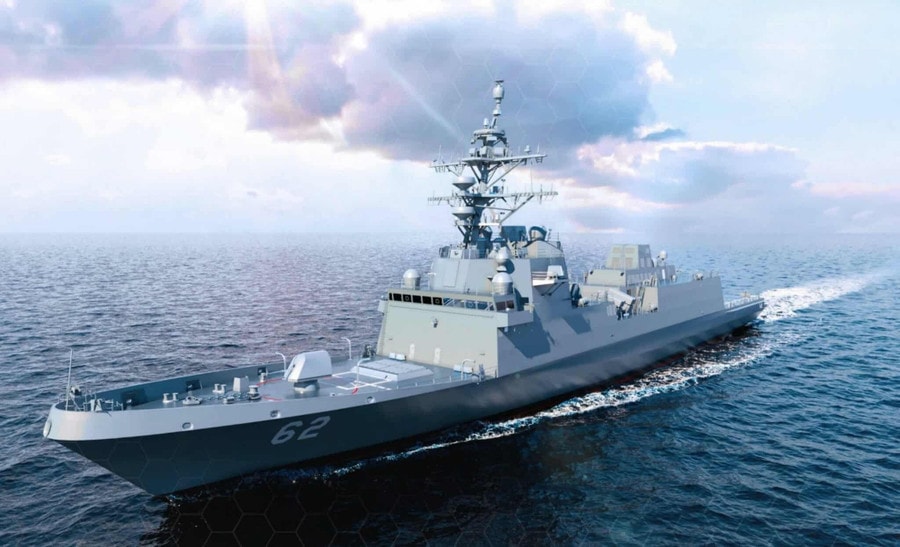
Overview: From the high-low naval concept to the need for Oliver Perry replacements
During the Cold War, the United States employed the concept of a "high-low navy": the "high" force was a carrier strike group centered around a nuclear-powered aircraft carrier, protected by missile cruisers, destroyers, and attack submarines; the "low" force consisted of smaller, cheaper warships that could be deployed in large numbers.
In the "high-end" segment, the Arleigh Burke class – essentially a "miniature Ticonderoga" – proved effective: high speed, excellent seaworthiness to closely track nuclear-powered aircraft carriers; carrying Tomahawk cruise missiles to attack ground targets; air defense capable of intercepting anti-ship and ballistic missiles; and a pair of SH-60 LAMPS III helicopters for enhanced anti-submarine warfare. This success led to the Zumwalt stealth destroyer program being cut short to 3 instead of the planned 32; the Zumwalt class was subsequently expected to be a carrier of hypersonic missiles.
In the "lower class" segment, the Oliver Perry-class frigates were nearing the end of their service life, forcing the US Navy to seek a replacement. In 2020, Fincantieri Marine Group was selected, with a design based on the FREMM frigate. The FREMM was originally an Italian-French project for a multi-purpose vessel, primarily focused on offshore patrol and low-intensity missions such as protecting the exclusive economic zone and humanitarian relief – prioritizing low cost.
Technical analysis: From cheap FREMMs to "weaker destroyers"
Instead of maintaining a minimalist configuration for mass production, the US Navy equipped the Constellation with an expensive package: the Aegis combat information system, the Raytheon AN/SPY-6(V)3 Enterprise air surveillance radar (EASR) with three fixed antennas and integrated AESA, and the COMBATSS-21 anti-submarine warfare system. The result was an "over-upgraded" European FREMM design, resulting in a ship with a configuration close to a destroyer, but still considered weaker than the Arleigh Burke.
The practice of "packaging" sensors and combat systems standard for destroyers into a hull optimized for low-intensity combat significantly increased costs. Based on production cost calculations, the $1.1 billion per vessel price was deemed unacceptable for its intended role.
The reference role of the Arleigh Burke in carrier strike groups.
The Arleigh Burke class serves as the core escort for carrier strike groups, with extensive air defense/missile defense capabilities and ground attack capabilities using Tomahawk missiles. Their speed and seaworthiness allow them to closely track nuclear-powered carriers, while the SH-60 LAMPS III helicopters provide significant anti-submarine warfare capabilities. This context demonstrates the very high capability standard of the "high class" within the high-low model, a standard that the Constellation class would struggle to achieve while maintaining economic viability.
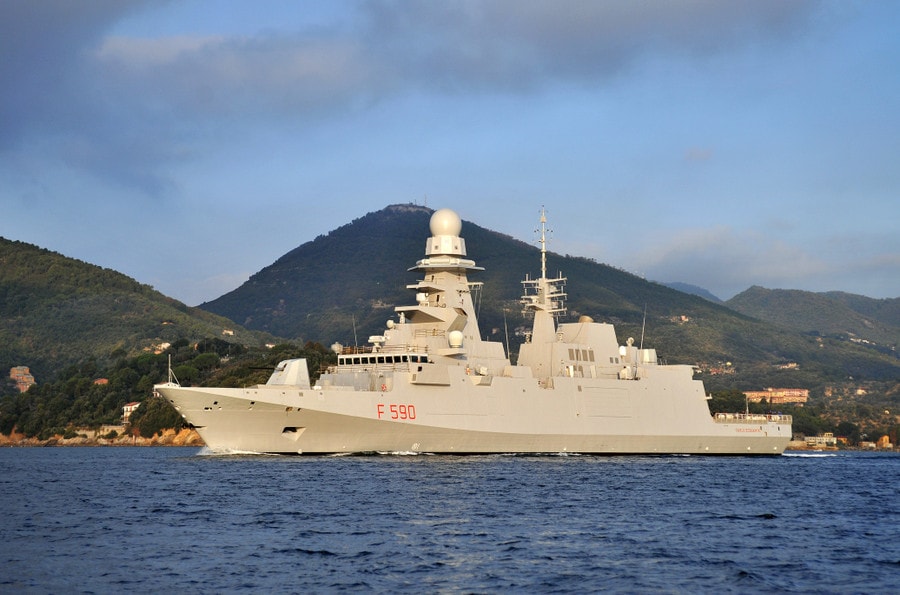
Compare costs and roles by source.
| Ship class | Role by source | Estimated cost per unit |
|---|---|---|
| FREMM (Europe) | Offshore patrol vessels for low-intensity conflicts; protection of exclusive economic zones; humanitarian relief. | Approximately $350-$700 million |
| Constellation (FFG) | Based on FREMM technology, incorporating Aegis, AN/SPY-6(V)3 radar, and COMBATSS-21; considered a "less powerful destroyer". | Approximately $1.1 billion |
| Arleigh Burke (DDG) | Carrier escort; air defense/missile defense; ground attack with Tomahawk missiles; 2 SH-60 LAMPS III helicopters | Approximately $2.1 billion |
Tactics and doctrine: role imbalance leads to cost imbalance.
According to Reporter, FREMM was attractive due to its low cost, making it suitable for low-intensity combat. However, when meeting the requirements of the US Navy, the addition of a high-altitude combat system caused the Constellation to deviate from its role as a “cheap second force”—the cornerstone of the “low” tier in the high-low concept—and move closer to a destroyer configuration. This shift in role led to increased costs, rendering the criteria for mass production meaningless.
Impact and lessons learned
- Mission-oriented configuration: With a hull geared towards low-intensity missions, integrating too many high-intensity systems will increase costs and risk not achieving the desired cost-effectiveness ratio.
- Avoid "over-upgrading": Finding a balance between cost and capability is key to maintaining shipbuilding volume and pace, especially with a "low" fleet size.
- The force stratification is clear: the "high" class, such as the Arleigh Burke class, meets the requirements for escorting carrier groups; the "lower" class needs to maintain a configuration compatible with its economic and numerical role.
In conclusion, the Constellation's price tag of $1.1 billion per ship – compared to approximately $2.1 billion for the Arleigh Burke and $350-700 million for the FREMM – was deemed disproportionate to its intended role, leading the U.S. Navy to limit the program to two ships before abandoning it, according to the source.


