
The US Navy has canceled plans to purchase the frigate Constellation.
On November 25, Secretary of the Navy John Phelan canceled plans to purchase Constellation-class frigates due to low efficiency; the program, which had initially planned for 20 ships, had already signed contracts for 6.
The U.S. Navy halted plans to purchase Constellation-class frigates following a November 25 announcement by Navy Secretary John Phelan. He cited inefficiency as the reason for the failure to meet combat readiness goals and indicated the Navy would shift its strategy away from the program to focus on combat advantage. A senior defense official quoted by USNI News stated that Washington needs to develop its fleet more quickly to meet future threats.
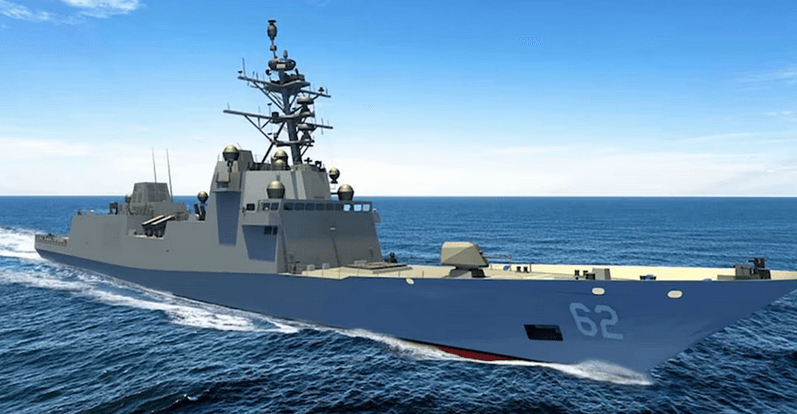
Overview of the Constellation program
According to CNN, the Constellation-class frigate program is part of the U.S. Navy's effort to catch up with the Chinese fleet. The Navy contracted with Fincantieri Marine Group to build six ships, initially aiming for 20 at a cost of approximately $1.1 billion each. These are touted as "next-generation small surface warships," versatile, multi-role, capable of operating in both open ocean and coastal waters, providing a more reliable forward presence in combat.
The Constellation-class frigates have a displacement of approximately 7,200 tons, filling the gap between the 10,000-ton Arleigh Burke-class guided missile destroyers (the backbone of the fleet) and the 3,500-ton Littoral Combat Ships (LCS). The U.S. Navy has had no frigates in its fleet since the USS Simpson was decommissioned in 2015.
Basic comparison table based on data source
| Type of ship | Displacement (tons) | The role mentioned in the source |
|---|---|---|
| Arleigh Burke (destroyer) | 10,000 | The backbone of the fleet. |
| Constellation (floodship) | ~7,200 | "Flexible, multi-tasking," offshore and coastal operations. |
| LCS (Littoral Combat) | ~3,500 | The littoral combat ship has been criticized for being small and ineffective. |
Official statement and proposed adjustments
Secretary John Phelan said, “I will not spend a single dollar if it does not enhance our combat readiness or our ability to win.” He said the Navy is reshaping how it builds and deploys its fleet, working with industry to deliver a combat advantage, “starting with a strategic shift away from the Constellation-class frigate program.”
Quantity pressure from China
Chinese shipyards are rapidly increasing production, and the country surpassed the U.S. in fleet size a few years ago. According to Pentagon estimates, the People's Liberation Army Navy is expected to possess around 400 ships by the end of this year. The International Institute for Strategic Studies estimates that about 50 of those will be frigates.
Evaluating and debating the effectiveness of combat operations.
Many experts have been quoted as saying that the Constellation program should be ended. Analyst Carl Schuster, a former U.S. Navy captain, stated that the Constellation ships are a “huge waste of money” and fail to meet mission requirements, even against low-level threats. He argued that the ships are poorly defended against UAVs, aircraft, missiles, and even small vessels, and “would not last long in a war against a Houthi-level threat.”
Naval analyst Sal Mercogliano, a professor at Campbell University in North Carolina, ranks Constellation among the most controversial programs, alongside the LCS. The LCS has been criticized for being small and ineffective; a 2023 ProPublica investigation called it “one of the worst wastes” in history of expensive and ineffective weapons system procurement.
Lessons from LCS and the program's impact
Since 2008, the U.S. Navy has commissioned 35 LCS ships, with two more still under construction. ProPublica estimates the total cost of the program could reach $100 billion. LCS ships frequently experience malfunctions and fail to deliver the expected mission flexibility, leading to the early retirement of some ships, with some serving for only about five years.
Against this backdrop, the decision to halt the Constellation acquisition plan demonstrates the U.S. Navy's priority on combat readiness and effectiveness, while simultaneously "reshaping" its surface force development strategy. According to USNI News, the goal is to accelerate fleet development to meet future threats; however, specific implementation steps were not mentioned in the source.
Technical and tactical perspective (based on source data)
- Force gap: The ~7,200-ton frigate is positioned to fill the intermediate space between a 10,000-ton destroyer and a 3,500-ton LCS.
- Expected capabilities: Increased forward presence, effective operations both at sea and inshore (as described by the Navy for Constellation).
- Limitations noted: Defensive capabilities against UAVs, aircraft, missiles, and small vessels are questionable (according to Carl Schuster's assessment).
- Program risks: Inheriting lessons from the LCS regarding high costs, low efficiency, and operational reliability.
Overall, the U.S. Navy's decision reflects a priority on restructuring its surface forces based on operational efficiency and deployment speed, while continued numerical pressure from China persists. Further details regarding alternative options or adjustments to tactical and technical requirements have not been released in the cited source.


