
South Korea accelerates nuclear submarine development; Japan considers options.
Washington approves fuel access to help Seoul accelerate its shipbuilding; South Korea aims to build four 5,000-ton nuclear submarines domestically within 10 years, putting pressure on Tokyo in the region.
South Korea is accelerating its nuclear submarine construction plans following supportive signals from US President Donald Trump, paving the way for Seoul to access nuclear fuel under a bilateral agreement. Analysts believe this move could pressure Japan to consider nuclear propulsion, and also impact the maritime security balance in Asia.
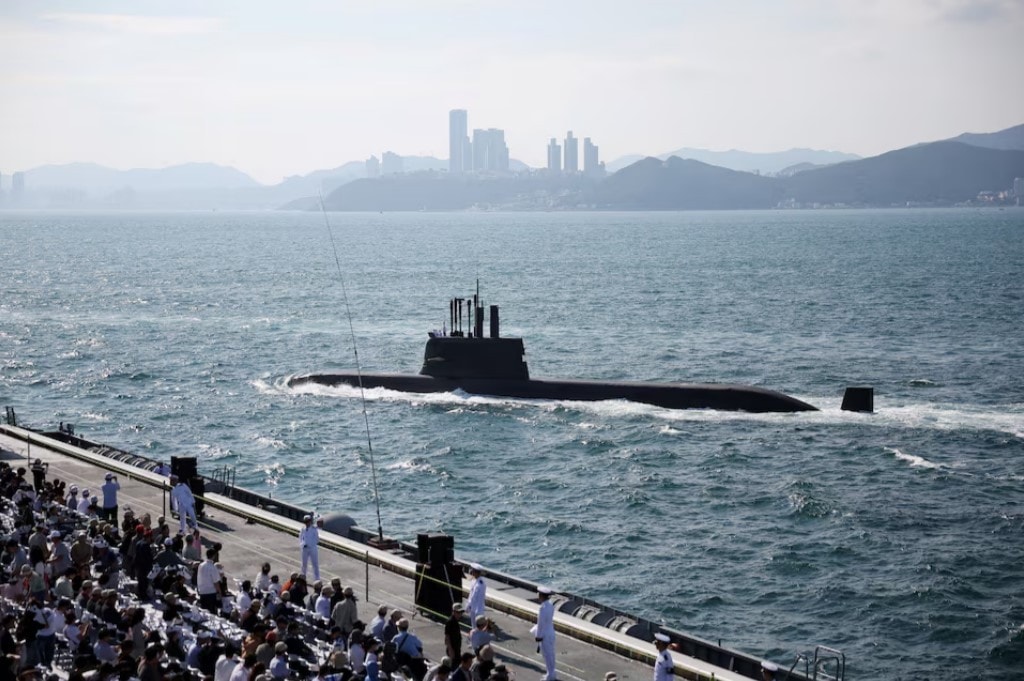
Overview
South Korea has long pursued nuclear submarines to deter and counter North Korea's submarine-launched ballistic missile capabilities. With the approval of U.S. President Donald Trump, a major hurdle related to nuclear fuel has been removed. South Korean President Lee Jae-myung called this a "great achievement" and asserted that the agreement enhances security flexibility and defense autonomy.
According to Defense Minister Ahn Gyu-back, the reactor assembly is in a "significant" stage. It is estimated that Seoul could build its own submarines within about 10 years, with a minimum requirement of four 5,000-ton nuclear submarines. A joint US-South Korea document released on November 14th shows Washington agreeing to cooperate in supplying nuclear fuel to its ally.
Regional reactions and consequences
Analysts note that South Korea's accelerated program could unsettle China and increase pressure on Japan. Reuters, citing sources familiar with the matter, reported that Tokyo was "shocked" by Washington's support for Seoul's plan; Japan believes that if the U.S. paves the way for such a large-scale program in the region, Tokyo "will have to get ahead" of South Korea. The Japanese Ministry of Defense declined to comment; Defense Minister Shinjiro Koizumi stated that nuclear propulsion is an option, but said Tokyo has not yet studied the possibility.
A Japanese official said that if Tokyo pursues nuclear submarines, it will request assistance from the United States. According to an anonymous Japanese naval expert, current small diesel submarines are suitable for shallow waters, while nuclear submarines could extend their operational range into the Pacific Ocean and pave the way for future nuclear counterattack capabilities. From the US side, Admiral Daryl Caudle, Commander of Naval Operations, expects South Korean nuclear submarines to play a deterrent role in the region.
North Korea claims to be developing similar capabilities and released images of Chairman Kim Jong Un inspecting a nuclear submarine in March of this year, although the extent of progress remains unclear. Some analysts suggest Pyongyang is being supported by Russia; Russia and North Korea say they are strengthening defense cooperation but have not provided technical details. North Korean state media has warned that Seoul's plan could create a "nuclear domino effect."
Program specifications and key milestones
- Nuclear fuel: US agrees to cooperate in supply (joint document released November 14).
- Technical progress: Reactor assembly is at a "significant" stage, according to Defense Minister Ahn Gyu-back.
- Projected scale: A minimum of 4 nuclear submarines, 5,000 tons each.
- Roadmap: South Korea estimates it can close the border independently within 10 years.
- Political stance: President Lee Jae Myung affirmed the defensive purpose of deterring North Korea; Seoul does not pursue nuclear weapons and respects the non-proliferation mechanism.
- Background: In 2017, President Moon Jae-in reportedly persuaded Trump to agree in private talks, but the US side was still concerned about nuclear proliferation. South Korea first raised the idea of nuclear submarines in 1994.
Technical and operational aspects
According to lawmaker and defense expert Yu Yong-weon, nuclear submarines can operate faster and for longer periods underwater than diesel-electric submarines, thus increasing the effectiveness of tracking North Korean submarines. Choi Il, a former South Korean Navy submarine captain, stated that submarines are an effective attack system, and an underwater arms race in the region is inevitable.
From a deployment perspective, the sustained operational capability of nuclear-powered ships helps maintain a deterrent presence and expand patrol areas. This aligns with Seoul's stated goal of enhancing ballistic missile deterrence from submarines. An anonymous Japanese naval expert suggested that with nuclear-powered ships, Tokyo could expand its operational range into the Pacific Ocean, beyond the shallow waters currently suitable for its small diesel fleet.
Stakeholder positions
South Korea insists on a defensive objective, avoiding escalation and not pursuing nuclear weapons. National Security Advisor Wi Sung-lac said President Lee reassured Chinese President Xi Jinping that Seoul's nuclear submarines are solely for deterrence against North Korea. On the US side, a White House official said Washington supports South Korea's ambitions to “enhance burden-sharing and deter threats” within the alliance, including the development of nuclear attack submarines. Australia's AUKUS agreement is seen as having eased obstacles for Seoul.
Impact assessment
South Korea's pursuit of nuclear submarines is likely to reshape the underwater security environment in Northeast Asia. Japan faces a strategic dilemma, weighing nuclear propulsion technology and its dependence on US support. For North Korea, signals of nuclear submarine development and warnings of a "nuclear domino effect" indicate a risk of increased tension, although the actual extent of Pyongyang's progress remains unclear.
On a broader scale, U.S.-South Korea fuel cooperation and statements from the U.S. Navy reflect a priority on sea-based deterrence over regional capabilities. However, concerns about nuclear proliferation previously raised by U.S. agencies suggest the program will continue to be subject to close scrutiny.
Prospects
Former Vice Foreign Minister Choi Jong-un remarked that the AUKUS agreement had “opened the door,” while another former South Korean official likened it to “the ship having set sail”—implying that progress is underway but much work remains to be done. Key milestones to watch over the next decade include: the completion of the design, reactor integration, the construction roadmap, and the configuration of South Korea's minimum fleet of four 5,000-ton nuclear submarines; as well as Japan's policy response and signals from North Korea.


