
South Korea deploys Hyunmoo-5: The world's largest ballistic missile carrying a bunker-busting warhead.
The Hyunmoo-5 possesses a warhead weighing up to 9 tons and a hypersonic speed, allowing it to penetrate deep into and destroy even the most fortified underground structures on the Korean Peninsula today.
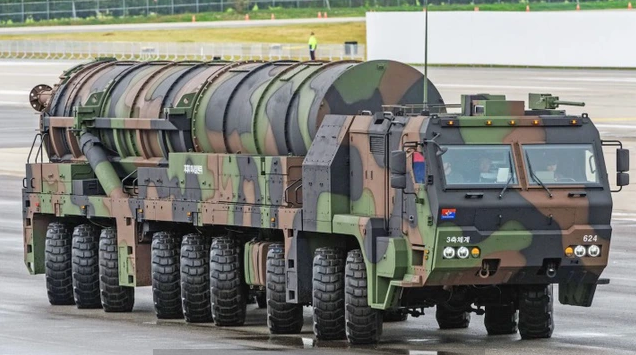
The South Korean military has begun deploying the new generation Hyunmoo-5 tactical ballistic missile. This weapon is considered to carry the largest non-nuclear warhead ever integrated into a ballistic missile, marking a new step forward in Seoul's deterrence capabilities.
The Hyunmoo-5 warhead boasts superior technical specifications.
According to technical estimates, the Hyunmoo-5's warhead weighs approximately 8,000-9,000 kg. This figure far exceeds the standards of most tactical ballistic missiles currently in use worldwide. For comparison, Russia's Iskander-M missile uses a warhead of about 500 kg, while the US ATACMS system carries a warhead weighing only 227 kg.
Notably, the Hyunmoo-5's warhead mass-to-total weight ratio (approximately 36,000 kg) is five times higher than that of heavy strategic missiles such as Russia's RS-28 Sarmat. The combination of its enormous mass, high accuracy, and hypersonic impact speed allows the missile to penetrate deep into the ground before detonation, creating devastating destructive power against fortified targets.
The strategic role in Seoul's military doctrine.
The deployment of the Hyunmoo-5 is part of South Korea's "KMPR" (Kmaliform, Massive Retaliation, and Punishment) doctrine. The primary objective of this weapon is to neutralize command centers, military bases, and nuclear facilities located deep within the enemy's vast underground network of fortifications with a single strike.
In addition, this system can be deployed from mobile launchers, increasing its flexibility and survivability in combat. South Korea can launch a salvo of these missiles at a single target to increase the ability to penetrate to the deepest layers, where conventional airstrikes would have difficulty reaching.
The arms race on the Korean Peninsula.
The appearance of the Hyunmoo-5 is a response to Pyongyang's efforts to develop similar missiles. Previously, North Korea had tested the KN-23B missile with a 2,500 kg warhead and the Hwasong-11-Da-4.5 variant with a 4,500 kg warhead.
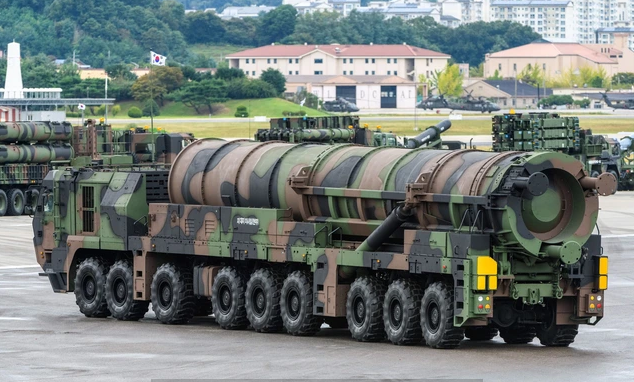
This competition reflects a clear escalation in the development of tactical missiles carrying super-heavy warheads. While North Korea expands its missile arsenal and strengthens technological cooperation, South Korea focuses on precision strike and deep penetration capabilities with non-nuclear weapons, asserting its leading position in the world's tactical ballistic missile technology.


