
The nightly actions of writer Kim Lân brought heartbreak to his family.
After his wife passed away, writer Kim Lân would arrange yellow chrysanthemums in his vases every day, the kind of flower they both loved. At night, when the children were asleep, he would look at his wife's photograph and tell her about the day, about things that had become part of his memory...
Among the articles written about the writer Kim Lân, one occasionally finds him mentioning his wife - Mrs. Nguyễn Thị Tám (born 1926 - died 2001).
In particular, Kim Lân's mention of his wife is particularly striking on two occasions. These are the scene where the old woman holds the cart of animal feed while the old man pushes from behind (which inspired the work "The Picked-Up Wife"), and the line, "Most of the children resemble their mother; their beauty is thanks to their mother."
Few people know that, in their married life, writer Kim Lân and his wife were extremely affectionate people.
|
| Writer Kim Lân and his wife. Photo: Provided by the family. |

Artist Nguyen Thi Hien (born in 1946, the eldest daughter of writer Kim Lan) said that her mother was the younger sister of cinematographer and People's Artist Nguyen Dang Bay.
During her marriage to writer Kim Lân, Mrs. Tám was the one who took care of the household finances and supported the entire family.
“When life was tough, my mother took on military supply work: mending and repairing clothes and blankets, buying rice to mill for the soldiers, and using the bran to feed pigs. Later, after returning to the capital, she took on crocheting scarves, knitting wool, and making mesh bags, and she worked alongside her children,” Mrs. Hien said.
Despite all the hardships and worries, Mrs. Tam was very devoted to her husband and very hospitable.
“Since I was a child, I witnessed poets like Nguyen Huy Tuong, Nguyen Hong, To Hoai, Nguyen Tuan… frequently visiting my home to see my teacher Kim Lan. When they arrived, my mother would start cooking so that my teacher and they could enjoy a meal together while chatting about literature and reading aloud newly written works…”
"Those conversations could last from 9 a.m. the day before until 3 a.m. the next day. Their infectious laughter would still echo throughout the neighborhood, and my mother never complained," the artist said.
|
| Artist Nguyen Thi Hien and writer Kim Lan stand beside a painting she created of her father. Photo: Provided by the family. |
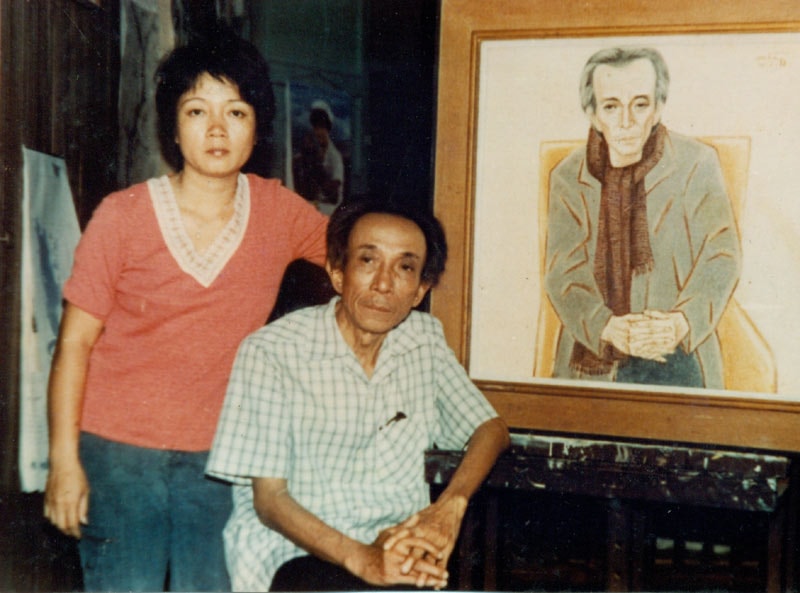
It was also through these friends that artist Nguyen Thi Hien said she learned more about the life and love of her parents. This included the story of writer Kim Lan taking his wife to give birth.
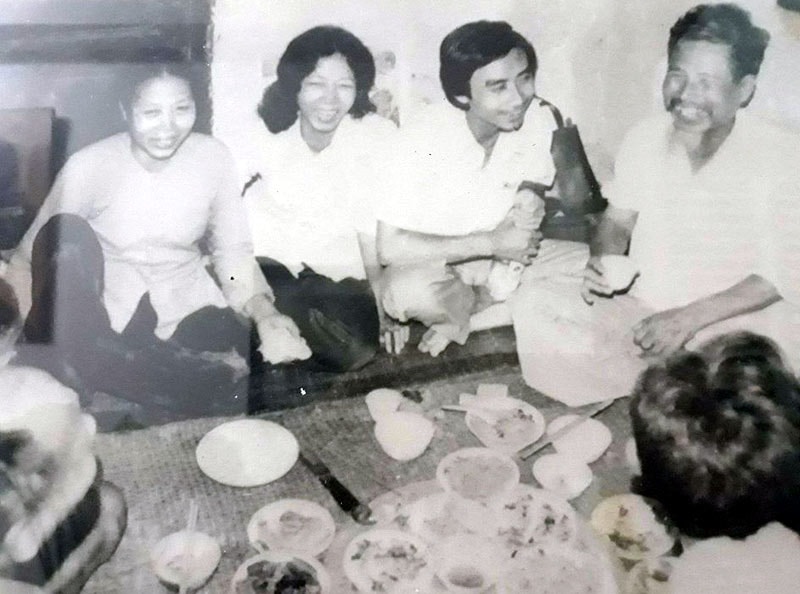
"Every time writer Nguyen Hong came to our house and saw me, he would burst out laughing and recount the story of how he and my father took my mother to the hospital to give birth to me."
That time, as my mother's due date approached, my father and Uncle Nguyen Hong drove her through Dau Market, Dinh Bang (Tu Son, Bac Ninh) to the maternity ward. But even after going back and forth several times, I still wasn't ready to be born.
The women selling goods at the market saw the scene and covered their mouths to stifle their laughter, making my teacher blush profusely. Afterwards, the people at Dau Market said, "This child in the womb is very stubborn. The husband has to climb over the roof three times and wade through the pond before his wife can give birth."
Back home, Uncle Nguyen Hong kept secretly watching to see if my teacher followed the villagers' advice. One day, he discovered that, taking advantage of the absence of others, my teacher had climbed onto the roof, run up and down three times. After that, he rolled up his trousers and waded across the pond. While doing all this, he kept glancing around to avoid being seen.
The next day, my mother gave birth to me…”.
This story is from the distant past. However, because she heard it recounted many times by the writer Nguyen Hong, its content has been deeply imprinted in her memory and has become a cherished recollection whenever she thinks of her father.
|
| The photo shows writer Nguyen Hong (far right) recounting the story of Kim Lan taking his wife to give birth. |
Recalling her father's habits, artist Nguyen Thi Hien recounted: "My father went to work, and he gave all his money to my mother. I remember once when our family was evacuated, my father cycled from Hanoi to Yen The, Bac Giang to give my mother her salary. When he had to cross the river to return to Hanoi, he realized he had no money in his pocket to pay the ferry fare. So he had to turn back to see my mother..."
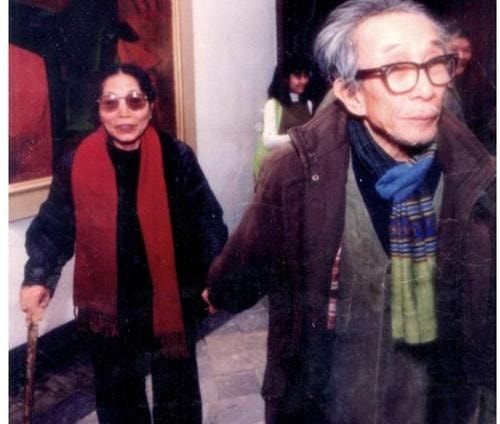
Continuing to recount her parents' marriage, the artist said: "My father and mother occasionally argued, but they were very affectionate. Wherever writer Kim Lân went, he always held his wife's hand. Even when sitting next to each other, my father would hold my mother's hand, or vice versa."
The artist also recounted that in her family, all members loved reading. Whenever a new book came out, they would become engrossed in it, paying no attention to meals. Her parents were even more so.
“I remember when I was little, before going to bed, my father always had the habit of reading to his wife. He read all kinds of books. I would lie next to them, pretending to be asleep so I could listen along. However, when he read ghost stories, I would get scared and roll over to lie between my parents,” Mrs. Hien recalled.
|
| Writer Kim Lân often held his wife's hand whenever they walked together. Photo: Provided by the family. |
Later, after her mother passed away, writer Kim Lân's deep affection for his wife made her realize how immeasurable the love her parents had for each other truly was.
"My teacher told us that he loved my mother when she was alive, but he felt even more sorrow for her after she passed away."
After my mother passed away, my father would arrange yellow chrysanthemums in his vase every day, a flower they both loved. At night, when the children were asleep, he would light an oil lamp and look at his wife's picture, telling my mother about the day's events and memories.
"We knew, but we let it be so that he could continue living in the feeling that his life partner was still by his side," Mrs. Hien said emotionally as she recalled the old story.


