
Onion prices in Nghe An province have increased sharply at the beginning of the season.
(Baonghean.vn) - Currently, farmers in Nghe An are entering the shallot harvest season. Traders are coming directly to the fields to buy the shallots at prices three times higher than during the peak season, so the farmers are very happy.
shallotsIt is mainly grown in the central provinces, with the largest quantities in Nghe An and Ha Tinh. This tuber is considered a specialty with a unique flavor of Nghe An, a spice that contributes to the preparation of many delicious dishes, and also a valuable medicinal herb.
Nghi Loc district is considered the "shallot capital" of Nghe An province, with communes having large areas of concentrated shallot cultivation such as Nghi Thuan, Nghi Hoa, Nghi Lam, Nghi Kieu, Nghi Van...

In the days following the Lunar New Year, despite the drizzling rain and cold weather, people in Nghi Loc district were still rushing to the fields to harvest shallots.
Ms. Ha Thi An's family in Hamlet 8, Nghi Thuan Commune, has 3 sao (approximately 0.3 hectares) of shallots. After about half a year since planting, the shallots have started to yield a harvest after Tet (Lunar New Year). "This is the sixth year my family has grown shallots, and it's much more profitable than growing corn or peanuts before. This year, the yield hasn't increased compared to previous years, only about 4 quintals per sao. However, because the price is high at the beginning of the season, everyone is rushing to harvest shallots while the price is still good," Ms. An shared.

Currently, the price of shallots ranges from 50,000 to 70,000 VND/kg, which is three times higher than the peak season of last year. Ms. Nguyen Thi Lam from Nghi Lam commune shared: "After Tet (Lunar New Year), shallot prices are usually high due to high market demand and many shops reopening. Besides, because it's the beginning of the season, the harvested shallot area is still limited. In about half a month, when the main harvest begins, the price will decrease, usually fluctuating between 15,000 and 20,000 VND/kg."

Shallots have taken root in this land.Nghi LocFor about 10 years now, onions have gradually become one of the crops that bring economic efficiency and stable income to farmers here. In this region, onions are grown using a rather special method: intercropping them with corn. After the corn grows tall, the onions also begin to be harvested.

The onion cultivation process is also unique, involving covering the plants with a layer of pine needles and rice husks. According to local people, pine needles are clean and highly porous, and combined with rice husks, they add organic matter to the soil, significantly increasing crop yields, especially for shallots. Therefore, in shallot-growing areas like Nghi Lam, Nghi Thuan, and Nghi Van, pine needles are considered "as precious as gold." Every year, people here go into the forest to collect pine needles to use for planting shallots.
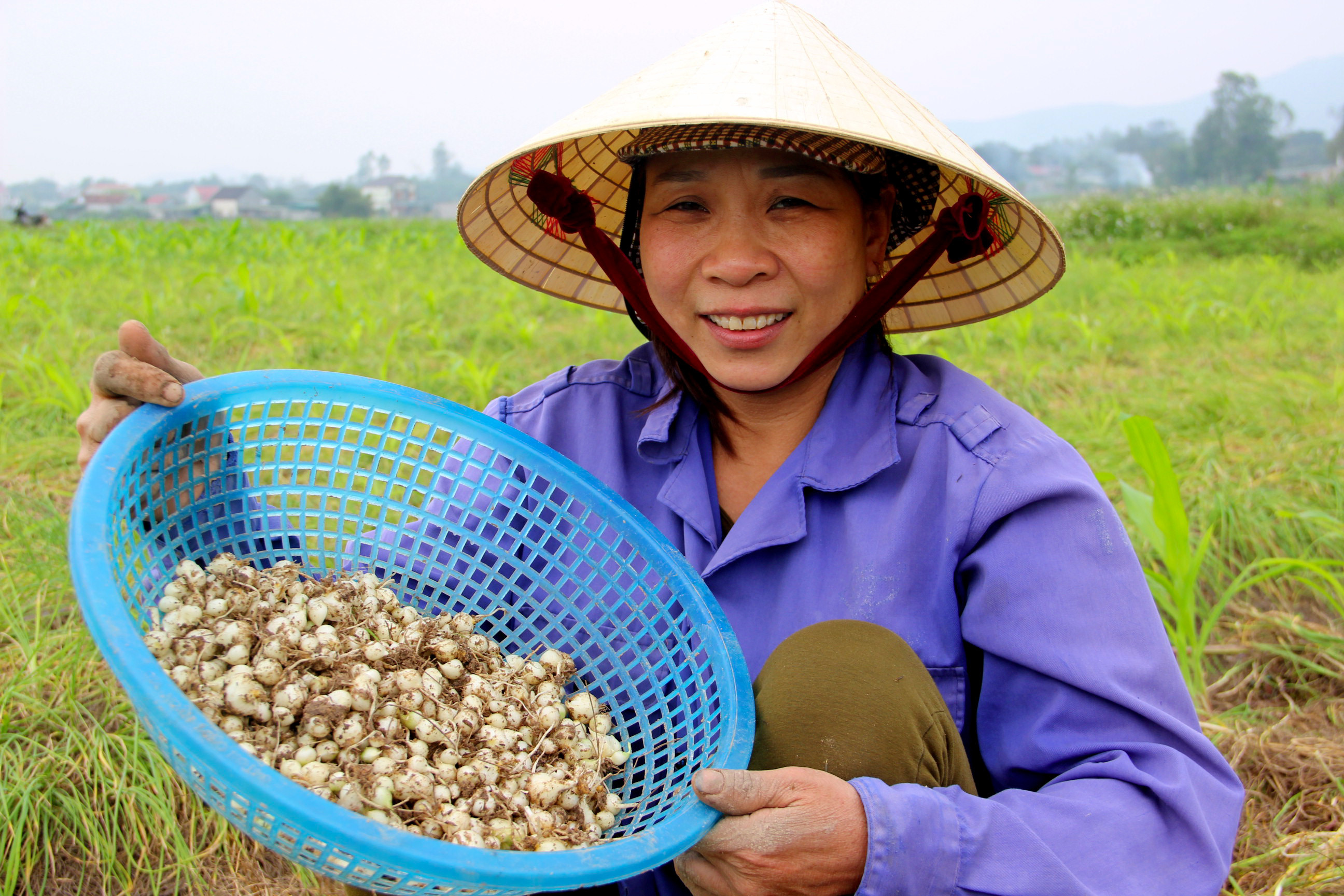
Thanks to proper care, the quality of shallots in Nghe An is always superior; the bulbs are large, round, rich in essential oils, and very fragrant, making them popular with customers. The process of growing and caring for shallots is not as labor-intensive as other crops, and they are less susceptible to pests and diseases. However, the harvesting period is time-consuming and requires patience and diligence.
Ms. Hoang Thi Khanh from Nghi Thuan commune shared: "The locals here usually harvest shallots in two ways. Most people pull the plants up by hand and cut off the bulbs, while others use tools to loosen the soil and then pick out the shallots. Both methods are time-consuming because the shallots are small and mixed with mud. Most families go out early in the morning, and after a whole morning they only manage to gather about a few tens of kilograms, which they quickly bring home to clean in time to sell to traders."

Mr. Tran Nguyen Hoa, Head of the Agriculture and Rural Development Department of Nghi Loc District, said: The entire district currently has more than 300 hectares of shallot cultivation, and the area is expanding because shallots have proven their economic effectiveness. Currently, shallots in Nghi Thuan and Nghi Lam communes have both been certified as 3-star OCOP products, which is an important leverage to bring the Nghi Loc shallot brand to the market. Shallot cultivation not only brings economic benefits but is also a model for adapting to climate change because shallots grow well on the high-lying, drought-prone land in the area.
Shallots are commonly used as a spice in many everyday dishes. Additionally, in traditional Eastern medicine, shallots are used as a medicinal herb to disinfect, detoxify, and treat colds. Because of their wide range of uses, shallots are very popular and sought after by consumers.


