
The 70-year journey of the Quy Chau District Party Committee in the western part of Nghe An province.
(Baonghean) - On July 5, 1947, the Hoang Van Thu Party Branch was established, the first Party organization in Quy Chau district. From the initial 4 Party members, after 70 years, the Quy Chau District Party Committee now has 3,870 Party members, operating in 41 grassroots Party organizations, including 234 branches directly under the grassroots Party committees.
On this occasion, Comrade Lang Van Chien - Member of the Provincial Party Committee, Secretary of the Quy Chau District Party Committee - gave an interview to Nghe An Newspaper.
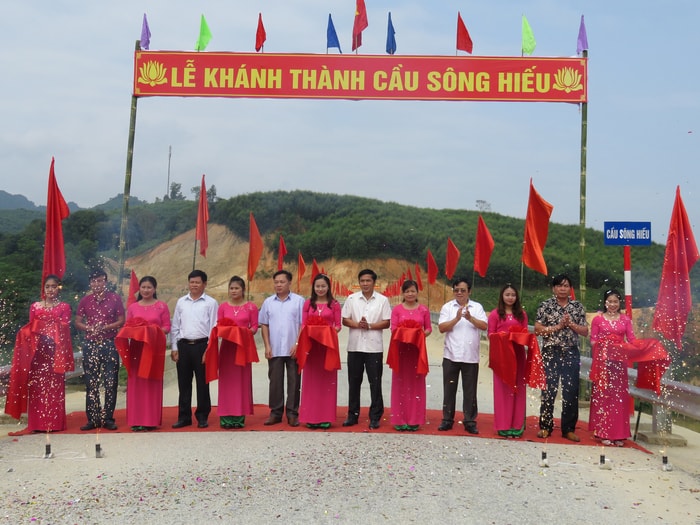 |
| Inauguration ceremony of the bridge over the Hieu River. Photo: Ke Kien |
PV:Could you briefly outline some of the basic aspects of the 70-year journey of formation and development of the Quy Chau District Party Committee?
Comrade Lang Van Chien:In December 1946, the nationwide resistance war broke out, and the people of the whole country entered the fight against the second war of aggression by the French colonialists. To meet the needs of revolutionary leadership, the urgent requirement was to establish a Party organization. Given the developing situation of the resistance war, and based on considering the necessary conditions for the establishment of a communist organization in Quy Chau, on July 5, 1947, at the ancestral temple of Mrs. Huong An, Tan Lac hamlet, the Hoang Van Thu Party Branch was established with 4 members. The Hoang Van Thu Party Branch was the first Party base of the Indochinese Communist Party in Quy Chau district.
Through numerous Party congresses, under the leadership of the Party, the people of Quy Chau district enthusiastically participated in the resistance against French colonialism and American imperialism, contributing to the overall victory of the nation. During the two resistance wars against French colonialism and American imperialism, Quy Chau district had nearly 4,454 people who rendered meritorious service to the revolution, including 270 martyrs, 180 wounded and sick soldiers, one collective awarded the title of Hero of the People's Armed Forces, 12 mothers awarded and posthumously awarded the title of Heroic Vietnamese Mother, and hundreds of cadres and soldiers of the district's armed forces awarded high honors and medals by the Party and the State.
From its inception as the Hoang Van Thu Party Branch to the present day, the Quy Chau District Party Committee has grown stronger. Starting with only 4 party members, after 70 years, the Quy Chau District Party Committee now has 3,870 party members, operating in 41 grassroots party organizations, including 234 branches directly under the grassroots party committees. The Party Committee has always focused on building the party in terms of ideology and organization. In each historical period, the Party Committee has always correctly identified its political tasks, focusing on cultivating and refining the ethics, qualities, and knowledge and leadership capacity of each party member. This ensures that party members remain the red thread connecting the party with the masses, and that grassroots party organizations are the core leading the comprehensive implementation of the Party Committee's political tasks.
PV:In the process of building and protecting our homeland, the Party Committee, government, and people of Quy Chau district have achieved many accomplishments in various aspects; could you please review the recent results, specifically during the 2010-2015 term, Comrade?
Comrade Lang Van Chien:With the investment and attention of the Government and the province through various policies and mechanisms, with the leadership and guidance of the Provincial Party Committee and the Provincial People's Committee, and the support of various sectors and levels, the Party Committee and people of all ethnic groups in Quy Chau district have united and strived to create strong breakthroughs in all areas of socio-economic development, national defense and security...
In particular, most recently during the 2010-2015 term, under the leadership of the District Party Committee and the efforts of the political system and the entire population, Quy Chau has made remarkable progress. The average economic growth rate reached 9.5%. Per capita income increased from 9.4 million VND in 2010 to 19.2 million VND in 2015. The economic structure shifted in a positive direction: the proportion of agriculture, forestry, and fisheries decreased from 46% in 2010 to 36.38%; industry and construction increased from 16.35% to 19.46%; and services increased from 37.65% to 44.16% in 2015. Budget revenue increased from 5.75 billion VND to 21 billion VND, reaching 133.7% of the target set by the District Party Congress for the 2010-2015 term.
Specifically, the agricultural economy has shifted towards gradually reducing the proportion of crop production and increasing the proportion of livestock and aquaculture. Several concentrated production areas have been established, such as: high-quality rice in Chau Tien and Chau Binh communes (900 hectares); acacia plantations for raw materials in Chau Binh and Chau Hoi communes (over 5,000 hectares); sugarcane in Chau Binh, Chau Hoi, and Chau Hanh communes (1,246 hectares); and incense raw materials in the town and Chau Hanh commune. The district has successfully built two large-scale model fields in Chau Binh and Chau Tien communes and is testing several new high-yield rice varieties. Forestry has seen significant growth, with over 5,325 hectares of new concentrated forests and forests planted after logging, reaching 6,725 hectares in the 2011-2015 period, increasing forest cover to 78%.
Industry, handicrafts, and construction continued to grow. Several handicraft and industrial products saw strong growth, such as incense production, brocade weaving, and forest product processing. Hydropower production reached approximately 90 million kWh. Other products such as construction stone, sand, gravel, and bricks maintained stable production. The district has 7 craft villages, including 2 villages specializing in incense production, regularly employing nearly 500 workers with an average income of around 35 million VND per person per year. Infrastructure development continued to receive focused investment, and the mobilization of investment capital yielded positive results, contributing to socio-economic development and the increasingly modernized urban and rural landscape. Trade and services experienced significant growth, with the value of production in the trade and service sector reaching 521.47 billion VND. The market system has been invested in and developed; by the end of 2015, a total of 4 markets had been built in the area, achieving 100% of the 5-year plan. The new rural development movement has been actively supported by the people. Of the total budget for new rural development in the past term, which reached 566,584.6 million VND, the people contributed 20,832.6 million VND. To date, one commune has met 16 criteria, one commune has met 15 criteria, and three communes have met 11-13 criteria...
Culture and society have made significant progress. The quality of education and training has improved. To date, 31 out of 37 schools have met national standards. Medical examination, treatment, and healthcare for the people have received attention. Efforts to address employment, poverty reduction, and policies for war veterans and social security have been effectively implemented. National defense and security are ensured; a military posture is being built within the district's defense zone; policies supporting the military are being effectively implemented, conscription targets are being met, and the reserve mobilization force is being well managed. The fight against crime and social evils has been strengthened; political security and social order are ensured. Party building and the development of the political system have been intensified, gradually improving the quality of grassroots Party organizations; and the planning, training, development, rotation, and promotion of cadres have been effectively carried out.
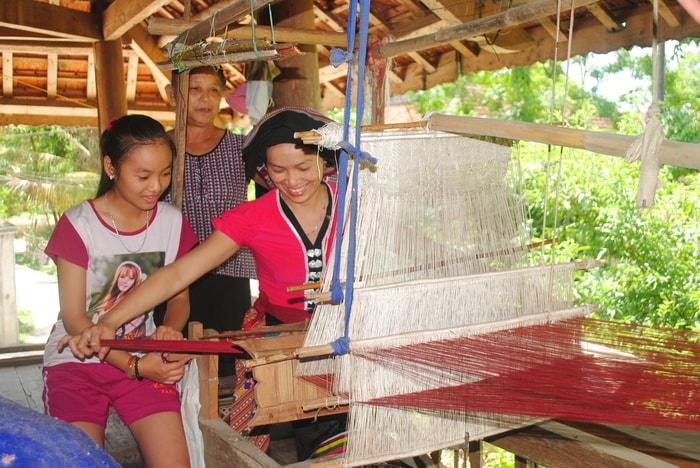 |
| Passing on the craft of brocade weaving in Hoa Tien village, Chau Tien commune (Quy Chau district). Photo: Dang Cuong |
PV:To achieve the above results, the leadership role of Party committees at all levels in the area is crucial. Could you please highlight the key aspects of Party building work during the past term?
Comrade Lang Van Chien:Recognizing the crucial role of Party committees at all levels within the district, the past term has focused on improving political and ideological education, enhancing the revolutionary qualities and ethics of cadres and Party members; building clean and strong grassroots Party organizations, consolidating weak Party organizations, strengthening inspection and supervision; promoting collective strength while emphasizing individual responsibility, especially for the heads of Party committees, government agencies, and units. Simultaneously, Party committees at all levels have seriously implemented Directive 03-CT/TW, dated May 14, 2011, of the Politburo on "Continuing to promote the study and emulation of Ho Chi Minh's moral example," in conjunction with the implementation of Resolution 4 of the 11th Central Committee on "Some urgent issues concerning Party building today," creating positive changes in the awareness and actions of cadres and Party members, especially the heads of all levels. There are many practical and effective movements, models, and examples of implementing the campaign to learn from and follow President Ho Chi Minh's example in various fields; proactively developing work plans and programs, and concretizing implementation to suit each Party committee, branch, agency, and unit.
PV:Comrade, the goal set by the District Party Congress for the 2015-2020 term is to lift Quy Chau out of poverty by 2020; so what are the proposed directions and solutions?
Comrade Lang Van Chien: With the goal of enhancing the leadership capacity and fighting strength of the Party Committee, strengthening unity within the Party, fostering consensus among the people, effectively mobilizing and utilizing resources, and leveraging the advantages of the locality to lift Quy Chau district out of poverty by 2020, the locality has clearly defined its development orientation as follows: Promoting the shift in economic structure towards the development of agriculture, forestry, small-scale industries, and services, contributing to rapid and sustainable development; accelerating the implementation of the National Target Program for building new rural areas; preserving and promoting the identity of traditional ethnic cultural values; ensuring strong national defense and security and social order; doing a good job in Party building, continuing to consolidate and improve the quality of the cadre; and building a stronger Party Committee, government, Fatherland Front, and people's organizations.
Accordingly, the development solution for Quy Chau is: To leverage internal strengths while maximizing the exploitation of external resources. To promote the application of scientific and technological advancements in production and business; to effectively manage the relationships in development: Economic development linked to environmental protection; economic development linked to addressing social issues; and socio-economic development linked to ensuring social stability and maintaining national defense and security.
PV:Thank you, comrade!
Dang Nguyen
(Perform)


