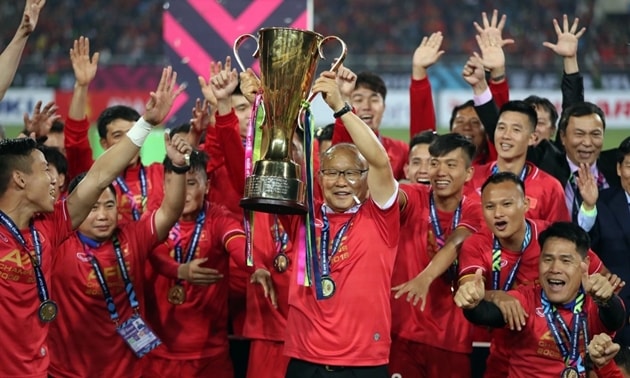
The century-long journey of Vietnamese football: From its beginnings to the pinnacle of Southeast Asian football.
Explore the tumultuous history of the Vietnamese national team through different periods, from its early days of introduction in 1896 to its era of regional dominance with 3 AFF Cup championships.
Over more than 100 years of formation and development, the Vietnamese national football team has risen strongly from a nascent footballing nation to a leading force in the region. Nicknamed "Golden Star Warriors," the team not only reflects the aspirations of Vietnamese sports but also leaves a strong mark on the continental football map with historic achievements in the Asian Cup and World Cup qualifiers.
The era of continental expansion and regional dominance.
The period from 2017 to the present is considered the golden age of Vietnamese football. Under the leadership of coach Park Hang-seo and subsequently coach Kim Sang-sik, the national team has set unprecedented milestones, solidifying its position in the top 100 of the FIFA rankings.
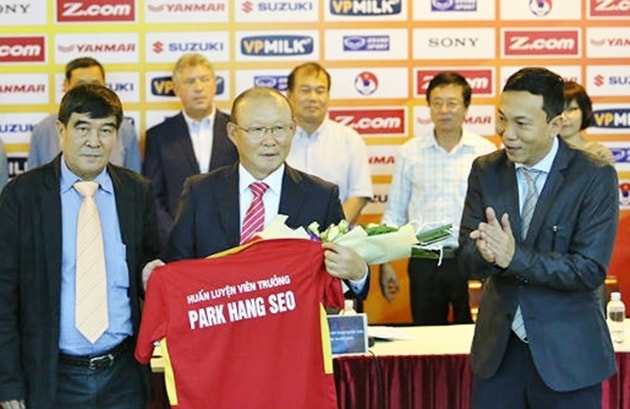
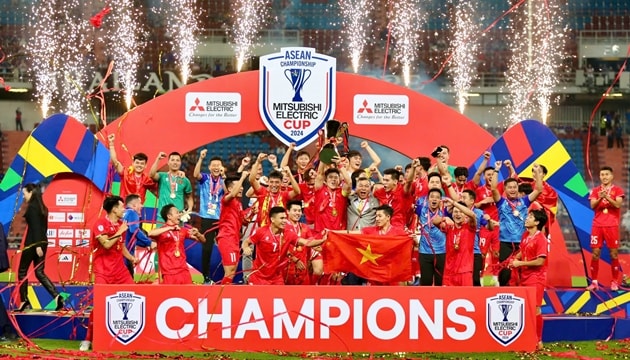
Under coach Park Hang-seo (2017-2023), Vietnam won the 2018 AFF Cup undefeated and reached the quarter-finals of the 2019 Asian Cup. Notably, their first-ever appearance in the third round of the 2022 World Cup qualifiers in the Asian region is the clearest evidence of their rising professional level. Continuing this legacy, coach Kim Sang-sik led Vietnam to their third ASEAN Cup (AFF Cup) title in 2025 after defeating rivals Thailand in both finals.

Impressive statistics under coach Kim Sang-sik
By the end of 2025, coach Kim Sang-sik achieved an extremely high winning rate, helping Vietnam sweep all regional titles including the ASEAN Cup 2025 and the SEA Games 33 gold medal. The team maintained stable performance with a modern playing style, harmoniously combining the experience of veteran players with the youthful energy of the new generation.
Historical milestones through different periods
Football was introduced to Vietnam by the French in 1896, initially thriving in Southern Vietnam before spreading nationwide. After the period of division (1954-1975), with the distinct successes of the South Vietnamese team at the 1966 Merdeka Cup and the Asian Cup, Vietnamese football officially entered an era of integration in 1991.

Since its inauguration in 2003, My Dinh National Stadium has become a "sacred place," witnessing a historic moment on the evening of December 28, 2008. Le Cong Vinh's header in the final minute of injury time secured Vietnam's first-ever AFF Cup title, ending a decades-long trophy drought.
Summary of key milestones
| Timeline | Featured event |
|---|---|
| 1896 | Football began to be introduced to Vietnam. |
| 1959 | The Southern team won the gold medal at the SEAP Games (the predecessor of the SEA Games). |
| 1995 | Silver medal at the 18th SEA Games, showcasing the first "Golden Generation". |
| 2007 | Reached the quarter-finals of the Asian Cup (co-hosting). |
| 2008 | Win the AFF Cup for the first time in history. |
| 2018 | Winning the AFF Cup for the second time with an unbeaten record. |
| 2022 | Making their first appearance in the third round of the World Cup qualifiers in the Asian region. |
| 2025 | Winning the AFF Cup for the third time after defeating Thailand. |
Looking back over more than a century, it's clear that Vietnamese football has always possessed outstanding individuals such as Nguyen Hong Son, Le Huynh Duc, Le Cong Vinh, and most recently, Nguyen Quang Hai. With the increasingly improved infrastructure at My Dinh Stadium and the strategic direction from the VFF, the national team is aiming for the 2027 Asian Cup and, further afield, the dream of the World Cup.