
The People's Council of Nghe An province has proposed amending the policy to allow people to receive an advance payment of support for building prefabricated houses.
The Standing Vice Chairman of the Provincial People's Council requested the Provincial People's Committee to study and submit amendments and additions to Resolution 09/2024/NQ-HĐND to allow for partial advance payments to enable people to build houses.
.jpg)
On the morning of December 12th, following the questioning session on "the effectiveness of state management in responding to and mitigating the consequences of natural disasters and restoring sustainable livelihoods for people in the province," at the 35th session of the 18th Provincial People's Council, the session chairman delivered a conclusion.
Attending the session were: Comrade Nguyen Khac Than - Secretary of the Provincial Party Committee; Comrade Nguyen Van Thong - former Standing Deputy Secretary of the Provincial Party Committee, member of the Provincial People's Council; Comrade Vo Trong Hai - Deputy Secretary of the Provincial Party Committee, Chairman of the Provincial People's Committee; Comrade Vo Thi Minh Sinh - Deputy Secretary of the Provincial Party Committee, Chairwoman of the Vietnam Fatherland Front Committee of the province, Head of the Provincial National Assembly Delegation.
Comrades Hoang Nghia Hieu - Standing Deputy Secretary of the Provincial Party Committee, Chairman of the Provincial People's Council; Nguyen Nam Dinh - Standing Vice Chairman of the Provincial People's Council; and Nguyen Nhu Khoi - Member of the Provincial Party Committee, Vice Chairman of the Provincial People's Council, presided over and conducted the session.
.jpg)
In his concluding remarks, Comrade Nguyen Nam Dinh, Standing Vice Chairman of the Provincial People's Council, acknowledged the high sense of responsibility shown by the 14 delegates, who asked focused, clear, complete, and concise questions.
The Director of the Department of Agriculture and Environment presided over the meeting, providing a comprehensive response, identifying existing problems, explaining inadequacies and limitations, their causes and responsibilities, and proposing tasks and solutions to address them.
The Directors of the Departments of Industry and Trade, and Construction coordinated to answer questions related to their respective fields, clarifying issues of concern to delegates and voters.
After listening to the report and the proceedings of the questioning session, Comrade Nguyen Nam Dinh affirmed: In the past period, the Provincial People's Council acknowledged the efforts and results in leading and directing the work of responding to and overcoming the consequences of natural disasters, minimizing the consequences and restoring sustainable livelihoods for people in the province. However, there are still some shortcomings and inadequacies.
.jpg)
To effectively carry out disaster prevention and control and restore livelihoods for the people, in the coming period, on behalf of the Provincial People's Council, Mr. Nguyen Nam Dinh - Standing Vice Chairman of the Provincial People's Council, requested the Provincial People's Committee to direct relevant departments and localities to implement key tasks and solutions.
First, the comrade suggested strengthening the understanding of the policy on sustainable socio-economic development adapting to climate change and extreme weather; innovating and diversifying the content and forms of propaganda, mobilization, guidance, and organization of disaster prevention, response, and mitigation for cadres and Party members; and improving skills in recognizing emergency situations and measures for disaster prevention, response, and mitigation.
The Standing Vice Chairman of the Provincial People's Council also proposed integrating disaster prevention and control into socio-economic development plans; urban planning and investment in construction, residential areas, infrastructure projects, dikes, dams, flood control works, energy infrastructure, and information and communication infrastructure; rearranging and improving the response capacity of residential areas and tourist areas in high-risk regions; strengthening the protection of flood drainage spaces in river basins and riverbeds to ensure flood drainage capacity; supplementing and adjusting plans and methods for preventing, responding to, and mitigating the consequences of natural disasters to suit the reality; maintaining the regular and continuous operation of shelters, hospitals, schools, transportation infrastructure, electricity, and communication... when natural disasters occur; and directing relevant sectors to review and adjust the operating procedures of single and interconnected reservoirs to suit the new situation.

Promote research, application of science and technology, and digital transformation to adapt to disaster prevention, mitigation, and recovery efforts, tailored to the specific characteristics of each region and locality, in forecasting, warning, monitoring, and managing disaster risks. Connect and operate the province's database system to the national database on natural disasters and climate change; build a digital disaster management platform, applying artificial intelligence, assessing and analyzing risks, and updating disaster risk maps to support the direction and command of disaster prevention and control.
In addition, the Provincial People's Committee needs to clearly define the authority and responsibilities of local governments at the provincial and commune levels, as well as inter-agency bodies, in accordance with the implementation capacity of each level; strengthen inspection, examination, and supervision in disaster prevention, control, and mitigation work according to the "four on-the-spot" principle; review, reorganize, and consolidate the organizational structure to ensure uniformity, focusing on human resource development, improving the efficiency and effectiveness of state management, and enhancing the capacity for inter-agency direction, management, and coordination in disaster prevention and control.
Mobilize and effectively utilize all resources from the State budget, funds, aid, and grants to respond to, prevent, and mitigate the consequences of natural disasters. Invest in modern equipment, vehicles, and essential medical and social supplies suitable for rescue and relief work in each natural disaster situation, especially in communes in high-risk areas that are frequently isolated. Prioritize budget allocation to focus on urgently and thoroughly addressing and resolving damage to dikes, critical reservoirs, transportation infrastructure, power grids, communication systems, healthcare, and education systems caused by natural disasters in 2025.
Simultaneously, allocate resources in the medium-term public investment plan for the period 2026-2030 and annual budget reserves to organize the implementation of the overall plan, programs, and key projects of the province, as well as projects on disaster prevention and control; request acceleration of the progress of projects for relocating and resettling people in areas frequently affected by natural disasters, focusing on people living in areas prone to landslides, flash floods, riverbank erosion, and coastal erosion; invest in upgrading infrastructure for disaster prevention and control; and flood prevention and control in major urban areas.
In addition, review, update, and develop and approve disaster response plans in the area in the new situation, focusing on decisively implementing measures to ensure the safety of people's lives first and foremost, reducing casualties when landslides, flash floods, and major storms occur; develop readiness scenarios to protect vulnerable points, avoiding passivity and surprise when natural disasters occur; direct and organize the implementation of measures to protect production when natural disasters occur to mitigate damage and quickly restore production; compile, statistically analyze, and assess damage caused by natural disasters and disburse timely support according to regulations.
Timely solutions are needed to restore sustainable livelihoods for people after natural disasters, such as: financial support; provision of seeds and production materials; restructuring production towards safety; building more resilient infrastructure; diversifying livelihoods, along with social security, health, and education policies to ensure people's stability and long-term development.
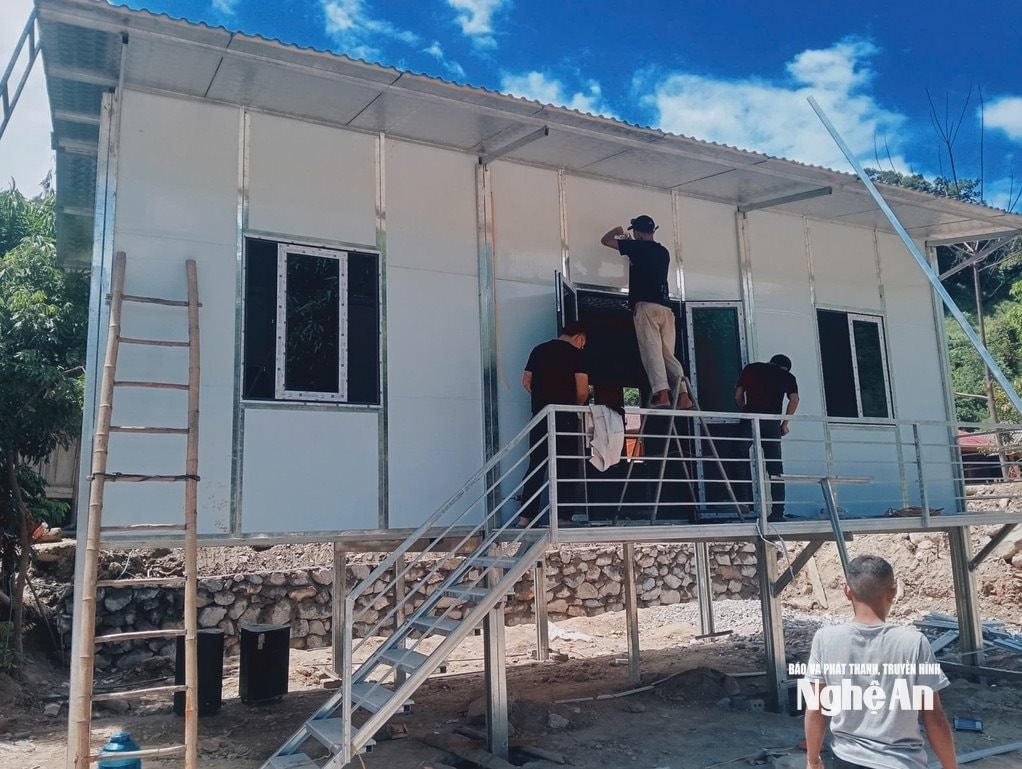
In particular, a key issue raised during the questioning session concerned the policy of providing support in a mixed manner. Specifically, according to Resolution 09 of the Provincial People's Council, households in landslide-prone areas only receive 250 million VND in support after completing their new houses. This regulation is strict in terms of management but results in a much lower number of households actually accessing the policy compared to their actual needs, especially in the context of people lacking resources after natural disasters.
Therefore, the Standing Vice Chairman of the Provincial People's Council proposed that the Provincial People's Committee study and submit a proposal to amend and supplement Resolution 09/2024/NQ-HĐND to allow for partial advance payments so that people have the means to build houses.
Regarding the voters' petition in the hydropower reservoir area, the comrade requested the Provincial People's Committee to direct the Department of Industry and Trade to continue working with the Ministry of Industry and Trade and the investors of the Khe Bo and Chi Khe hydropower projects to clarify the responsibility for compensation for damages in areas where flooding exceeded the design level, and to promptly disburse payments and provide answers to the people.


