
The era of "give and take" in agricultural investment is over.
The wave of businesses investing in agriculture and rural areas has contributed to boosting the sector's growth to its highest level in the last seven years. With many preferential policies, the number of businesses investing in agriculture will certainly increase significantly...
The number has increased dramatically.
According to a report by the Ministry of Agriculture and Rural Development, the number of agricultural enterprises has increased sharply in recent years (from 2,397 enterprises in 2007 to 7,033 enterprises in 2017, a 2.93-fold increase), with a total capital of VND 213,394.9 billion. By the end of 2018, more than 8,000 enterprises had invested in the sector. Many enterprises have become the core of the agricultural value chain and high-tech agricultural production, developing the market.
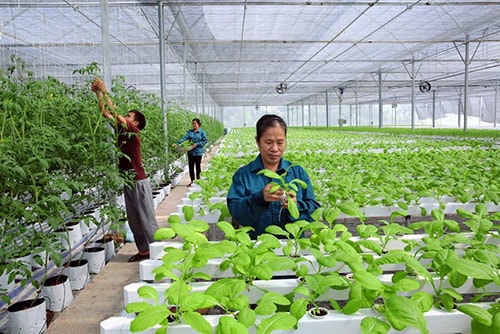
Vegetable and fruit production using the peeling technology at a business in Thanh Tri district, Hanoi. Photo: Ba Hoat.
It is noteworthy that many large corporations have recognized the enormous potential of agriculture and boldly explored new directions, especially in the field of high-tech applications, such as TH True Milk and VinEco (VinGroup),...
"Clearly, the opportunities for businesses to invest in agriculture and rural areas are immense. The number of businesses has increased sharply in recent years, especially in 2018 when 16 more businesses invested in the fruit processing sector with a total value of 8,700 billion VND, showing that the agricultural sector has great potential."
Dr. Nguyen Do Anh Tuan
Speaking at the 2019 Forum on Businesses Accompanying Agriculture, Farmers, and Rural Areas, Deputy Minister of Agriculture and Rural Development Hoang Van Thang affirmed that, in order to create a favorable and equal environment for investors in agriculture and rural areas, many preferential investment policies and mechanisms have been issued.
For example, regarding investment and business conditions, the Ministry of Agriculture and Rural Development has drastically reduced regulations, implemented online public administrative services at level 4, and reduced the list of goods subject to specialized inspection before customs clearance by nearly 80% in the past year. In particular, Decree No. 57/2018 on mechanisms and policies to encourage businesses to invest in agriculture and rural areas has opened up many opportunities for businesses with flexible regulations such as exemption from land use conversion fees for land used to build housing for workers at the project, and exemption from land use fees for that land after conversion.
Capital and land – two bottlenecks that need to be addressed.
In fact, localities now have mechanisms and policies to attract businesses to invest. Dr. Nguyen Do Anh Tuan - Director of the Institute of Agricultural and Rural Development Policy and Strategy (Ministry of Agriculture and Rural Development) shared that, in a discussion with the leaders of Binh Dinh province, Mr. Phan Trong Ho - Director of the Department of Agriculture and Rural Development of Binh Dinh province, frankly stated that there is no longer a "request-and-grant" mechanism for businesses, and localities must find every way to invite businesses to invest.
However, according to representatives from many businesses, despite new policies and mechanisms, businesses still face many difficulties that need to be addressed when investing in agriculture, especially in accessing credit and land consolidation.
Responding to the businesses' recommendations, Mr. Ngo Minh Cuong, Deputy Director of the Department of Enterprise Development (Ministry of Planning and Investment), affirmed that the Government has directed the continued improvement of policies and mechanisms to attract businesses to invest in agriculture and rural areas. This includes strengthening support measures, facilitating capital flows, resolving land-related issues, and creating conditions for businesses to participate in trade promotion activities.
"Vietnam is being assessed as a country with potential for innovative startups, especially in the agricultural sector. Therefore, in the coming time, startups will also receive a lot of attention," Mr. Cuong affirmed.


