
Community formation - a qualitative new development for ASEAN.
(Baonghean.vn) - Today, December 31, 2015, the ASEAN Community was officially formed with the Kuala Lumpur Declaration signed on November 22, 2015, at the 27th ASEAN Summit.
This event marks a significant milestone in the development of the Association of Southeast Asian Nations after nearly 50 years of formation and development, resulting from the efforts of all members in implementing the roadmap for building the ASEAN Community (2009-2015), marking a strategic transformation and the beginning of a new, higher-level phase of development for ASEAN: from an Association to a Community of Nations.
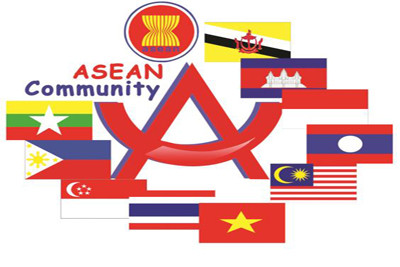 |
| The ASEAN Community was officially formed on December 31, 2015. |
What is the ASEAN Community?
Structurally, the ASEAN Community is an intergovernmental cooperative organization with sovereign equality among its member states; decision-making is based on the principle of consensus and agreement. The legal basis of the ASEAN Community is the ASEAN Charter, signed in 2007 and effective from December 2008.
The ASEAN Coordinating Committee (AC) is organized on the basis of the ASEAN Charter with the following bodies: the ASEAN Summit (the highest authority); the ASEAN Coordinating Council (ACC) (comprising the ASEAN Foreign Ministers); the ASEAN Community Councils; the Committee of Permanent Representatives of ASEAN (CPR); the ASEAN Secretary-General and Secretariat; and the National ASEAN Secretariat (located within the Ministry of Foreign Affairs of the member states).
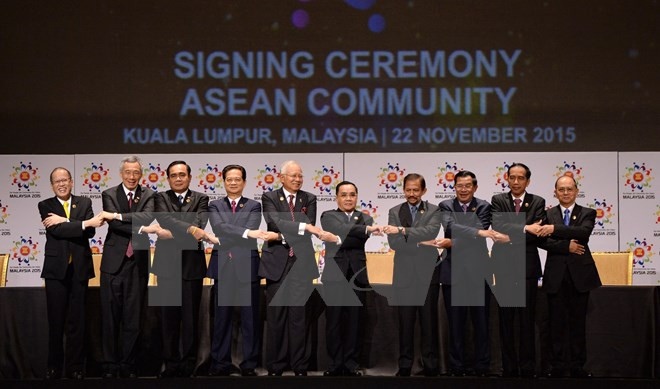 |
| ASEAN leaders participate in signing the "Kuala Lumpur Declaration" establishing the ASEAN Community. (Source: THX/VNA) |
In terms of cooperation content, the ASEAN Community engages in comprehensive and in-depth cooperation across many fields, revolving around three pillars: the ASEAN Political-Security Community (APSC), the ASEAN Economic Community (AEC), and the ASEAN Socio-Cultural Community (ASCC).
The APSC pillar is a community that operates according to shared values and norms; is cohesive, peaceful, and self-reliant, and is responsible for ensuring comprehensive security; at the same time, it is also a dynamic community ready to expand cooperative relations with friendly countries and partners.
In addition to the ASEAN Charter, the APSC operates on the basis of the Association's existing mechanisms and tools for political and security cooperation, which are normative institutions in ASEAN's regional conduct, such as: the Treaty of Friendship and Cooperation in Southeast Asia (TAC), the Southeast Asia Nuclear Weapon-Free Zone Treaty (SEANWFZ), the Declaration on the Conduct of Parties in the South China Sea (DOC), the East Asia Summit (EAS) Declaration on the Principles of Mutually Beneficial Relations in the Region…
The AEC pillar is a regional economic integration process with 4 objectives: (1) A common market and unified production base where goods, services, investment and labor move freely; (2) A stable, prosperous and highly competitive ASEAN economic region; (3) Balanced economic development and (4) Integration into the global economy.
To achieve those four objectives, the AEC has been, is, and will continue to implement solutions such as: removing tariffs and non-tariff barriers; facilitating trade, harmonizing product standards (conformance) and regulations; expediting customs and import/export procedures; finalizing rules of origin, facilitating services and investment, and strengthening the development of the ASEAN capital market.
Contributing to the goals and measures of the AEC are a series of Agreements, Treaties, and Declarations between ASEAN countries and between ASEAN and its partners, among which the three most important agreements are: the ASEAN Trade in Goods Agreement (ATIGA); the ASEAN Framework Agreement on Services (AFAS); and the ASEAN Comprehensive Investment Agreement (ACIA).
With a market of over 600 million people and a GDP of approximately $2,500, the AEC promises to become an increasingly dynamic and developing economic region.
The ASCC pillar is a socio-cultural cooperation framework that focuses on ensuring and promoting equality, social justice, social security, sustainable development, and fostering a sense of community. ASCC is people-centered, aiming to build a shared identity and improve the living standards and well-being of its citizens.
Affirming its central role in regional structures
With the implementation of the contents of the 2015 ASEAN Community Building Roadmap, ASEAN is increasingly promoting and affirming its central role in regional structures.
ASEAN is a leading factor in ensuring peace, cooperation, and development in Southeast Asia, and an indispensable partner of all major countries and international organizations. This role will be further strengthened when the ASEAN Community is officially formed and operates as a complete entity encompassing political-security, economic, and socio-cultural aspects.
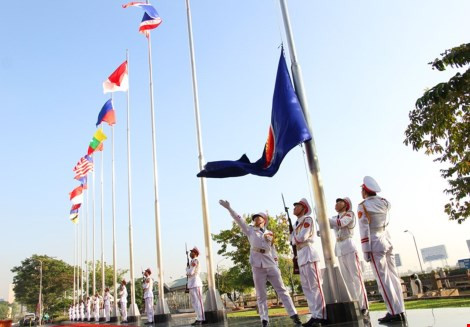 |
| ASEAN flag-raising ceremony on the occasion of the establishment of the ASEAN Community. Photo: Ho Chi Minh City Law Newspaper. |
In addition to intra-ASEAN cooperation, cooperation between ASEAN and its partners is extremely vibrant, through frameworks such as: the ASEAN+3 Summit (comprising the 10 ASEAN countries and China, Japan, and South Korea); the East Asia Summit (EAS: comprising ASEAN+3 and the United States, India, Australia, New Zealand, and Russia); the ASEAN+1 Summit with individual partners such as China, South Korea, Japan, the United States, India, and the United Nations...
Against the backdrop of major powers adjusting their strategies toward the Asia-Pacific region, with Southeast Asia at its center, ASEAN has become one of the most vibrant regional forums globally in recent years. Each of its conferences, whether at the ministerial or summit level, attracts the participation of most representatives from dialogue partners, demonstrating deep and practical interest.
With 11 dialogue partners, including 7 strategic partners (China, Japan, South Korea, India, New Zealand, Australia, and the United States), 4 comprehensive partners (Russia, the EU, Canada, and the United Nations), and 83 countries appointing ambassadors to ASEAN, the ASEAN Community has become one of the most successful regional cooperation organizations today.
Bao Ngan
| RELATED NEWS |
|---|


