
'Miss Ky Duyen has sparked an interesting controversy'
Media crisis management expert Le Ngoc Son said he witnessed an interesting debate about Vietnamese people's reading habits, seen through the case of Miss Nguyen Cao Ky Duyen.

Miss Nguyen Cao Ky Duyen's hesitant and confused answer about books in episode 2 of Miss Universe Vietnam has sparked an ongoing and inconclusive debate on social media forums for several days.
Amidst the criticism, Ky Duyen still received support and sympathy from many social media accounts. Many opinions suggested that reading is just a personal hobby and shouldn't be judged. To add weight to their comments, those defending Ky Duyen asserted that they themselves don't read books but are still successful. They also argued that there are many ways to acquire knowledge, not just through reading, especially in today's busy life.
Speaking to a reporter from Lao Dong newspaper on this topic, crisis management expert Le Ngoc Son - President of Berlin Crisis Solutions (BCS) in Germany - said: “Perhaps we should thank Miss Ky Duyen for initiating a very interesting debate about the reading habits of Vietnamese people. I believe that the opinions on reading reveal many perspectives on how Vietnamese people read, gather information, and consume information.”
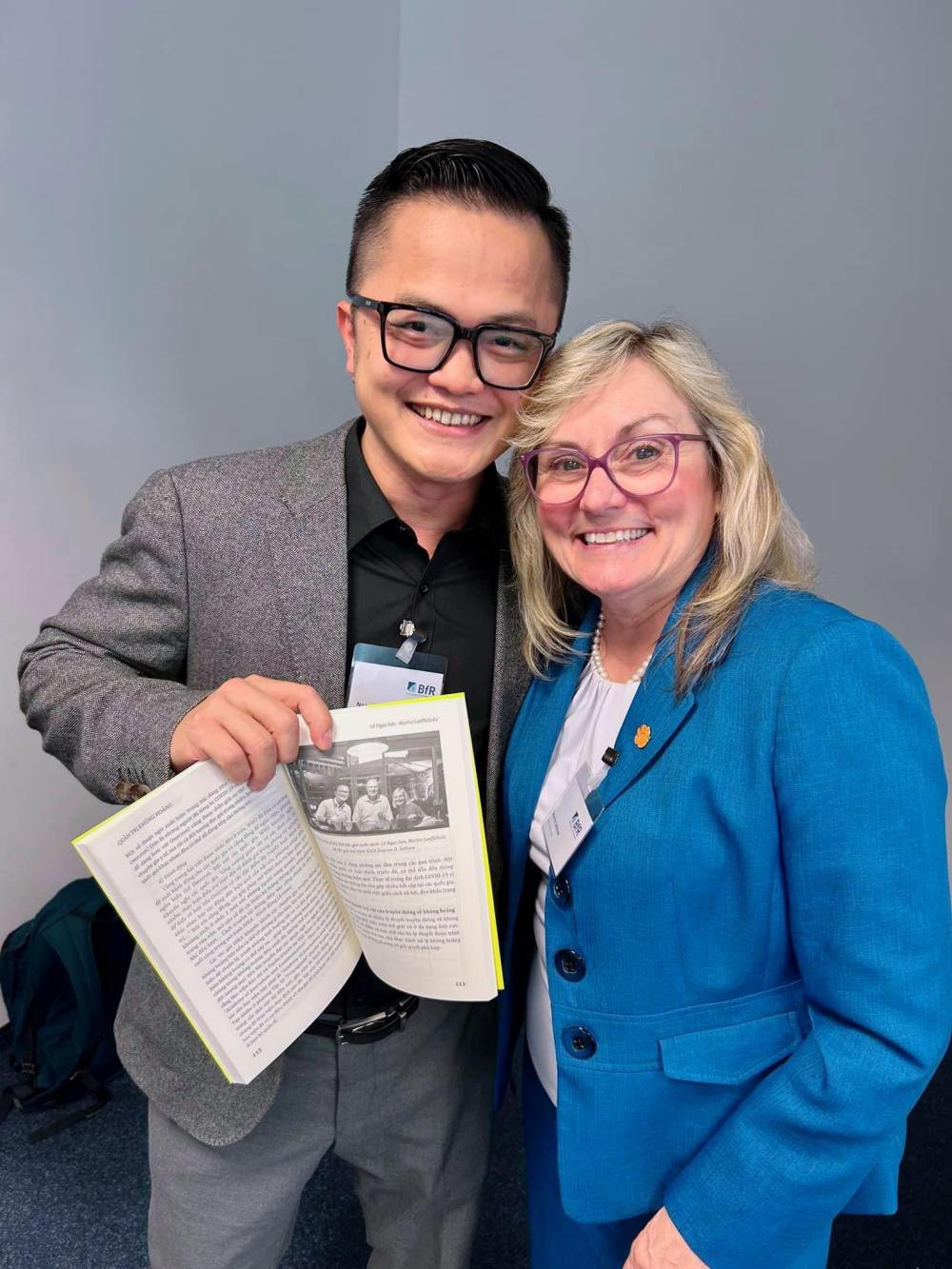
"Gaining knowledge from reading is different from all other means."
Crisis management expert Le Ngoc Son agrees that, with the rapid development of science and technology and the explosion of various forms of audiovisual media, everyone now has many different ways to access information and knowledge, and reading books is not necessarily required.
"However, reading books remains a distinct approach to knowledge, incomparable to other forms. Books are a scientifically organized and systematized collection of human data and knowledge. In books, knowledge is more than just information; it's refined and systematic. Other forms, such as social media or other communication channels, contain more information than knowledge and lack systematic organization."
The nature of reading books and acquiring knowledge from other channels is very different. Reading books is about reflection, about discovering new knowledge from an existing foundation. When you receive information from other channels, you may receive and consume a larger amount of information, but I can't guarantee the amount of knowledge you gain from it. In contrast, with reading books, the amount of knowledge gained will be many times higher," the expert said.
According to Mr. Ngoc Son, looking at the debate about reading, it's clear that many people are confusing reading with other methods of acquiring knowledge. Even with technological advancements and the emergence of new book formats such as audiobooks and ebooks, experts still highly value the role of traditional printed books.
"In my opinion, reading is a process of contemplation, reflection, and deliberation to understand, accumulate, and connect the knowledge acquired. Therefore, reading cannot be rushed or hurried; it requires concentration and tranquility. For me, traditional reading still holds irreplaceable value. And the benefits of reading are undeniable," said Le Ngoc Son.

"Many Vietnamese people prefer arguing online to spending time reading books."
Observing the debate surrounding reading over the past few days, a crisis management expert believes that it clearly reflects the reading habits and styles of Vietnamese people.
“I live in Germany. Here, you can find people of all ages, from the elderly to young children, quietly reading books in subway stations or airports while waiting for or on trains. When I returned to Vietnam, I observed that most people in these same spaces were scrolling on their phones. It's like two different lives in the same space.”
"I'm not surprised that many Vietnamese people are willing to spend hours arguing and quarreling on social media about books, instead of dedicating that time to reading," the expert said.
Many Vietnamese people are prioritizing information consumption over knowledge. To raise awareness of the role and significance of reading, experts say that simply shouting slogans and appeals is insufficient. “It’s like trying to get a large group to sail to an island; just saying ‘sail the boat’ will be difficult. It’s more effective if you show them the island, the stunning scenery, the valuable treasures it holds… People will naturally sail there. Reading is the same; it must awaken in each person a love for discovering knowledge, a desire to excel, and a passion for new things… Reading must be a self-driven need, not something to be forced. This need needs to be nurtured from the family to the school from a young age,” the expert stated.


