
Dazzled by lucky money envelopes featuring monkeys.
Despite regulations imposing fines of 20-40 million VND, many places still openly sell small denomination banknotes.
As Tet (Lunar New Year) approaches, the services of buying and selling small denominations of money, exchanging new banknotes, and trading unusual coins featuring monkeys become increasingly active, both online and in stores. The fees for exchanging small denominations are skyrocketing.
Gold-plated USD bills worth tens of millions of VND.
According to our survey, after the US central bank decided to print a 2 USD bill featuring a monkey, these bills are being sold everywhere for prices as high as 450,000-600,000 VND. Similarly, 1 USD bills are also being sold at exorbitant prices: 300,000 VND.
Currently, there are quite a few websites advertising currency exchange, especially for small denomination USD bills, with slogans like "Exchange 1 dollar, 2 dollar bills with lucky serial numbers, bringing good fortune and wealth…".
To convince customers, the owner of a website selling lucky money envelopes claimed that the $2 bill would bring good luck, happiness, and prosperity to whoever kept it. "Similarly, the $1 bill also brings miracles to whoever buys it," the website owner advertised.
Especially for the upcoming New Year's gift, thickly plated 100 USD bills, wrapped in 9999 gold and placed on trays, are being sold online for tens of millions of Vietnamese dong. Despite the exorbitant price, many people are still seeking to buy them.
Not only the US, but Indonesia also printed low-denomination banknotes featuring a monkey this year, and these are being sold for 25,000 VND. Similarly, small-denomination Australian banknotes with a monkey image are also being sold at a relatively high price. However, these banknotes are not as attractive to buyers as the US dollar.
Alongside the sale of foreign currency, many places are also selling gold-plated and silver-plated coins featuring monkey images, priced from 200,000 VND to 3 million VND per coin.
Meanwhile, Vietnamese dong banknotes with serial numbers such as birth year, auspicious numbers (1234, 4567...), lucky numbers, or numbers with three, four, or six identical digits are also being actively traded on the "black market." Also appearing on the "black market" are the old 10,000 dong banknotes (pink ones), being offered for 30,000 dong each.
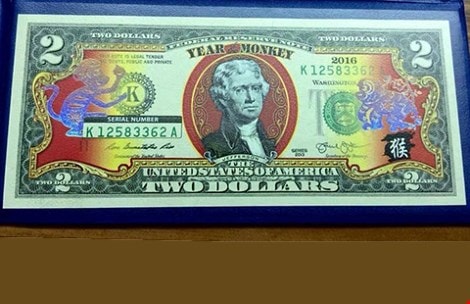 |
| Two-dollar bills featuring a monkey, presented in a leather box, are being offered for sale at 450,000 VND per bill. |
The demand for exchanging small denominations of money is increasing day by day.
Besides buying and selling coins believed to bring good luck, the service of exchanging small denominations of money is also booming.
Many websites openly advertise the exchange of small denominations of currency. For example, a 500,000 VND note is exchanged at a rate of 10 for 7, meaning 10 million VND is exchanged for 7 million VND or slightly less. For notes of 1,000 VND or more, the rate is 10 for 9.
At some exchange points in the market, the fees charged are as follows: 100,000 old banknotes will be exchanged for 80,000 new banknotes; or 100,000 old banknotes will be exchanged for 50,000 new banknotes in 500-dong denominations. In many places, the fee for exchanging new banknotes in consecutive series can reach 70%-80%.
"You have to order early to get your money because the closer it gets to Tet, the higher the exchange rate for smaller denominations and the harder it is to get," a money exchange service provider warned.
At a recent press conference, the State Bank of Vietnam (SBV) announced that it will continue to use small-denomination banknotes rationally and economically during the Lunar New Year. Specifically, this year, only used banknotes (5,000 VND and below) will be put into circulation, as in the previous three years. Based on the amount of used banknotes currently stored in warehouses, the SBV will transfer them to relevant units for distribution, ensuring sufficient cash supply during the Lunar New Year.
The State Bank of Vietnam also requested commercial banks and bank branches to continue strictly meeting the demand for small-denomination banknotes, and not to put newly printed banknotes of 5,000 VND or less into circulation if there is still inventory, only when banknotes that have already been in circulation are available to meet the payment needs of the people.
However, in a conversation with a commercial bank employee on Le Van Sy Street, District 3, Ho Chi Minh City, regarding exchanging small denominations, it was learned that exchanging 10,000 dong notes is possible and free of charge. However, they will have both new and old notes. As for denominations of 500 dong and below, banks all refused because the State Bank of Vietnam no longer prints small denomination notes.
The State Bank of Vietnam explains that the misuse of small-denomination banknotes causes significant waste for society in terms of printing, issuance, counting, sorting, transportation, and storage.
Heavy penalties
In reality, even though the State Bank of Vietnam did not print more small denomination banknotes during Tet, a large amount of money was still being offered for sale in the "black market" and online.
In a discussion with us about this situation, Mr. Nguyen Hoang Minh, Deputy Director of the State Bank of Vietnam's Ho Chi Minh City Branch, said that according to Government Decree 96/2014, if discovered by authorities, those exchanging small denominations of money to profit from the difference in exchange rates illegally will be fined 20-40 million VND.
The State Bank of Vietnam (SBV) stated that to curb the widespread and inappropriate use of small denomination banknotes at temples, festivals, and other locations, it will coordinate with relevant agencies to address the issue.
At the same time, if necessary, inter-agency inspection teams will be established to inspect and strictly handle cases of illegal trading of small-denomination banknotes that negatively affect the monetary circulation, culture, and image of the Vietnamese currency.
Savings of approximately 1,500 billion VND. According to the State Bank of Vietnam (SBV), the decision not to issue new banknotes of small denominations over the past four years has saved the state budget approximately 1,500 billion VND. This saving includes costs for printing, transportation, packaging, sorting, and counting. Specifically, in 2014, not printing new banknotes under 2,000 VND saved over 340 billion VND. In 2015, not printing new banknotes under 5,000 VND saved 580 billion VND, and in 2016, not printing banknotes under 5,000 VND saved 416 billion VND. According to our research, some countries (such as Singapore) encourage people to use old banknotes as lucky money during the Lunar New Year to avoid waste and protect the environment. |
According to PLO


