
More than 100 Chinese DF-31 ICBMs have been loaded into launch silos.
A draft Pentagon report indicates that China has loaded more than 100 DF-31 intercontinental ballistic missiles into three new launch silos near the Mongolian border, amid US efforts to push for a trilateral nuclear treaty with Russia and China.
A draft Pentagon report indicates that China has loaded more than 100 intercontinental ballistic missiles (ICBMs) into newly constructed fixed launch silos near the Mongolian border. This move comes as the U.S. pushes for a trilateral nuclear arms reduction framework with Russia and China, but what is happening on the ground shows that the arms control process is becoming increasingly complex.
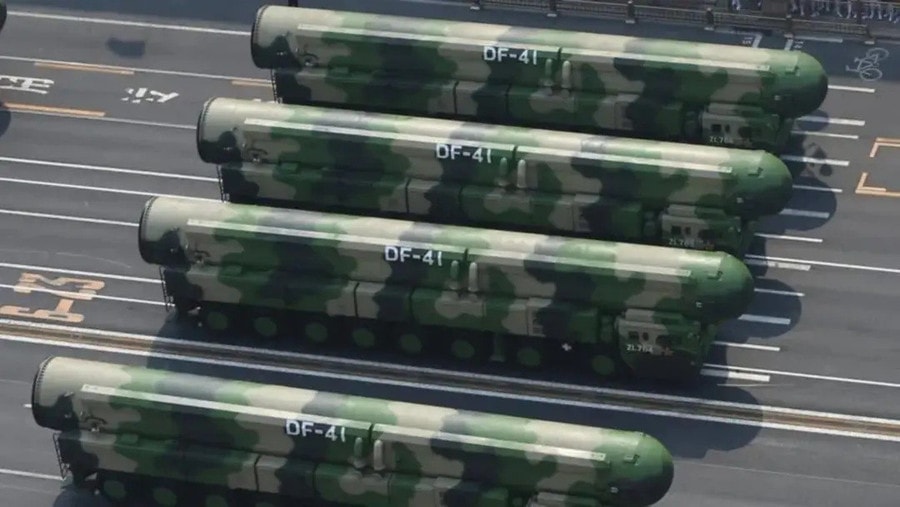
China has loaded more than 100 ICBMs into three new launch silo clusters.
According to the draft report, more than 100 ICBMs have been loaded into three newly constructed launch silos near the Mongolian border. The US had previously noted silo excavation and construction activity, but only now has information emerged about the loading of missiles into these structures.
The report states that these are DF-31 solid-fuel missiles. Compared to the phase of simply constructing launch silos, the deployment of these specific missiles represents a new step forward in perfecting intercontinental nuclear deterrence capabilities on the ground.
Fixed-trailer clusters with large numbers of missiles are often a crucial component of strategic deterrence forces. When more than 100 ICBMs are loaded, the scale of deployment in these areas becomes a significant factor in assessing the global nuclear balance of power.
The transition from infrastructure development to DF-31 deployment.
In the early stages, information from the US primarily focused on China digging and constructing new launch silos. Images and assessments at the time indicated incomplete infrastructure and no signs of missile deployment.
The fact that this draft Pentagon report directly mentions loaded DF-31 solid-fuel missiles is a significant difference. This indicates that the process from construction to deployment of launch vehicles has entered a new phase, with a higher level of strategic readiness compared to when the launch silos were empty.
However, the draft report does not detail the operational configuration, the number of silos relative to the number of missiles, or the specific operating procedures at these three launch silo clusters. Further technical assessments therefore depend on information that will be released or confirmed in the future.
The context of efforts to build a trilateral nuclear treaty.
Information about DF-31 ICBMs being loaded into launch silos emerged as US President Donald Trump pushed for a trilateral nuclear arms reduction agreement involving the US, Russia, and China. The goal is to expand the arms control framework that currently mainly binds the US and Russia.
The Strategic Arms Reduction Treaty (New START), signed by the US and Russia in 2010, limits each side to 1,550 nuclear warheads on 700 deployed systems. The treaty was extended for another five years in February 2021, but the current text does not allow for further extensions after its expiration.
This means that, after New START ends, the two largest nuclear powers will no longer have a binding bilateral treaty of equal standing, forcing the US to seek a new agreement. According to reports, President Trump wants this new framework to be trilateral, including China.
Opposing positions on arms control and nuclear arsenal modernization.
The report suggests that recent moves from Beijing indicate China's unwillingness to participate in comprehensive arms control measures. The loading of over 100 ICBMs into new launch silos is cited as an example, accompanying accusations about the rapid pace of modernization of its nuclear arsenal.
Meanwhile, China denies these allegations. Beijing maintains that its nuclear forces are maintained at the minimum level necessary for national security and reiterates its "no first use" policy. These two contrasting interpretations reflect significant differences in how the parties perceive the role and scale of China's nuclear forces.
The report also mentions the US considering resuming nuclear testing. This factor, along with China's modernization and the inability to extend New START indefinitely, adds further complexity to the global arms control landscape.
The risk of strategic imbalance among the three nuclear powers.
If a new agreement is not reached after New START expires, the U.S., Russia, and China risk falling into an imbalance and insecurity, according to the report's assessment. The expansion or modernization of forces by any side, without a transparent and binding mechanism, could easily increase strategic suspicion.
In this context, China's deployment of more than 100 ICBMs in new launch silos is not just an isolated technical development, but also impacts the calculations of all three nuclear powers. Every step in the deployment, testing, or upgrading of nuclear weapons could affect the ability to achieve a new arms control framework.
From a military-technical perspective, the figures mentioned in the Pentagon's draft report indicate that China is moving from infrastructure development to the actual deployment of ICBMs at fixed locations. This development, combined with differences in arms control stances, will continue to be a key factor in any assessment of strategic stability between the U.S., Russia, and China in the coming period. (According to IE.)


