
Latest guide on writing a self-assessment report for probationary Party members.
After 12 months, probationary Party members must write a self-assessment report to be considered for full membership. Below is a sample self-assessment report for probationary Party members according to Guidance 38-HD/BTCTW, along with clear and easy-to-follow instructions on how to write it.
Regulations regarding self-assessment reports for probationary Party members.
According to Clause 1, Article 5 of the Party Charter:
Those admitted to the Party must undergo a twelve-month probationary period, starting from the date the Party branch holds the admission ceremony. During this probationary period, the Party branch continues to educate and train them, and assigns full Party members to help them progress.
Therefore, before being considered for full Party membership, probationary individuals must complete 12 months of training under the support of the Party branch and full Party members.
Clause 4.2, Article 4 of Guidance Document No. 06-HD/TWIt also clearly states that one of the mandatory documents when considering the recognition of a full Party member is a self-assessment report. The regulations stipulate the following:
Twelve months after the date of admission by the Party branch, probationary Party members write a self-assessment report outlining their strengths and weaknesses in fulfilling their duties as Party members, and proposing measures to overcome shortcomings and deficiencies; they then request the Party branch to consider and recognize them as full Party members.
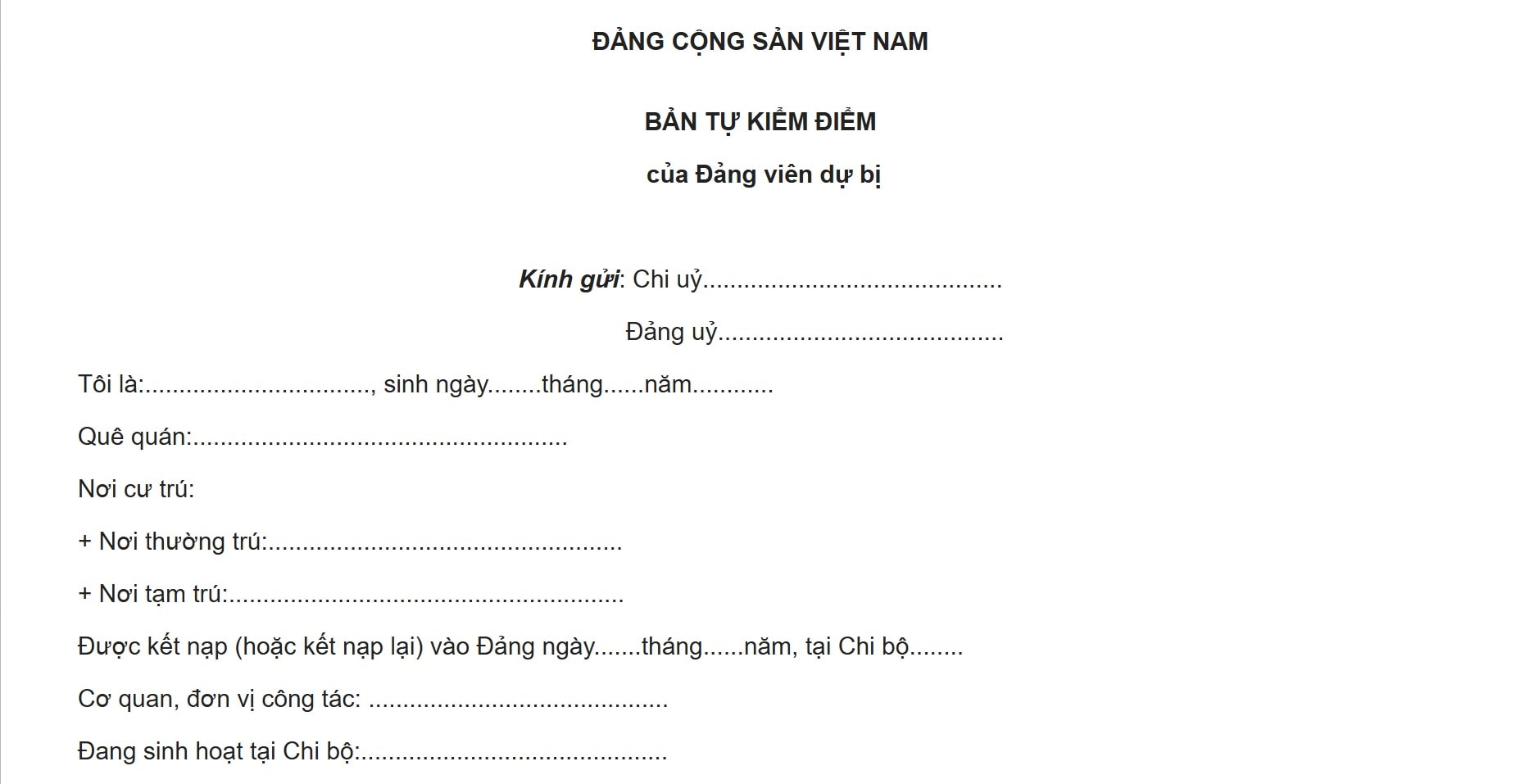
Sample self-assessment form for probationary Party members according to Guidance 38-HD/BTCTW
Download the sample self-assessment form for probationary Party members.Instruction 38-HD/BTCTW
COMMUNIST PARTY OF VIETNAM
SELF-ASSESSMENT REPORT
of probationary party members
Dear Sir/MadamParty Committee
Party Committee..........................................
My name is:................................., born on........day......month......year............
Place of origin:.......................................................
Place of residence:
+ Place of permanent residence:....................................................
+ Temporary residence:..........................................................
Admitted (or re-admitted) to the Party on .......day......month......year, at the Party Branch........
Workplace/Organization: ............................................
Currently a member of the Party Branch:.............................................
Based on the standards for Party members, and my process of self-cultivation, training, and striving to fulfill my duties as a Party member, I conduct the following self-assessment:
Advantage:.......................................................
.........................................................................
Defect:..................................................
...........................................................................
Remedial measures for the shortcomings:................................
......................................................................................
I believe I meet the eligibility requirements to become a full party member. I request that the Party Branch consider my application and report it to the higher-level Party Committee for a decision on my recognition as a full party member.
I promise to always strive to fulfill my duties as a Party member well, and to be worthy of being a good Party member.
......, date …… month …… year ……
SELF-INSPIRED PERSON
(Signature, printed name)
Instructions for probationary Party members on writing self-criticism reports.
Based on the self-assessment template, probationary Party members should focus on three key areas: strengths, weaknesses, and corrective measures. A clear and honest presentation helps the Party branch accurately assess their training process.
1. Advantages of the preparatory process
In the section on advantages, the writer should highlight the positive achievements made during the 12 months of training. Some content that could be included includes:
Probationary Party members always have faith in the Party's leadership and maintain a firm political stance. They fully comply with the Party's guidelines, viewpoints, and policies, as well as the State's laws and regulations. In addition to fulfilling their duties, probationary Party members also encourage their families and neighbors to abide by the law, contributing to maintaining social order.
During their training, trainees continuously study and strive to follow the ideology, ethics, and style of Ho Chi Minh; maintain a healthy lifestyle, and promote solidarity and support among comrades and colleagues. At the same time, fulfilling assigned tasks and striving to improve their professional skills and expertise are also important points to mention in this section.
2. Weaknesses to identify
Besides their strengths, probationary Party members must assess their existing shortcomings. Some common weaknesses include:
The large workload and complex nature of the tasks sometimes lead to errors in the execution process. Probationary Party members often lack the courage to express their opinions, offer criticism, or engage in self-criticism during branch or unit meetings.
Clear self-assessment helps the Party branch review the efforts, proactive attitude, and self-improvement spirit of the probationary member.
3. Measures to correct shortcomings
This section should outline specific solutions to overcome the limitations described above. A probationary party member might mention:
I will continue to practice to confidently present my opinions in meetings and enhance my proactiveness in the overall work of the agency. At the same time, I will continue to learn and improve my expertise to minimize avoidable mistakes in my assigned tasks.
Practical and feasible solutions will demonstrate a proactive spirit and a willingness to improve oneself before being considered for official recognition.


