
iPhone Duo priced at $2,000: Hardware trade-offs that will make users think twice.
Despite expectations of a breakthrough, the $2,000 iPhone Duo revealed several limitations in terms of battery life, camera, and multitasking capabilities compared to its competitors on the market.
The iPhone Duo is currently the focus of attention in the tech world, marking Apple's first foray into the foldable smartphone segment. With its premium design and strong brand appeal, this model is predicted to generate a massive wave of purchases upon its release. However, its starting price of around $2,000, along with numerous trade-offs in both hardware and software, raises serious questions about the device's practicality.
The hardware has to make many compromises because of the folding structure.
The iPhone Duo's price tag of around $2,000 is significantly higher than the $1,199 price tag of the iPhone 18 Pro. Despite the higher price, the device is said to have sacrificed several key hardware components. Specifically, it features a smaller battery, a downgraded camera system, and the absence of Face ID facial recognition technology.
The complexity of the folding mechanism is a technical hurdle that makes it very difficult to fit all the high-end components into a slim and compact body. Compared to foldable screen competitors from Samsung, Apple's model is noted to be significantly thicker and heavier. This directly impacts the one-handed grip experience over extended periods.
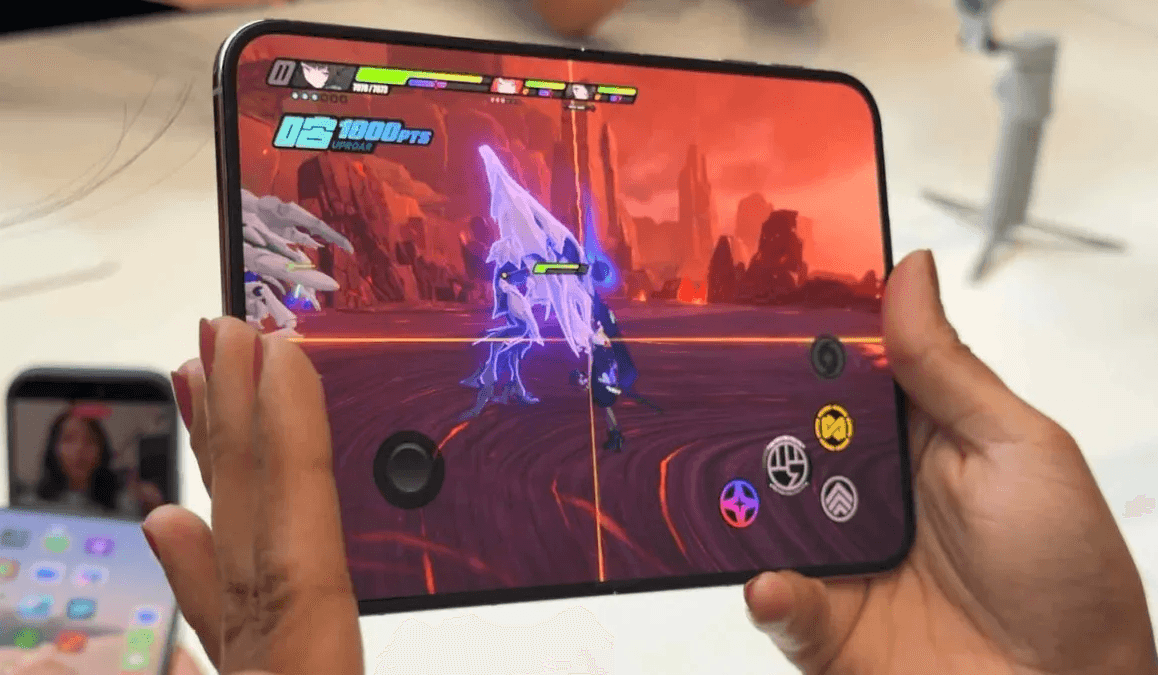
Furthermore, the power solution also raises significant questions. While Android competitors have adopted silicon-carbon batteries to increase storage density without increasing the device's thickness, Apple has yet to implement this technology. This means the iPhone Duo's battery life may be shortened, forcing users to charge it more frequently. Although the screen has a matte finish to minimize attention to the crease, this mark is still physically present on the panel.
The software boundary between phones and tablets.
Not only the hardware, but the software experience on the iPhone Duo also raises many concerns. The operating system is said to only support a maximum of two applications running simultaneously. For comparison, many competing foldable smartphones allow displaying three applications at the same time, combined with flexible floating windows.
| Evaluation criteria | iPhone Duo (Expectations) | Android foldable screen rivals |
|---|---|---|
| Starting price | Approximately $2,000 | More competitive or equivalent |
| Multitasking applications | Up to 2 applications running simultaneously. | 3 applications that combine floating windows |
| Battery technology | Traditional batteries | High-density silicon-carbon batteries |
| Biometric security | No Face ID | Side/in-display fingerprint sensor |
This limitation stems from Apple's product segmentation strategy. Although the Duo's display area is comparable to the iPad mini when expanded, the company still wants to position it as a phone to avoid encroaching on the tablet market. Furthermore, the unique and appealing startup animations of the Duo have already been successfully tested on the Galaxy Z Fold 8, diminishing the device's exclusivity.
Challenges related to durability and pressure of expectations.
Durability is a top priority for Apple, with the iPhone Duo expected to meet the IP68 water resistance standard. However, water resistance cannot guarantee the mechanical longevity of the hinge and screen after years of continuous opening and closing. Deep creases over time remain a risk on all foldable devices.
Apple traditionally enters the market late to perfect its technology after competitors have tested the risks. However, waiting nearly a decade means the iPhone Duo carries enormous expectations. At a price of $2,000, any compromises in camera quality or handling experience would face intense scrutiny from consumers.


