
Discover the ancient fir tree population in Western Nghe An Province.
(Baonghean) - I had heard that along the Vietnam-Laos border, in the Pu Hoat Nature Reserve, there were hundreds-year-old oil palm trees. But I didn't imagine there would be entire clusters of these magnificent, gigantic ancient oil palm trees there.
Mountain and forest symbol
From Phu Phuong intersection, it takes 1 hour by car to reach the ancient Thai village of Hua Muong (belonging to Hanh Dich commune, Que Phong district), and then another 6 hours of walking and climbing uphill to reach the border area between Vietnam and Laos.
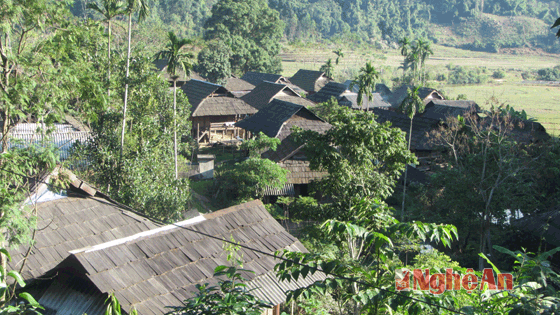 |
| The ancient Thai village of Hua Muong features houses with roofs made entirely of black fir wood. |
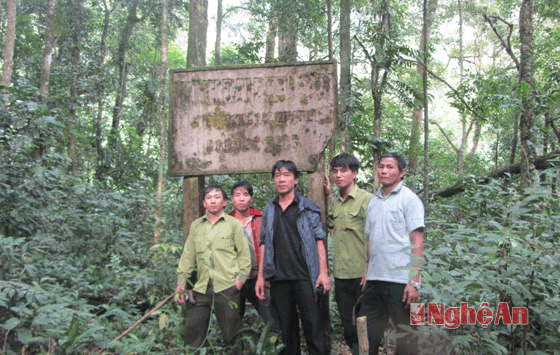 |
| Next to the border sign marking the Vietnam-Laos border. |
We pitched our tents and slept overnight in the forest. The next morning, after another hour of trekking along the mountainside, we finally reached the cluster of ancient oil palm trees. The cold late winter weather, coupled with torrential forest rain, intensified the chill. Yet, the trip was incredibly enjoyable.
From the ancient Thai village of Hua Muong with its closely packed stilt houses roofed with dark black cypress wood, nestled amidst majestic mountains and forests; to the Huoi Dan stream, stretching for tens of kilometers, with its Seven-Tiered Waterfall cascading down a series of uniquely shaped rock formations.
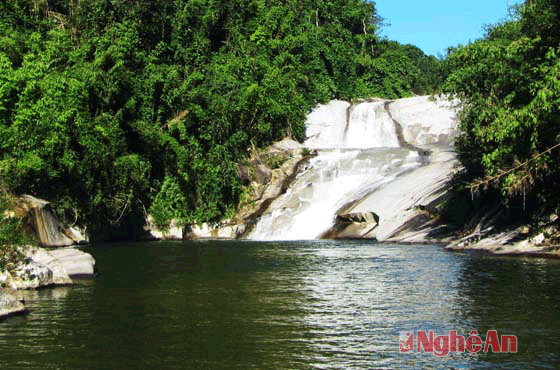 |
| A section of the Seven-Tiered Waterfall on the Huoi Dan stream. |
The forest boasts a diverse ecosystem, from patches of moss and algae in various shades of green clinging to rocks and tree trunks; white, red, orange, and brown mushrooms; countless varieties of orchids and climbing plants; and rows of precious timber trees such as Dipterocarpus, Terminalia catappa, Shorea spp., and Dalbergia spp., reaching tens of meters in height and requiring several people to encircle them.
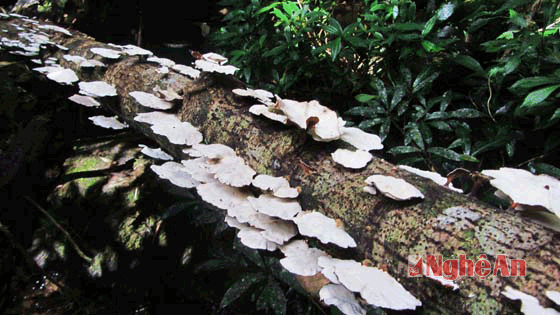 |
| In the Pù Hoạt forest area, there are all kinds of mushrooms. |
Then, upon seeing the enormous cluster of ancient oil palm trees in the Huoi Cham stream area (Sub-area 60), despite being tired and drenched in rainwater, my chest felt like it was about to burst with joy and shout. This is truly majestic nature. The feeling of standing before these towering oil palm trees, reaching 40-50 meters in height and averaging 2-3 meters in diameter, stretching across a vast forest area of over 25 hectares, is indescribable; it makes one feel incredibly small in the face of nature.
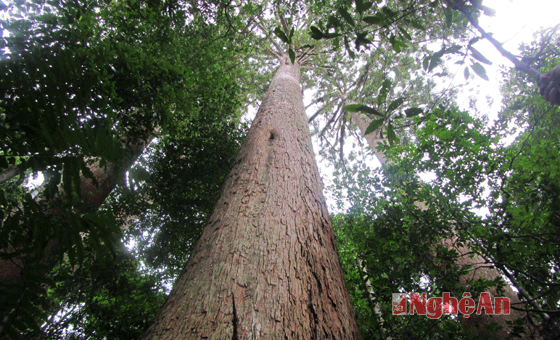 |
| The oil palm trees in Pu Hoat all have a diameter of 2-3 meters. |
Mr. Lo Van Thuong, a local resident and former soldier of the 324th Division (Military Region 4), affirmed that this is a precious tree species closely associated with the life and culture of the people in the Que Phong highlands. Meanwhile, officials of the Pu Hoat Nature Reserve are proud that the oil palm tree is a majestic symbol not only for Pu Hoat but for the entire flora of Vietnam. They are also proud that nowhere else possesses such a population of this precious tree species.
Truly worthy of being called a heritage site!
Within the Pù Hoạt Nature Reserve, the oil palm (Pterocarpus indicus) is found in the Tri Lễ, Nậm Giải, and Hạnh Dịch areas. However, it is most abundant and concentrated in Hạnh Dịch. Three distinct populations have been discovered there, most notably in the Huồi Chạm stream area with 216 trees, concentrated in the high, rugged mountainous border region at an altitude of 1,400-1,800 meters above sea level. Most trees have a diameter of 1.5m-2.5m; notably, there is one giant individual tree with a diameter of 3.7 meters.
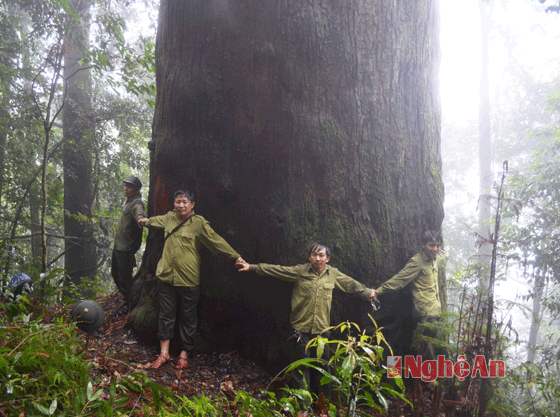 |
| The largest oil palm tree discovered has a diameter of 3.7m. |
The oil cypress, scientifically known as Cunninghamia konishii Hayata, belongs to the cypress family (Cupressaceae). Locally (in Thai), it is called "Long Lenh tree"; in some places, it is also known as "Ngoc Am tree". The oil cypress is a rare species. In Vietnam, its distribution is limited to some high mountain ranges in the North, such as Ha Giang (Tay Con Linh, Du Gia), Thanh Hoa (Pu Hu, Xuan Lien), Son La (Xuan Nha Nature Reserve), and in Nghe An, it is found in Pu Mat, Ky Son, and Pu Hoat.
The world conservation status of the oil palm is assessed as endangered. The national status of the oil palm is that it is a near-extinction species, listed in the List of Rare and Endangered Species prioritized for protection under Decree 160/213/ND-CP.
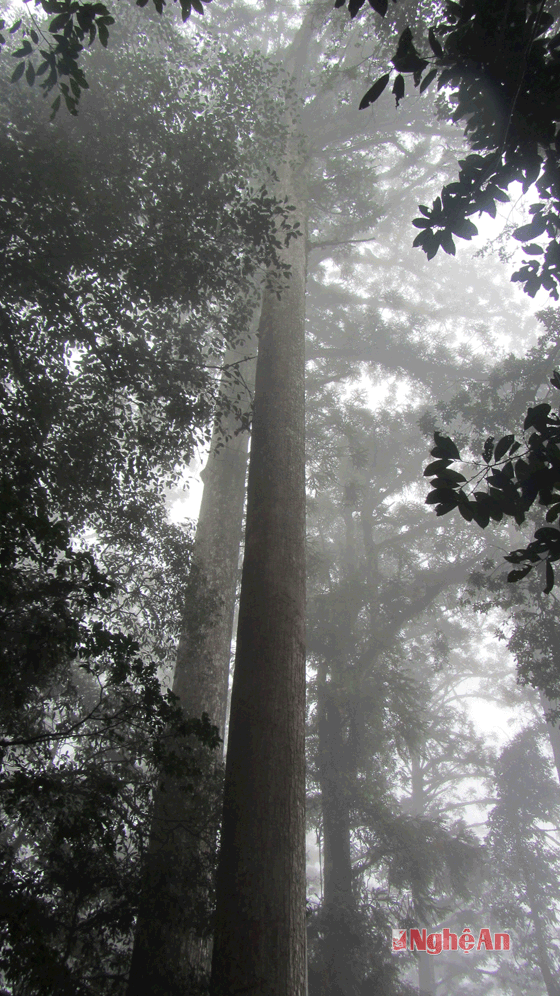 |
| Ancient fir forest in the early morning mist. |
Given the reality of this rare tree species gradually becoming extinct, and in order to preserve the majestic symbol of the mountains and forests, contributing to the conservation of the nation's valuable genetic resources, the Management Board of the Pu Hoat Nature Reserve is currently preparing a dossier to propose the recognition of the fir tree population as a heritage tree population. This is truly a noteworthy idea. Que Phong is famous for Sao Va Waterfall, the Nine-Room Temple, Hua Na Hydroelectric Lake, ancient Thai villages, and Huoi Dan stream with its seven-tiered waterfall; now, ancient fir tree populations have been discovered. If these fir tree populations are recognized as national heritage, it will contribute to unlocking the tourism potential of western Nghe An province.
Nhat Lan
| RELATED NEWS |
|---|


