
Teacher English proficiency assessment: How should it be correctly interpreted?
From Official Letter No. 816/NGCBQLGD-PTNGCB dated May 26, 2026, regarding the organization of English proficiency surveys for general education teachers, what is needed now is not speculation or creating anxiety, but rather to correctly interpret the document, understand the survey's purpose, and place the issue within the context of developing the teaching staff for the new phase.
In recent days, many secondary school teachers nationwide have been paying attention to Official Letter No. 816/NGCBQLGD-PTNGCB dated May 26, 2026, from the Department of Teachers and Educational Management Staff regarding the organization of English proficiency surveys for secondary school teachers.
Immediately after the information was released, various opinions emerged. Some argued that this was a necessary activity to prepare for the goal of making English the second language in schools. Others wondered whether the survey results would be used to evaluate and rank teachers. Some teachers also questioned: If this is an English proficiency survey, why are English teachers not included in the survey?
Those concerns are perfectly understandable. However, before making any judgments or conclusions, it is crucial to carefully read the text and place this survey within the broader context of current educational development.
1. What is the actual purpose of this survey?
According to Official Letter No. 816/NGCBQLGD-PTNGCB, the survey activity was implemented to carry out Plan No. 179/KH-BGDĐT dated February 3, 2026, of the Ministry of Education and Training on surveying English language proficiency and determining training needs for teachers.
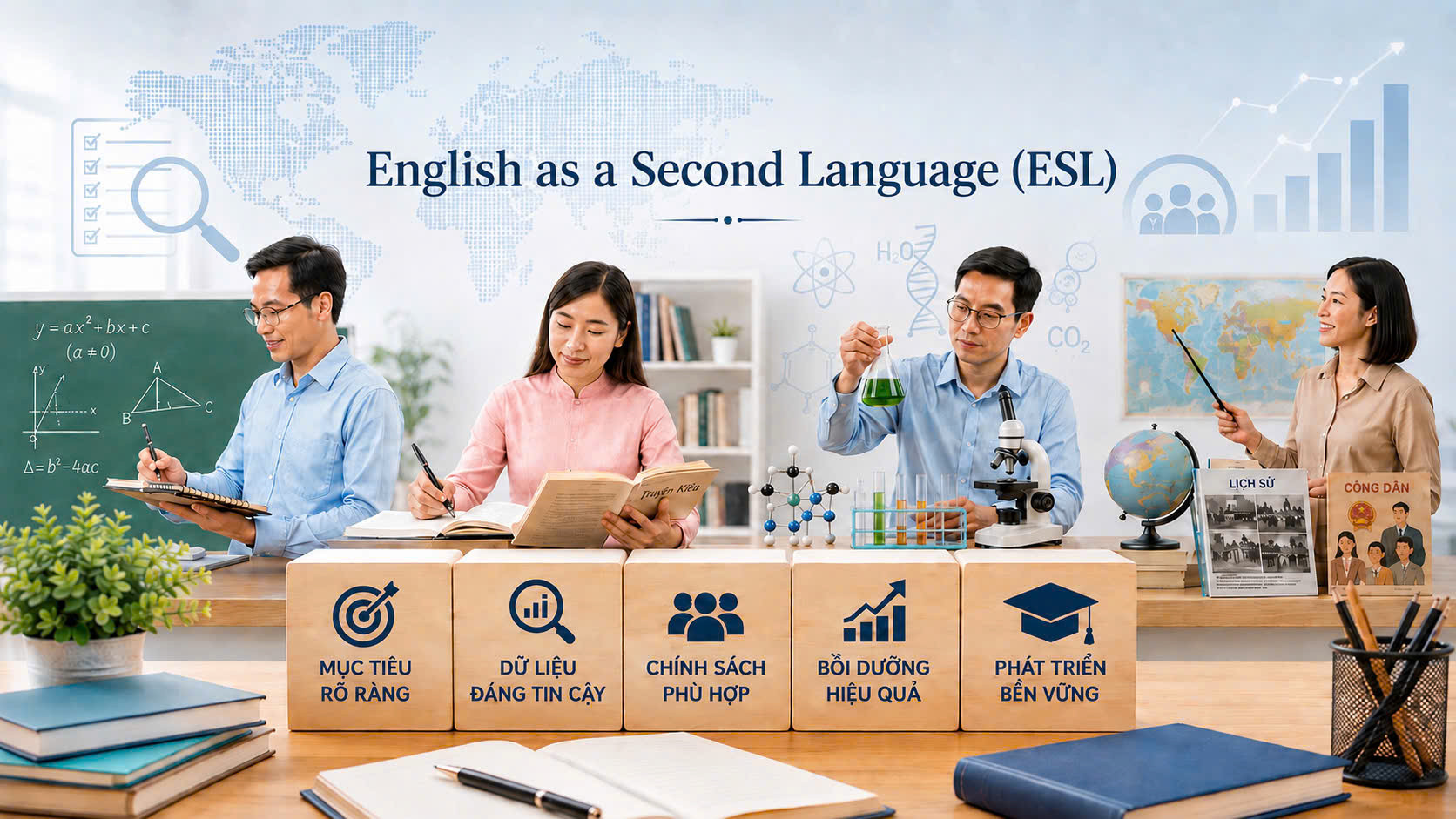
It is noteworthy that the text does not use terms such as "test," "assessment," "ranking," or "examination." Instead, the text emphasizes two objectives: surveying the teachers' current English proficiency and identifying future training needs.
This is a crucial difference. In educational management science, before developing a large-scale staff development program, managers need to answer a fundamental question: Where are we now?
Without reliable data on the current situation, policy-making is easily based on subjective assumptions rather than factual evidence. In other words, this survey is primarily a data-gathering activity for policy planning.
That is also why the official document emphasizes: "Do not use the results of this survey for teacher evaluation." From a state management perspective, this is an important message that needs to be fully and seriously understood.
The nature of this survey was clearly defined from the policy design stage: it is completely independent of the processes for evaluating civil servants or periodic performance rankings. Therefore, any inference that the survey results will affect the consideration of promotion or disciplinary action against officials is completely inappropriate and lacks legal basis.
2. Why weren't the survey subjects English teachers?
This is perhaps the most frequently asked question in recent days. At first glance, this seems paradoxical. However, when placed in the context of the policy of gradually making English the second language in schools, the Ministry of Education and Training's approach has a solid scientific and practical basis.
In reality, the professional competence of English teachers has been and is being managed through various mechanisms such as teacher training output standards, recruitment, ongoing professional development, and specific professional requirements.
Meanwhile, what the education sector currently lacks is data on the English proficiency of teachers in other subjects. If the future goal is to create a learning environment where students have more opportunities to be exposed to and use English, then the question is not only: What is the current level of English teachers? But also: What is the current level of the entire education system?
A math teacher might need to read professional materials in English. A physics teacher might need to access international STEM learning resources. A computer science teacher frequently needs to access new technologies through English-language materials. An education administrator might need to participate in international collaborative programs or professional exchanges.
These needs are not entirely the same. To develop appropriate support policies, it is first necessary to understand the current situation. Therefore, from a policy-making perspective, surveying teachers other than English teachers is understandable.
3. Should teachers be worried?
In my opinion, the answer is: We shouldn't panic, but we shouldn't be indifferent either.
There is no need to panic, as the current regulations clearly state that the survey results are not to be used for teacher evaluation. Any speculation beyond that scope lacks legal basis.
However, we shouldn't be indifferent. The important thing is not just today's survey, but the changes taking place in education and in our own professions.
In today's world, new knowledge is created at a very rapid pace. The vast majority of research papers, digital learning materials, online courses, and international professional resources utilize English. This means that foreign language proficiency is becoming an increasingly important professional tool for teachers, regardless of the subject they teach.
I believe the most positive aspect of this survey isn't the results themselves. The most positive aspect is that it gives us an opportunity to reflect on ourselves.
Having limited English proficiency isn't necessarily a cause for concern. What's more concerning is failing to recognize the need for learning and developing skills in this new context.
Modern education does not view professional competence as a fixed state. Teachers, like their students, always need to learn, adapt, and develop.
In conclusion
I think the most important thing teachers need to see from this survey isn't just the test itself. It's a signal that the education sector is entering a new phase of preparation for bigger changes in the future.
Surveys are not the destination; they are merely the starting point. More important is how the data collected will be used to develop training, support, and development programs for teachers in the coming years.
And perhaps the most thought-provoking question isn't: "Will the survey results affect me?", but rather: "In a rapidly changing world, what do I need to prepare for to continue developing my career in the next 5 or 10 years?" That's the question every educator needs to answer for themselves, not because of a survey, but because of the future of the profession they have chosen.
References:
1. Ministry of Education and Training (2026). Plan No. 179/KH-BGDĐT dated February 3, 2026 on surveying English proficiency and determining training needs for teachers.
2. Department of Teachers and Educational Management Staff (2026). Official Letter No. 816/NGCBQLGD-PTNGCB dated May 26, 2026, on organizing a survey of English proficiency for general education teachers.
3. National Assembly of the Socialist Republic of Vietnam (2019). Law on Education No. 43/2019/QH14.
4. OECD (2019). Making Education Policies Work: Evidence-Based Policy Making in Education.
5. UNESCO (2024). Global Education Monitoring Report: Leadership in Education / Teachers and Teaching.


