
Approximately one-third of the tasks assigned to the district will be transferred to the provincial level, and two-thirds will be transferred to the commune level.
According to the government's proposal, Deputy Prime Minister Nguyen Hoa Binh stated that approximately one-third of the tasks currently undertaken by districts will be transferred to the provincial level, and two-thirds will be transferred to the commune/grassroots level.
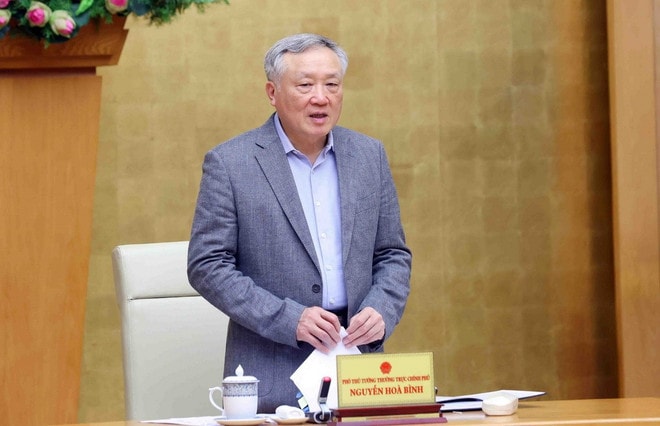
On the afternoon of March 13, the Steering Committee for the implementation of the rearrangement and reorganization of administrative units at all levels and the construction of a two-tiered local government organizational model held its first meeting.
Deputy Prime Minister Nguyen Hoa Binh, Head of the Steering Committee, chaired the meeting.
A unified timeframe is needed to end the district-level government model.
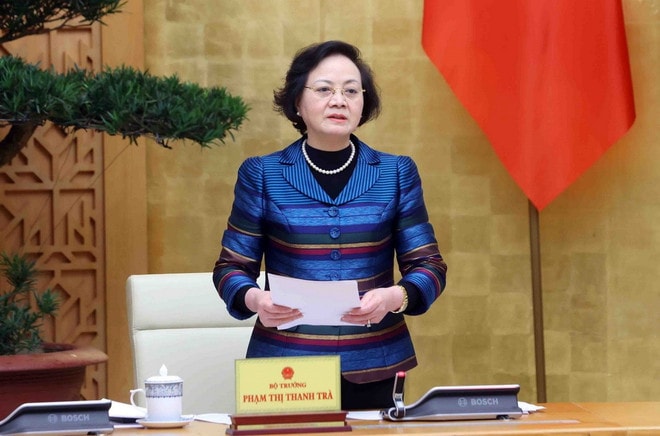
At the meeting, Minister of Home Affairs Pham Thi Thanh Tra, Deputy Head of the Standing Committee of the Steering Committee, announced Decision No. 571/QD-TTg on the establishment of the Steering Committee for the implementation of the rearrangement and reorganization of administrative units at all levels and the construction of a two-tiered local government organizational model.
Discussing the Steering Committee's operational plan, Minister of Justice Nguyen Hai Ninh stated that the Law on Organization of Local Government will soon be amended to regulate the organization of local government at two levels, clearly defining the responsibilities between provincial and sub-provincial governments; and addressing issues related to the transition in implementing tasks, powers, and organizational structure of local governments when reorganizing into two levels.
The Ministry of Justice will consult with agencies of the National Assembly to determine whether it is necessary to draft a resolution addressing certain issues when reorganizing administrative units, similar to Resolution No. 190/2025/QH15 of the National Assembly.
Sharing the opinion of Minister Nguyen Hai Ninh, Minister of Agriculture and Environment Do Duc Duy said that we are currently regulating according to a three-tiered local government model, in which there are specialized fields where district-level governments have many powers and handle numerous administrative procedures, for example, in the field of land.
The plan does not specify when the district-level administrative model will officially end, whether after the merger of communes or when the provincial level is completed. If it ends on June 30th, a resolution from the National Assembly is necessary, addressing the most urgent and fundamental issues related to citizens and businesses.
“Land, social security, education, health… these issues fall under the jurisdiction of the district level. In the Land Law, many contents depend on the district level, from district-level land use planning/planning to the initial issuance of land certificates… If we resolve this with one law amending many laws, it will not be possible to finish in time for the National Assembly session in May,” Minister Do Duc Duy stated.
He suggested that a resolution of the National Assembly should be issued in May 2025 and the Law amended in October 2025.
"If this issue is not addressed promptly, it will create significant bottlenecks in both social management and socio-economic development. After reporting to the Central Committee, it is also necessary to agree on a timeframe for discontinuing the district-level government model so that the Government can proactively develop guiding documents and other related content," the Minister proposed.
Ms. Nguyen Phuong Thuy, Vice Chair of the National Assembly's Committee on Law and Justice, agreed that after the Central Committee meeting, a resolution on the rearrangement of administrative units should be submitted to the National Assembly Standing Committee to serve as a basis for localities to develop plans and implement the rearrangement early.
According to Ms. Nguyen Phuong Thuy, reducing the number of district-level governments and decentralizing power to commune-level governments, in addition to requiring increased tasks, powers, and a larger workforce of officials and civil servants, also requires significant resources. Without amending the State Budget Law to change the allocation norms for different levels of government, communes will not have sufficient resources to carry out their assigned tasks. The State Budget Law is a priority that needs immediate amendment and supplementation; otherwise, it will become a deadlock.
According to Ms. Thuy, the administrative apparatus was recently reorganized horizontally, with essentially equivalent authority. Now, eliminating one level of government requires a way to redefine authority while amending relevant legal documents.
"Through the recent restructuring, we found that some aspects need clearer regulations. For example, what documents need to be changed and what don't need to be changed needs to be clearly defined. Regulations shouldn't be geared towards changes made only when people request them," Ms. Thuy said.
Ms. Nguyen Phuong Thuy argued that, firstly, people still going to change their ID cards creates an additional burden for government agencies, and secondly, some places are still encouraging people to change their ID cards even when it's unnecessary, causing difficulties for both sides.
This is a very important, complex, and large-scale task.
Emphasizing that this is a very important national and ethnic matter, a very large, difficult, and complex undertaking, Minister of Home Affairs Pham Thi Thanh Tra stated that the workload ahead is immense. On March 14th, the Politburo met to agree on the policy, after which the Government Party Committee will send the proposal to localities for feedback and to ministries and agencies for their input. It is expected that the Steering Committee will report to the Central Committee around mid-April 2025.
Regarding the reorganization of commune-level administrative units, the Minister of Home Affairs stated that there are currently 10,035 commune-level administrative units, which will be reorganized to a scale of only about 2,000, "almost like a small district." This falls under the authority of the National Assembly Standing Committee and can be done immediately after the Central Committee meeting. After the amended Constitution; the amended and supplemented Law on the Organization of Local Government and related laws come into effect, the operation of district-level local governments will cease. "Once we have a complete legal basis, including the Constitution, the amended and supplemented Law on the Organization of Local Government, and especially a Resolution, we will focus on rearranging and merging provincial-level administrative units… After that, we will implement matters related to the congress," the Minister of Home Affairs informed.
In his concluding remarks, Deputy Prime Minister Nguyen Hoa Binh welcomed the Ministry of Interior's early establishment of the Steering Committee, the development of the plan, and the issuance of regulations. He noted that this is a very important matter, concerning the nation, the people, and the effectiveness and efficiency of the apparatus. He emphasized that the work is extensive and complex, requiring high-quality completion within a very tight timeframe. The Deputy Prime Minister urged ministries, agencies, and members of the Steering Committee to demonstrate a sense of responsibility, fully participate in all meetings, carefully study the documents, and contribute to the Steering Committee's efforts to fulfill its assigned tasks. The Ministry of Interior will incorporate the feedback from the meeting to finalize the plan.
Regarding the abolition of district-level administrative units, the Deputy Prime Minister stated that, according to the government's proposal, approximately one-third of the tasks currently undertaken by districts will be transferred to the provincial level, and two-thirds will be transferred to the commune level – the grassroots level. The Politburo will decide on the names of these communes and the roadmap for implementation; next week, the Politburo will seek opinions from Party organizations, ministries, agencies, and localities.
The Deputy Prime Minister also assigned specific tasks to several ministries and agencies, requesting that the Procuratorate and the Courts proactively propose matters related to procedural procedures and jurisdiction.


