
Don't let practice go too far before theory can offer a conclusion.
The General Secretary and President suggested that theoretical research and practical总结 (summarization) should be elevated, and that practical experience should not be allowed to go too far before theory is summarized; policies should not be developed only after problems become bottlenecks.
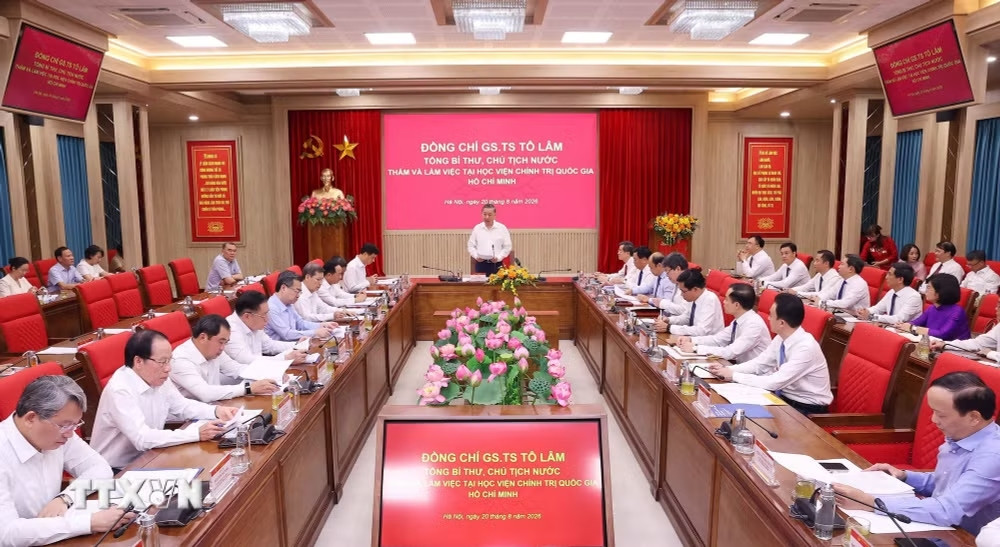
On the afternoon of August 20th, in Hanoi, General Secretary and President To Lam and the Central Delegation visited and worked with key leaders of the Ho Chi Minh National Academy of Politics.
Attending the working session were members of the Politburo and Secretaries of the Central Committee of the Party: Nguyen Duy Ngoc - Head of the Central Organization Department; Tran Sy Thanh - Chairman of the Central Inspection Committee; Trinh Van Quyet - Head of the Central Propaganda Department; Le Minh Tri - Head of the Central Internal Affairs Department; Nguyen Thanh Nghi - Head of the Central Policy and Strategy Department; General Nguyen Trong Nghia - Head of the General Political Department of the Vietnam People's Army; and Politburo members: Doan Minh Huan - Director of the Ho Chi Minh National Political Academy; and Tran Duc Thang - Secretary of the Hanoi City Party Committee.
Also present were Mr. Nguyen Xuan Thang - Member of the 13th Politburo, Chairman of the Central Theoretical Council; members of the Central Committee of the Party, government leaders, and leaders of central committees, ministries, and agencies.
According to the report presented at the meeting, the Ho Chi Minh National Academy of Politics has comprehensively implemented its assigned political tasks; proactively carrying out the policy of restructuring in a way that links theory with practice. Digital transformation, administrative reform, investment in construction, international cooperation, governance and management, and Party building work have seen positive changes. The staff, lecturers, and scientists have demonstrated a sense of responsibility, proactiveness, creativity, and quick adaptation to the requirements of innovation and development of the Academy in the new phase.
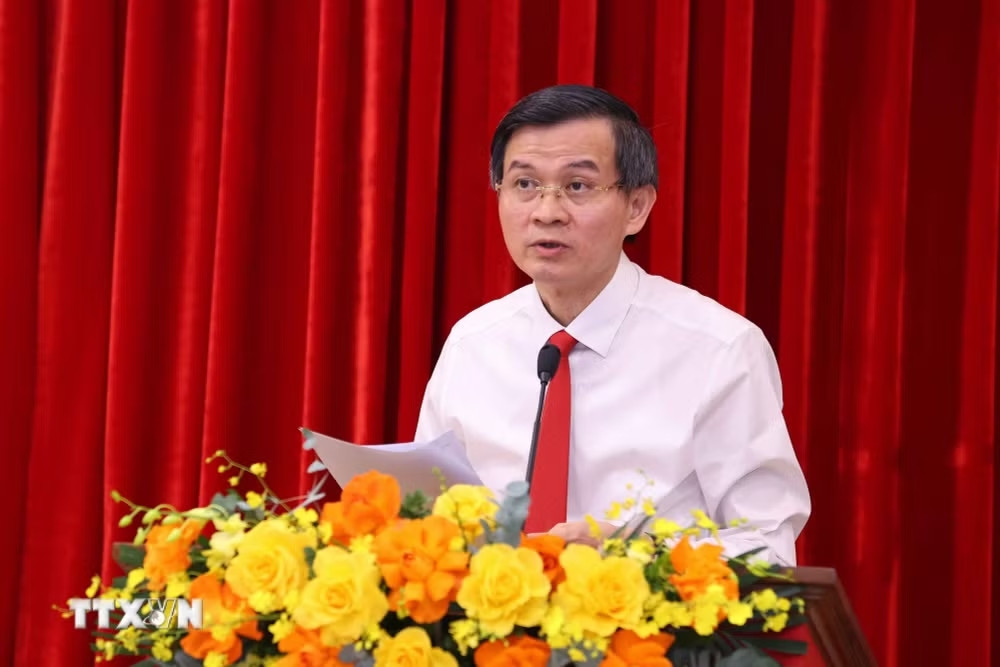
In the coming period, the Academy will continue to comprehensively innovate its scientific research activities, closely linked to the requirements of national development and the Party's political tasks in the 2026-2030 period; improve the quality of theoretical research, practical summaries, and the preparation of advisory reports and recommendations to serve the Politburo, the Secretariat, the Government, and central ministries and agencies; continue to strongly and comprehensively innovate training and education by shifting from the "traditional theoretical training" model to the "lecturer-student co-creation of knowledge" model; linking theory with practice, training based on scenarios, contributing to enhancing the vision, thinking, leadership and management methods, and strategic thinking of leaders and managers at all levels in the digital age.
After listening to the reports and the frank, heartfelt, and insightful opinions, which were both theoretically sound and closely aligned with practical realities, General Secretary and President To Lam acknowledged and commended the important efforts and contributions of the Ho Chi Minh National Political Academy, the Central Theoretical Council, its affiliated institutes, and the entire system of political schools nationwide in the recent past.
While generally agreeing with the major orientations, the General Secretary and President emphasized the need to accurately assess results, frankly acknowledge limitations, and clearly define the Academy's position, mission, and development requirements in the new phase.
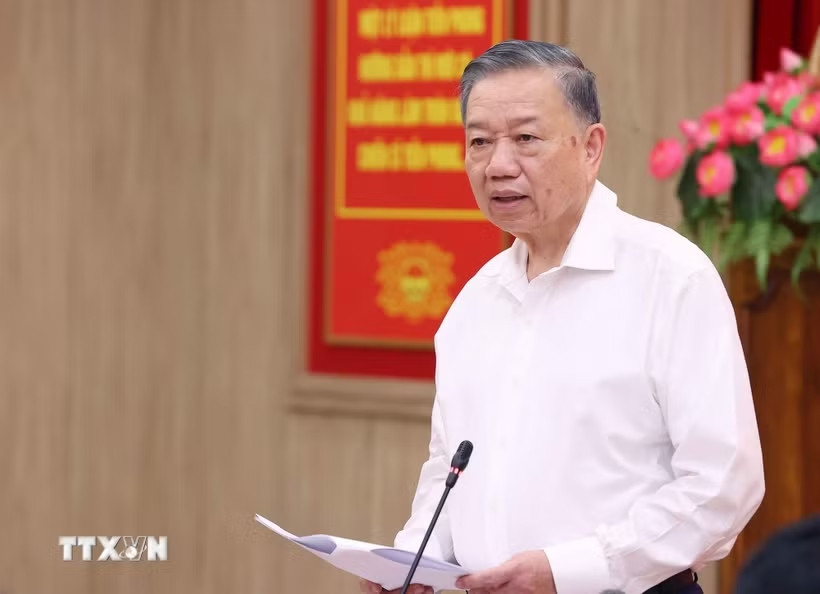
The Academy must fully and comprehensively fulfill its assigned functions and tasks, and continuously improve the quality of its work; befitting its status as the Central Party School, a national center for training and fostering leadership and management cadres; and for conducting research in political theory, leadership science, administrative management, state management, and public administration.
Each field must produce products of theoretical and practical value, directly serving the work of Party building, building the political system and the cadre; and organizing the implementation of guidelines, policies, and strategies.
The functions must be interconnected into a unified whole, creating synergy in knowledge, theory, and practice. The Academy must significantly enhance its research, forecasting, and strategic advisory capabilities; proactively summarize major issues, identify new trends, recognize unprecedented problems and changes affecting the country early on; and promptly provide reliable scientific, theoretical, and practical arguments for the planning and improvement of the Party's guidelines and the State's policies and laws.
The Academy must contribute to training a team of cadres with firm political convictions, theoretical and strategic thinking, leadership, management, and organizational skills; capable of transforming guidelines into concrete results; protecting the Party's ideological foundation; and proactively and resolutely combating and refuting erroneous and hostile arguments.
The General Secretary and President proposed a comprehensive reform of working methods, creating a clear qualitative and effective transformation; it is necessary to elevate the level of theoretical research, practical总结, strategic consulting, and the protection of the Party's ideological foundation. We must not wait until practice has gone too far before theoretical summation; we must not wait until a problem has become a bottleneck before implementing policies.
The scientific organization will summarize 100 years of the Party's leadership of the Vietnamese revolution, 40 years of implementing the 1991 Platform, and the special program for the period 2026-2030. Each task needs to produce a system of academic products: policy recommendations, data, case studies, and learning materials; using novelty, accuracy, timeliness, persuasiveness, and the extent of their application as metrics.
The General Secretary and President emphasized the need for fundamental and comprehensive reform in training and education, focusing on developing the product and capabilities of cadres. The shift should be from simply knowing theory to "understanding correctly, having firm conviction, applying creatively, and acting responsibly"; using theory as the foundation, political acumen as the core, organizational and implementation capabilities as a direct requirement, ethics and integrity as the standard, and the interests of the people as the measure.
The academy develops competency frameworks based on leadership levels, job titles, and positions. It incorporates real-world problems, challenging situations, conflicts of interest, and decision-making pressures into the classroom, addressing them through case studies and practical solutions.
In the "lecturer-learner co-creation of knowledge" model, learners contribute practical knowledge; lecturers provide political guidance, methodology, and theoretical anchors. Training is linked to personnel planning, utilization, and evaluation, but without mechanically making grades and diplomas the sole criteria for personnel decisions. Lifelong learning must become an organizational discipline and a habit of cadres; overcoming the disconnect between learning and practice.
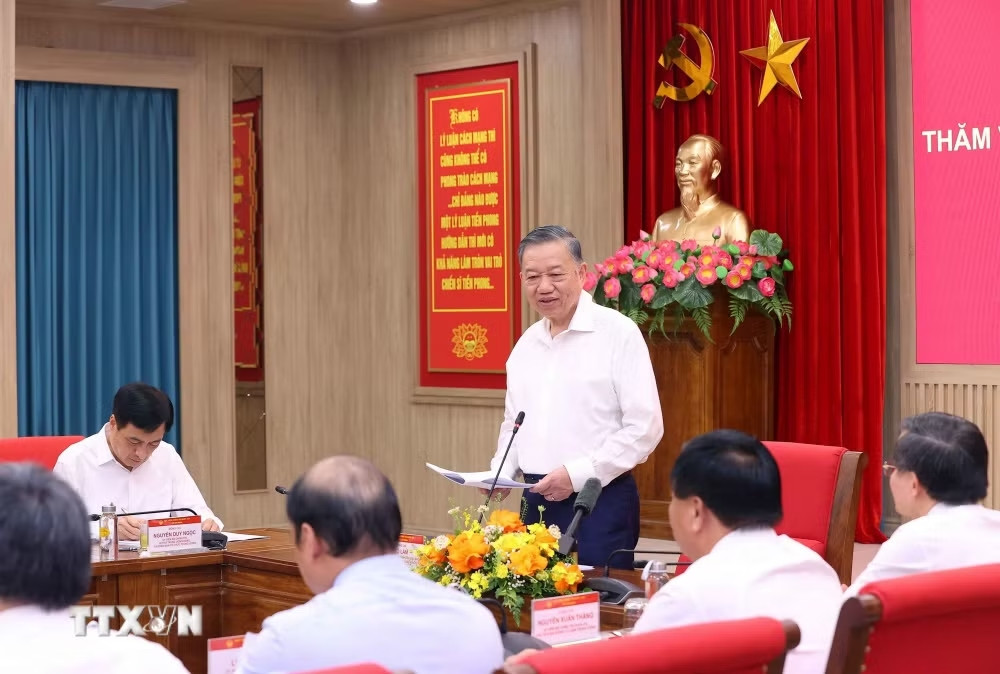
The General Secretary and President emphasized the need to reorganize operational methods to unify knowledge, policies, training, and practice. This includes building a workforce capable of fulfilling its tasks, and establishing exemplary Party committees and Party school cultures. The selection, evaluation, utilization, and remuneration processes should be reformed based on qualities, capabilities, and output/impact; avoiding egalitarianism and relying solely on academic titles and degrees.
Practical experience for faculty members is crucial, and continued training and learning are equally important, enabling scientists to understand the decision-making process and for practitioners to participate in training and research. The Academy must be a model for Party building, discipline, academic integrity, public service ethics, the use of public resources, and accountability; combating formalism, academic fraud, reluctance to debate, and avoidance of difficult issues. Faculty and staff must lead in lifelong learning and set an example through the quality of their work.
Furthermore, breakthroughs in data, digital transformation, artificial intelligence (AI), and governance are necessary. Digital transformation requires redesigning governance, research, and learning based on a unified data architecture; data must be "accurate, complete, clean, and active," with verifiable origins, accountable entities, and protected by established rights.
The General Secretary and President emphasized that immediately after the meeting, the Academy's Board of Directors should finalize the action program until 2030 and the annual plan. They should prioritize tasks that will bring about change and see them through to completion. Each task must have clear responsibilities, clearly defined roles, and clearly assigned personnel.
Ministries, departments, and localities consider coordination with the Academy as a shared responsibility; they proactively request practical solutions, share data within their authority, facilitate field trips, send officials for training according to needs, and provide feedback after training. Provincial and city Party committees build political schools in accordance with regulations, linking standard achievement with quality and effectiveness.
The General Secretary and President emphasized that focusing on building the Academy is focusing on the fundamental work of the Party, on intellectual capacity, leadership capacity, and the quality of cadres.
The Party Academy should be a place where new problems are discovered early, difficult problems are thoroughly researched, practice is elevated to theory, and theory is transformed into action; a place where every cadre, upon leaving the Party School, must be more steadfast in character, clearer in theoretical thinking, more responsible, and more effective in their work for the Party, the country, and the people.


