
A scenario that could cause Trump to lose the presidency.
Trump may not become the US president if he is abandoned by Republican electors in the upcoming in-person vote.
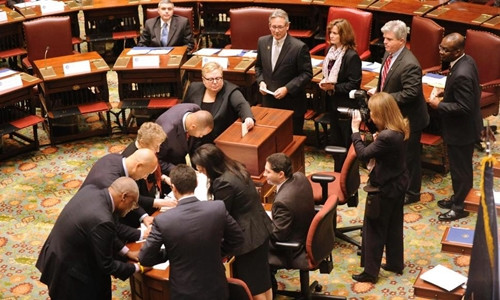 |
Electors cast their votes in New York in 2012. Photo: AP |
Two electors, Bret Chiafolo of Washington state and Michael Baca of Colorado, announced on November 14th that they would not vote for Donald Trump and hoped that at least 37 of their Republican colleagues would do the same. This is precisely the scenario many of Trump's opponents were hoping for, to cause him to lose the White House at the last minute through the electoral college vote.
The November 8th vote did not officially put billionaire Donald Trump in the US presidency; it only determined the 538 electors in states across the country who would directly vote to do so.
Before Election Day, both parties in each state select a group of potential electors for their respective parties. When Donald Trump or Hillary Clinton wins a state, they effectively win the electors for that state. For example, Trump winning Alaska means that the three Republican electors – former Governor Sean Parnell, Jacqueline Tupou, and Carolyn Leman – officially become the three electors representing Alaska.
On December 19th, electors will cast their votes for president in their respective states. Each state has a different voting system. In New Jersey, electors vote by marking the candidate's name on a pre-printed ballot, while in North Carolina, they write the candidate's name on a piece of paper. The vote counters then announce the results.
After the election, the electors sign six certificates, one of which, containing the results and certificate, is sent to the President of the Senate, who is Vice President Joe Biden.
On January 6, 2017, the U.S. Congress will convene to count the electoral votes under the chairmanship of Vice President Biden. Biden will announce the results of the presidential election by the electoral college, and then ask if there are any objections from any members of Congress. Each objection must be submitted in writing and signed by a member of the House and a member of the Senate.
If there is a dissenting opinion, the House and Senate will hold separate meetings, each limited to two hours. Each member may speak for a maximum of five minutes. Congress then resumes its session, and the results of the two separate meetings are announced. Both the Senate and the House must agree for a dissent against one or more electoral votes to be accepted.
If no presidential candidate wins at least 270 electoral votes, the 12th Amendment to the Constitution will be invoked, allowing the House of Representatives to choose the 45th president from among the three candidates with the most electoral votes.
Electoral College 'disobeys'
Many opponents of Trump have called for electors to become "disobedient" electors, meaning they would abandon their commitment to vote for Trump. However, some states have laws requiring electors to vote for the candidate they pledged to, with those who violate the pledge potentially facing fines of around $1,000, according to Inverse. Fifteen states do not have voter-binding laws: Georgia, Arizona, Arkansas, Indiana, Iowa, Kansas, Kentucky, Louisiana, Missouri, North Dakota, Pennsylvania, Tennessee, Texas, Utah, and Virginia.
According to CNN, nine of the last 17 US presidential elections have seen disobedient electors, totaling 179 who did not vote for their pledged candidate; however, this has not happened since 2004.
Only once in history has an electoral disobedience been able to influence the outcome of a vote. In 1836, all 23 electors in Virginia initially pledged to vote for presidential candidate Martin Van Buren and his running mate Richard Mentor Johnson, but later rejected Johnson. Ultimately, the U.S. Senate still chose Johnson.
According to Vox, in this year's election, Trump theoretically won 306 electoral votes compared to Clinton's 232. If 37 Republican electors abstained from voting for Trump, he would not have the minimum 270 votes needed to become the 45th president of the United States.
A narrow door for Clinton
However, the hope among Clinton's supporters that she could snatch victory from Trump through a "disobedient electorate" scenario is considered highly unlikely.
In the event that the electors "betray" Trump, they would have to vote for Clinton for her to have a chance of becoming president. If they don't vote for her, neither Clinton nor Trump would win the 270 electoral votes, and the US House of Representatives would decide who is president. Since the US House of Representatives is controlled by the Republican Party, it is clear that Trump would still be the winner.
Those chosen as electors are typically active and loyal party members. Before selecting them, the Republican Party vets their backgrounds to ensure they will be truly loyal to their party's presidential candidate. Some Republican electors may not support Trump, but they are unlikely to betray their party to vote for the Democrats.
Furthermore, any large-scale defiance by the electors would be opposed by Trump supporters in those states, leading to a split in the electoral vote. Under the law enacted in 1887, in this case, the decision would rest with Congress, and clearly the Republican-controlled House would not award victory to Clinton.
In fact, Clinton has conceded defeat and acknowledged Trump as the winner. There is no indication that she will support or participate in this effort.
Even if this scenario were to occur, the electoral college stripping Trump of his victory would undoubtedly trigger a constitutional crisis, as the Republican Party—which controls the U.S. Congress—would never accept Clinton winning the presidency in this manner. When similar situations have arisen elsewhere in the world, they typically create a military crisis, destabilizing the country.
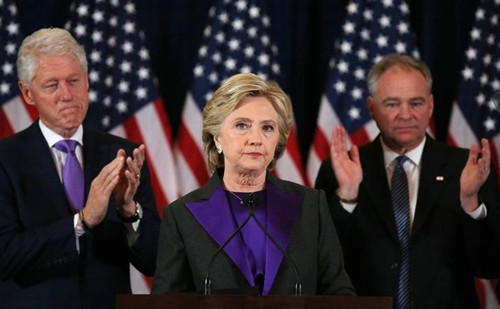 |
Hillary Clinton urged voters to accept the election results in her speech on November 9th. Photo: Reuters |
Another possible scenario is that Republican electors don't betray their party but simply reject Trump. They might choose another Republican such as Vice President Mike Pence, Senator Ted Cruz, or Mitt Romney, but that would require a large number of disobedient electors to make a difference, according to the Independent.
This is only likely to become a reality if some major event occurs. This could be if something unfortunate happens to Mr. Trump, if he continues to be involved in scandals, or if he faces serious problems during his presidency.
In that scenario, no one might win all 270 electoral votes, and the decision would rest with the House of Representatives. The House could only choose someone with a certain number of electoral votes, namely Trump or Clinton, but if they don't want to, they could choose not to decide and pass the decision to the Senate. The Senate could then choose someone other than Trump or Clinton, such as Vice President-elect Mike Pence.
Even in this scenario, Trump supporters are unlikely to remain silent, and protests and civil unrest are highly probable in opposition to the results.
According to VNE
| RELATED NEWS |
|---|


