
What scenarios would allow Vietnam U23 to beat China U23?
Vietnam U23 is considered the favorite in the semi-finals of the U23 Asian Championship, having a clear advantage over China U23 in terms of form, attacking effectiveness, and game control.
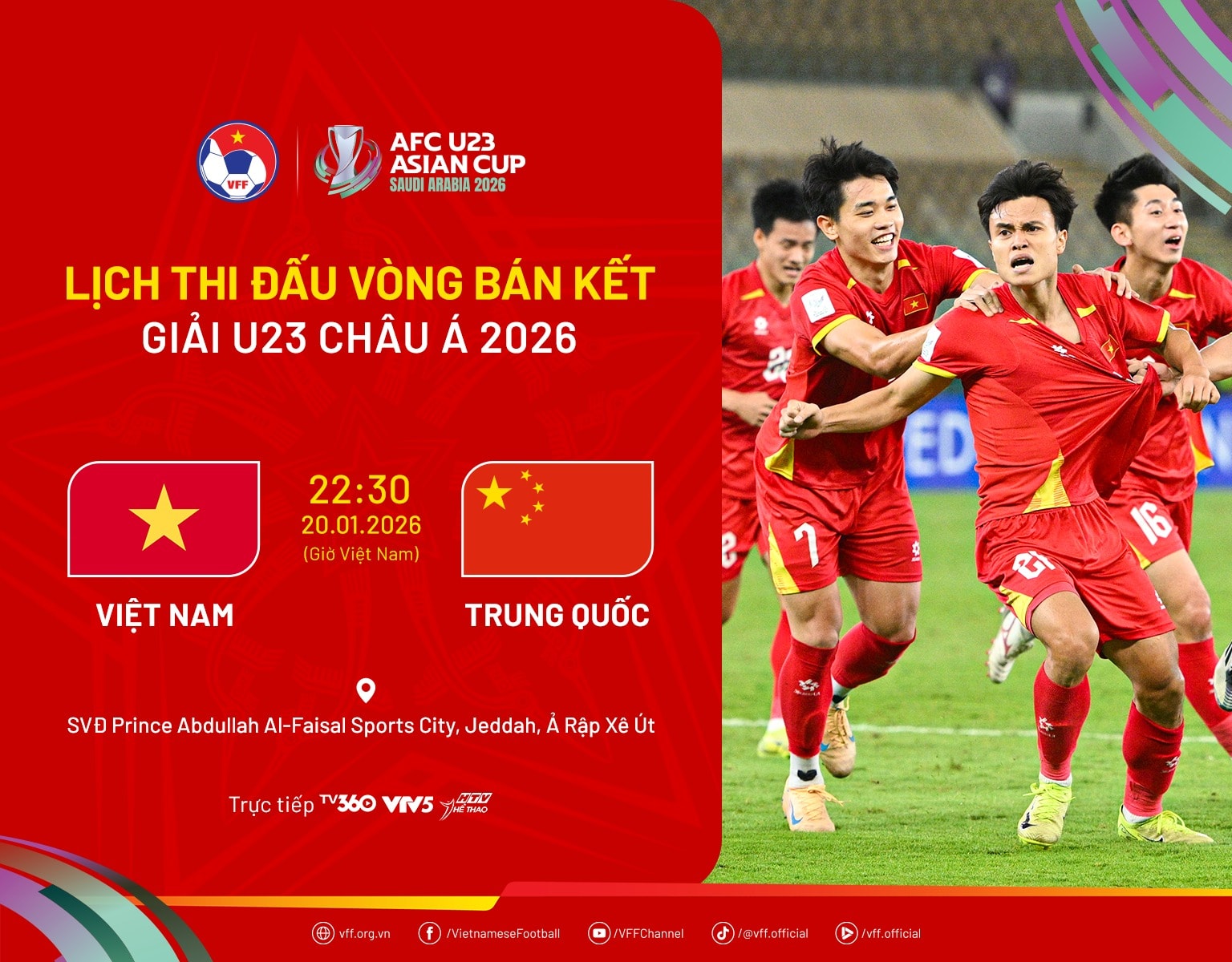
Match information: Vietnam U23 vs China U23
Time: 10:30 PM today, Tuesday, January 20, 2026 (Vietnam time).
Location: Prince Abdullah Al-Faisal Sports City Stadium, Saudi Arabia.
Nature: Semi-final match of the 2026 AFC U23 Asian Championship.
Predicting the odds of Vietnam U23 winning against China U23.
According to statistics, the Vietnam U23 team averaged 10.5 shots per match, almost double that of the China U23 team (5.5 shots). Vietnam's pass accuracy rate reached 79%, higher than China's 72%. More importantly, Vietnam consistently scored goals while maintaining defensive discipline, creating a significant advantage in crucial matches.
Conversely, the Chinese U23 team is physically strong, plays competitively, and handles pressure well, but shows clear limitations in attack. Scoring only one goal in four matches, along with a high number of fouls, is considered a risk when facing a Vietnamese team that is very dangerous in set-piece situations.
The Indian website Livescore chose Vietnam as the winner based on pure statistical data, as Vietnam won all four matches, while China only had one win and three draws.
Indonesian media also leaned towards a scenario where Vietnam controlled the game, China defended and counter-attacked, predicting a 1-0 victory for the Vietnamese team.
Notably, Chinese media also showed caution. Page 163 described this as a clash between "the spear" and "the shield," acknowledging Vietnam as the biggest dark horse of the tournament with its high-pressure pressing ability, proactive play, and superior physical fitness if the match goes on longer.
While praising China's three-centre-back defense, they also pointed out the inherent weakness: their inability to score goals.
Given the anticipated tight semi-final match, set pieces are seen as key. Vietnam U23 can certainly capitalize on corner kicks or aerial balls, where central defenders like Ly Duc or Hieu Minh can make a difference.
In a tense match, just one moment from a set piece can decide who gets to the final.
What scenarios would allow Vietnam U23 to beat China U23?
It is highly likely that the Vietnam U23 team will take the initiative to control the game from the start. With good physical condition and high confidence, the Vietnam U23 team will try to push their formation high, applying medium to high-pressure pressing to limit the opponent's ability to build up play. Controlling the midfield area, where Thai Son and Van Khang play a key role in regulating the game, is considered a top priority.
China U23 will likely not rush forward, but instead play defensively with their familiar 5-3-2 formation. The East Asian representatives will focus on maintaining their formation, sealing off the midfield, and forcing Vietnam to move the ball to the flanks.
In the first 20–30 minutes, China might accept being under pressure, aiming to maintain a draw and slow down the opponent's attacking tempo.
As the match progresses towards the middle of the first half, the Vietnam U23 team will increase the pressure through attacks down the flanks, early crosses, and especially set pieces. This is considered a crucial moment, because although China defends well, they often commit fouls when under constant pressure. Just one accurate corner kick or free kick could create a very real chance for Vietnam to open the scoring.
If the first half ends goalless, the second half will see a more tense and closely contested game. The Chinese U23 team will be forced to consider pushing their formation higher at times, and this is when Vietnam can exploit the gaps behind the opponent's defense with quick transitions.
In a scenario where the match goes into extra time, the advantage is likely to go to Vietnam U23 due to their superior physical fitness and ability to maintain a high level of pressing. Conversely, China U23 will play more cautiously, prioritizing taking the match to a penalty shootout if they don't concede a goal.
Overall, this was a low-scoring semi-final, decided by small details. Vietnam U23 had a better chance of winning if they had capitalized on set pieces or scored first, forcing China to abandon their preferred defensive strategy.
Extra time – penalty shootout scenario
If the deadlock cannot be broken within 90 minutes, the semi-final will most likely go into extra time in a tense and tightly contested match. Vietnam U23 is considered slightly superior at this stage due to their better physical condition and ability to maintain pressing.
With the Chinese U23 team playing deep to protect their lead, attacks down the flanks and set pieces continued to be Vietnam's main strategy.
In the event the match goes to a penalty shootout, China has a slight edge thanks to their consistent goalkeeper and ability to handle pressure well. However, having to defend continuously for 120 minutes could affect their accuracy in the decisive penalty shootout.
The player can make a difference.
On the Vietnamese U23 side, Nguyen Thai Son is expected to control the tempo and lay the groundwork for an dominant game. Meanwhile, Khuat Van Khang could become a key player from runs into the second line or from set pieces. With a tight game, just one clean finish could decide the match.
On the Chinese side, goalkeeper Li Hao remains the most important player. If Vietnam doesn't score soon, his role will become even more crucial in extending the match further.
Script summary
90 minutes: Vietnam controls possession, China defends with a large number of players.
Extra time: Vietnam has a physical advantage.
The cycle: China has a slight psychological advantage.
Predicted priority:Vietnam U23 won 1–0 in 90 minutes or 2–1 after extra time.


