
Experience in raising laying ducks...
The duck breeding model implemented by the Nam Sach Agricultural Extension Station in Hai Duong province brought high economic efficiency to farmers in 2015...
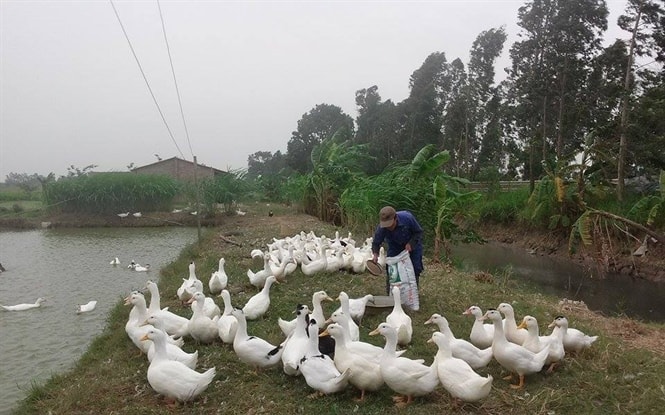 |
| Illustrative image |
Through the process of monitoring, supervising, and directing the model, here are some technical experiences for farmers to refer to.
Regarding the animal enclosures:Whether raising ducks for egg production in confinement or free-range, it's essential to prepare a sturdy and well-ventilated duck coop that is warm and airy inside. There should be a pond for the ducks to swim in, with proper drainage for water in and out. Before bringing in the ducks, disinfect the coop by spreading lime around the base of the walls and using disinfectants (such as Hanmid, Hankon WS, Vimekon, Vime-protex…). Leave the coop empty before bringing in the ducklings…
Regarding animal breeds: Purchase breeding stock from reputable establishments such as the Dai Xuyen Duck Research Center under the Institute of Animal Husbandry; CP Vietnam Livestock Corporation… Farmers will get reasonable prices and guaranteed quality breeding stock suitable for their farming purposes.
Regarding food and drinkThere are two common types of feed for laying ducks, depending on economic conditions and market prices, allowing breeders to invest accordingly. Firstly, feeding laying ducks entirely with commercial feed: Using pelleted feed has relatively high costs, but offers convenience, ease of use, control over quantity, and easy monitoring of daily feed intake...
Currently, the market offers many types of feed for different stages of duck development. Secondly, semi-industrial feeding of laying ducks: Use mixed pellet feed along with natural food sources such as boiled rice, green vegetables, duckweed, snails, fish, etc. Completely replacing pellet feed with natural food sources is not recommended because natural food sources do not provide adequate nutrition for laying ducks.
You can refer to the formula of 70% pellet feed + 30% natural feed (for example, raising 100 laying ducks requires 20 kg of feed/day, so there would be 14 kg of pellet feed (70%) + 6 kg of boiled rice or snails, fish, etc. (30%); about 5-10 kg of green vegetables per day for free feeding. If using golden apple snails, crush the shells before feeding them to the ducks). The daily feed intake of pullets must be controlled until 30-50% of the ducks start laying eggs, at which point free feeding should be allowed to ensure uniformity in the flock, preventing them from being too thin or too fat.
+ Collecting and storing eggs:Ducks primarily lay eggs between 2 and 4 AM, but may lay as late as 8 or 9 AM. Eggs should be collected 2-3 times to ensure cleanliness and prevent breakage. Store eggs in trays in a cool, dry place, and the method of preservation will vary depending on the intended use of the eggs.
+ Sanitation and veterinary services:Farmers need to ensure that feed is not expired or spoiled, use the correct type of feed for laying ducks, clean the feed and water troughs daily, and clean the duck coop weekly or monthly. Vaccination: Mix the vaccine with saline solution and inject subcutaneously into the neck or thigh.
Vaccinate ducks against two diseases: Duck Cholera at 15 days old and Duck Hepatitis at 21 days old; vaccinate against Duck Cholera at 45 days old and against Hepatitis at 60 days old; vaccinate against H5N1 avian influenza on day 70 and repeat the vaccination when laying ducks are 100 days old. Daily drinking water should be supplemented with electrolytes, B-complex vitamins, and antibiotics (Amoxycilin, Colistin, Gentamycinlin, and Tolysin) to increase resistance to intestinal and respiratory diseases in ducks.
*Note: When ducks are laying eggs, farmers should not use antibiotics as this will affect the quantity and quality of eggs.
According to Nongnghiep.vn


