
The remarkable effort of a Vietnamese mother in teaching her mixed-race child to speak the Nghe An dialect.
With a French father and a Vietnamese mother, the family currently lives in Paris. All three of Tú Anh's children speak fluent and sweet Nghệ An dialect, their maternal hometown.
Ms. TMs. Anh, 33 years old, was born and raised in Vinh, Nghe An. She is married to a French diplomat and has three children.Elisa Tú Anh is 11 years old, Nicolas Tuấn Anh is 9 years old, and their youngest sibling, Ema Hải Anh, is 4 years old. Elisa can speak, read, and write fluently in four languages: English, French, Chinese, and Vietnamese. Her younger brother Nicolas also speaks and writes well in English, French, and Vietnamese, while their 4-year-old sister can converse in Vietnamese and French.
Video of Ms. Tú Anh talking to her child in the Nghe An dialect.
.
Ms. Tu Anh shared the reasons why she wants to teach her children."Speaking Vietnamese, especially the Nghe An dialect, will help my children feel a stronger connection to their mother's homeland and love Vietnam as much as their mother does. Besides, I'll also have more opportunities to speak my native dialect and feel less homesick while living far away," she shared.
Furthermore, because he works in diplomacy and she is a foreign language major, both husband and wife understand that providing their child with opportunities to speak as many languages as possible will help their thinking develop and broaden their future prospects.
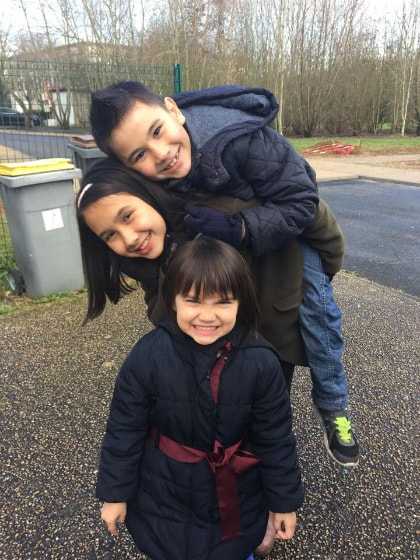 |
Ms. Tu Anh's three children: ELisa Tú Anh is 11 years old, Nicolas Tuấn Anh is 9 years old, and the youngest is Ema Hải Anh, 4 years old. |
With all three children, she started whispering to them in Vietnamese even while they were still in her womb. After they were born, she always talked to them and explained everything. "It had to be pure, standard Vietnamese, without any mixing of languages. For example, I would say 'Mommy and I are going to the park,' never 'Mommy and I are going to park,'" Ms. Tu Anh said. A "ritual" that was never missed before bedtime was that the children would read books in Vietnamese and could talk to their mother about everything in this language.
During family meals, everyone speaks English, but if she's speaking privately to her children and it's not related to her husband, she'll speak Vietnamese.
She has maintained this practice every day for over 10 years now."Teaching children Vietnamese is difficult, but maintaining consistency is even harder because if you neglect it for just a few months, they'll forget everything," she expressed.
A Vietnamese mother in France said that her children aren't always enthusiastic about learning Vietnamese, especially her second son.
"My son says Vietnamese is complicated and has too many tones, while at school he already has to speak both English and French. Many days, when he hears his grandmother speaking the Nghe An dialect, he gets annoyed because 'he's tired from school all day, and now he has to listen to a language he doesn't understand.' Many times, when it's 'Vietnamese speaking time,' he makes excuses, only saying one or two sentences before switching to English or French," she recounted.
However, the mother didn't lose heart and continued to nurture her child's bond every day. "Children love hearing their mothers whisper in their ears before bedtime. That's the easiest time for them to quickly absorb what their mothers want to convey," she shared her experience.
Another time, when she and her husband had a disagreement, she was upset and confided in her child, "When I'm sad, I just want to meet someone from my hometown to say a few words in the Nghe An dialect to ease my loneliness." The child quickly comforted her, "Don't be sad, Mom, I'll study hard so we can talk together."
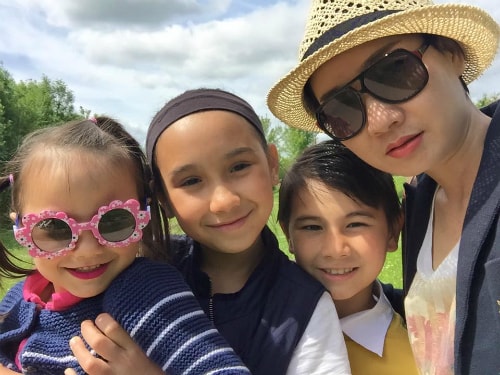 |
Ms. Tú Anh and her children are in France. |
She admitted that Vietnamese is easy to read but difficult to understand because it often uses literal and figurative meanings, and sometimes she's at a loss for how to explain it to her children. For example, once, she told her son that she never had time to "gossip" with friends because she went straight home from work to be with the kids, but the little boy kept asking about the phrase "gossiping." "Even when I explained that it's a way of talking between friends about small, unimportant things, he still didn't accept it and said, 'Then call it 'talking,' why call it 'gossiping'?' It left me speechless." There were times when, when her son asked and she didn't know how to explain, she would promise, "Let me find out more," but he would retort, "You don't even know your own language, Mom?"
Ms. Tu Anh said that many families abroad, even though both husband and wife are Vietnamese, have children who don't speak their native language at all. In a group of 40 Vietnamese friends, none of her children are fluent in Vietnamese; if they can speak it, it's only a few simple sentences. Some families, after living abroad for a while, don't want to return to Vietnam because they fear the heat, dirt, and lack of civility. They don't say it directly to their children, but they make the children understand through their behavior and attitude, and as a result, the children also don't want to return to Vietnam or speak Vietnamese.
"With my children, I also explain to them why my hometown is poor, lacks places for them to play, and is dirty and hot. I tell them about my childhood and take every opportunity to bring them back to Vietnam. Now it's more difficult because they are all very busy with school, but all three of them really enjoy going back to their maternal hometown. Honestly, they all love it."If you don't love your homeland, how can you teach your children to love and speak Vietnamese?", Ms. Tu Anh shared.
According to VNE


