
Expecting a 'flower street'
(Baonghean) - The "flower road" of Nghe An province, whether naturally formed, newly created, or long-standing, has reached a point where it needs preservation and transformation into a value dedicated to the homeland.
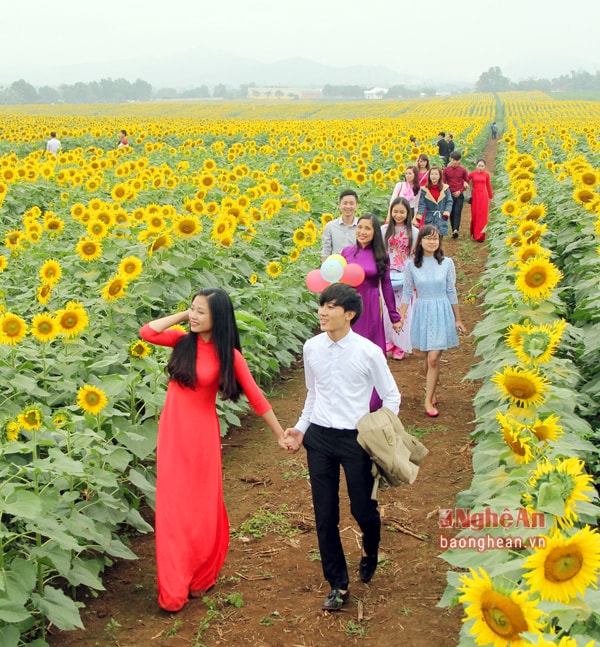 |
| Sunflower fields in Nghia Dan. |
Enchanting sunflower fields
In recent years, the sunflower fields in Nghia Son commune, Nghia Dan district, have attracted many tourists from near and far to visit and admire them. Hoping that the Phu Quy sunflower fields will become a world-renowned destination like Tuscany (Italy), Provence (France), or Hokkaido (Japan), the Nghe An tourism industry has repeatedly promoted this "product" at domestic and international tourism conferences and fairs.
In 2016, Nghe An once again showcased its sunflower fields at tourism promotion conferences in Bangkok and Udon Thani, Thailand. There, the sunflower fields were introduced again, along with two "new products": the Cau Cau Tea Plantation and Dam (Thanh Chuong district) and the Muong Thanh Safari Dien Lam Eco-tourism Resort (Dien Chau district). These sunflower fields and tourism products attracted the attention of leading Thai tourism companies.
It is quite possible that due to the allure of the sunflowers, the attractiveness of the diverse range of tourism products, or the emergence of direct flights between Bangkok and Vinh, a group of 61 Thai tourists visited the red basalt soil of western Nghe An province for the first time during the early days of the flowering season. With the arrival of this group of tourists, the captivating image of the sunflower fields began to spread beyond Vietnam's borders.
Present at the scene, Athitruta, a reporter specializing in Thai tourism, commented: "Visiting the flower fields, I found them very beautiful, poetic, and romantic. The local people are very friendly and hospitable." Athitruta added: "I was sent by a large travel company in Thailand with the task of documenting images of destinations in general, and the flower fields in particular, experiencing and evaluating tourism products; providing information to travel companies to help them design Thailand-Vietnam tours with Nghe An as a destination, as well as writing articles for travel websites and magazines..."
While delighted by the beauty of the flower fields, this travel reporter also subtly suggested that the flower fields still lack a system of hotels, guesthouses, homestays, and stalls selling local tourism products.
To make the sunflower fields a successful tourism product, contributing to the overall development of tourism, Nghe An province has implemented several effective solutions. One of these is establishing a tourist information counter at Vinh International Airport. Operating for two years, the counter has attracted 3,546 visitors seeking tourism information, including 543 international tourists.
 |
| Sara Arduino explores the sunflower field. |
Sara Arduino, an Italian tourist, learned about the flower fields, tea plantations, and many other destinations in Nghe An from this information booth. Visiting the flower fields, the tourist from Turin kept exclaiming: "Endless fields of bright yellow flowers under the late winter sun. It's so beautiful!"
In the context of declining beach tourism due to marine environmental incidents, in 2016, Nghe An province directed a strong shift towards ecotourism, homestay, and experiential tourism in the western region... And organizing the Western Spring Festival and the Sunflower Festival in 2016 was a wise decision.
In just three days of the festival, the sunflower fields attracted over 150,000 visitors, bringing the total number of overnight tourists in the province in 2016 to 3.22 million, including 72,860 international visitors, a 12% increase compared to 2015.
The sunflower fields – the starting point of the Nghe An flower road – beckon and open up a space in western Nghe An with majestic mountains, picturesque and poetic landscapes rich in color and fragrance. Along with that are the layers of rich cultural heritage of the Thai, Tho, Mong, Kho Mu, and O Du ethnic groups.
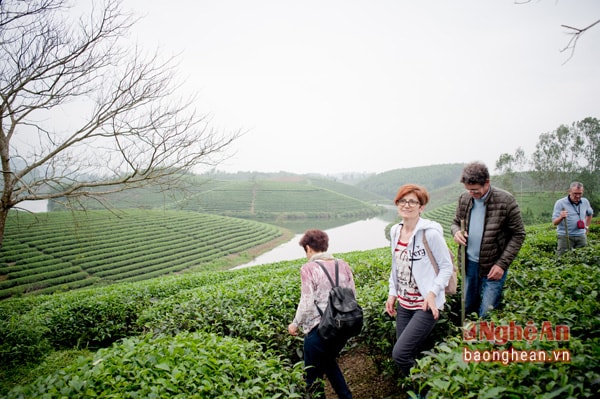 |
| International tourists explore Thanh An Tea Island. |
Tea Island - "Green Ha Long Bay"
From the sunflower fields, traveling south along the Ho Chi Minh Highway leads to the tea island; visitors will have another delightful experience with the charm of nature. This is the tea island - Cau Cau dam, located in Thanh An commune, Thanh Chuong district. Exploring the tea island by boat, Sara Arduino commented: "With over 100 peninsulas and 35 tea islands, this is a rare and enchanting landscape."
Often referred to as the "Green Ha Long Bay of Nghe An," the tea island is ideally suited for ecotourism development. Currently, the island receives around 100 visitors daily; on weekends, the number reaches 500-600, and on holidays, it can rise to thousands.
Currently, Nghe An's tourism industry is strengthening its communication and promotion efforts to attract tourists and invite major investors to cooperate in developing the tea island into a world-class tourist area. In December 2016, Nghe An province collaborated with the Ha Long Kayak Club (Quang Ninh) to organize the "Kayaking on Nghe An Tea Island" event.
Kayak Ha Long is a sports boating club in Quang Ninh province, bringing together many young people who love travel. The club's motto is not only to improve health but also to explore new tourist destinations, contributing to promoting local tourism... During the "Kayaking on Nghe An Tea Island" event, 40 members of the Kayak Ha Long Club participated in boating, sightseeing, taking photos, and posting images and experiences on sports and tourism forums.
Impressed and delighted with the tea plantation island cluster, Mr. Dinh Quoc Hung - Vice Chairman of the Ha Long Kayak Club said: "This is the first time I've paddled a kayak amidst such clear blue waters with picturesque, fresh, and charming tea hills beside it."
The lush green terraced tea hills here are just as beautiful as those in Moc Chau (Son La). It is hoped that as it develops, Nghe An will retain its pristine and harmonious beauty. To make the tea island even more attractive, further development of traditional and sport boat tours, along with accommodation and dining services, is essential.
Compared to other destinations in the province, the tea island has many advantages for development. Geographically, it is located right next to the Ho Chi Minh Highway, not far from Vinh City and Cua Lo town. Importantly, the tea island can be exploited throughout all four seasons of the year. Currently, there are no on-site accommodation or dining services, so most tourists visit briefly and then leave. It is known that only one enterprise has invested in the tea island so far.
According to the leaders of Thanh Chuong district, in order to sustainably develop the tea island - Cau Cau dam tourist destination, the district has proposed to the Department of Culture, Sports and Tourism to include the tea island in the tourism development plan for the western districts of Nghe An province; and to coordinate with the General Construction Corporation No. 4 to develop a master plan. While waiting for the plan and investment, the district calls on the people to ensure security, order and environmental hygiene...
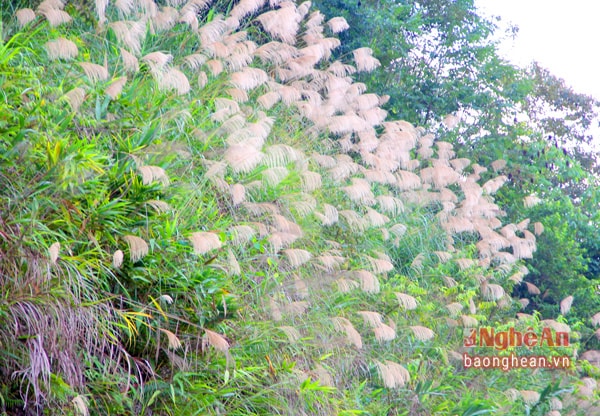 |
| The Hoa Binh, Cua Rao, and Ban Ve roads are famous for their reed flowers. |
Epilogue
In reality, the "flower road" of Nghe An province is much more than that. It's when February arrives, and the ponds and swamps, full of water after the spring rains, are covered in the purple of water hyacinths; in March, the sky is ablaze with blooming kapok flowers; and in summer, everywhere the flamboyant trees burst into bloom with cicadas and the crape myrtle blossoms a vibrant purple.
And, the pink lotuses in Kim Lien, Uncle Ho's hometown, and the pure, refreshing white lotuses in front of Can Linh Pagoda; as autumn transitions to winter, the reeds along the Lam River begin to bloom with vast expanses of pure white. In the Mekong Delta, the colors of poinsettias, wild sunflowers, white plum blossoms, pink peach blossoms, lilies, and orchids add to the myriad of colorful flowers in the mountain villages.
"The 'flower-lined roads' of Nghe An, whether naturally formed, newly created, or long-standing, have reached a point where they need preservation and be transformed into a value dedicated to the homeland..."
Thanh Son
| RELATED NEWS |
|---|


