
At what speed is driving an electric car most energy-efficient?
Real-world testing shows that the speed of an electric car directly affects battery life, meaning it affects the distance the electric car can travel on a single charge. So, at what speed is driving most efficiently to save battery power?
The driving range of an electric car, or the distance it can travel on a single charge, doesn't depend solely on battery capacity. In fact, many different factors can influence this figure.
For example, extremely hot or cold outside temperatures can impair battery performance. The size and type of tires, the weight of the vehicle, the number of passengers, and the cargo carried also contribute to energy consumption. Even seemingly minor details like wheel size or aerodynamic shape can make a significant difference.
Like gasoline-powered cars, electric vehicles also have to contend with physical forces during movement – from wind resistance and rolling resistance to gravity when climbing hills. Speed, in particular, is the most significant battery drain. The faster you drive, the greater the air resistance, meaning the car has to use more energy to maintain speed. This drastically reduces the driving range.
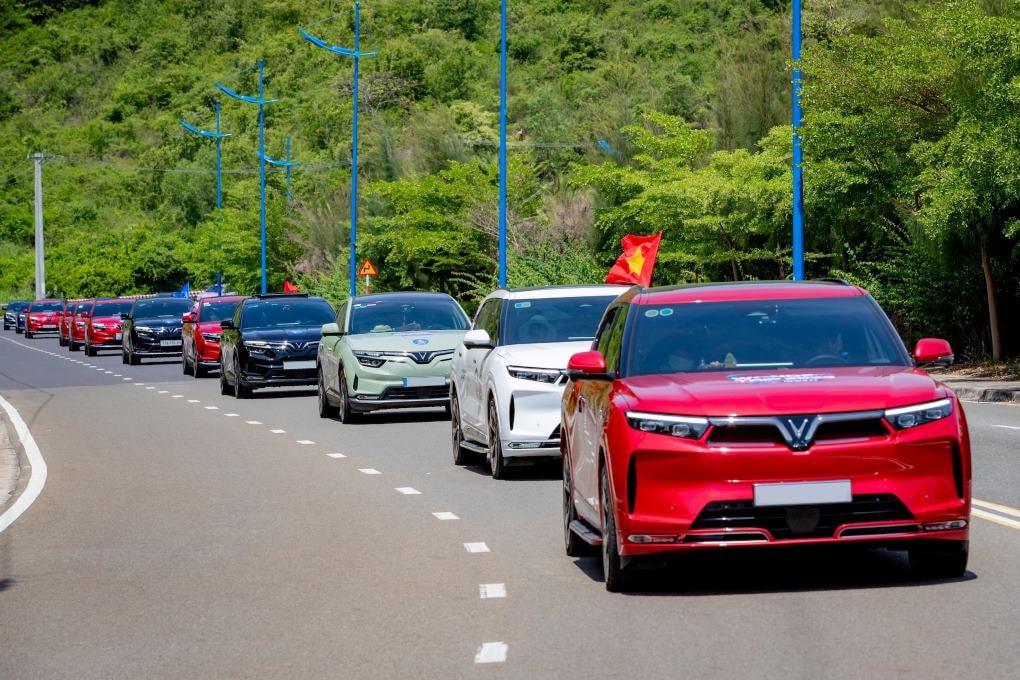
To achieve ideal driving range, you need not only a large battery capacity but also to maintain a stable speed, ideal road conditions, and minimize any factors that drain energy. Even the electric car with the best range, according to the US Environmental Protection Agency (EPA) 2025 rating, cannot escape these natural laws of physics.
At what speed will an electric car save the most battery power?
To answer this question, the MagazineCar and DriverA real-world test was conducted with three models, including two electric vehicles, the Lucid Air sedan and the Kia EV9 SUV, and a gasoline-powered Subaru Forester as a control. The goal was to examine how driving speed affects the range of an electric vehicle on a single charge.
The estimated driving ranges of the electric vehicles in the test varied according to EPA ratings, depending on the version. However, the results consistently showed a clear trend: the higher the speed, the more significantly the driving range decreased.
For example, at a speed of around 56 km/h, equivalent to city driving speed, the Lucid Air sedan shows an ideal range of approximately 781 km. But when accelerating to around 88 km/h, this figure drops to 608 km, a loss of over 170 km simply due to going faster. If further increased to around 121 km/h – a common speed on highways – the remaining range is only about 470 km, equivalent to a 23% reduction.
Specifically, when tested at speeds around 153 km/h, the remaining range decreased by a further 24%, to only about 355 km, less than half of the range achieved at speeds around 56 km/h. Meanwhile, the Kia EV9 SUV, with its less aerodynamic design, experienced an even more significant reduction.
This test clearly demonstrated that the faster an electric vehicle goes, the more energy it consumes, and the range it can travel decreases significantly. This is an important factor that users need to consider if they want to optimize their driving range on each journey, especially on long routes.


