
Driving an automatic car is simple, but mistakes still happen.
Automatic transmission vehicles, with their advantage of simple operation, are becoming increasingly popular, but the elimination of many control actions can easily lead to dangerous mistakes.
Thanks to the integration of components like the clutch, accelerator, and gear shift, drivers of automatic cars only need to focus on the accelerator and brake pedals, eliminating the hassle of shifting gears or worrying about the engine stalling midway. This makes driving more comfortable, even in congested traffic. However, this advantage can sometimes lead to complacency and over-reliance on technology, resulting in mistakes that endanger both the driver and the vehicle.
Habit of using both feet
Anyone who has studied traffic laws is likely familiar with the question, "When driving an automatic car, how should a driver use their feet correctly?", and the answer is, "Do not use your left foot; your right foot controls both the brake and accelerator pedals." However, recently, numerous "runaway car" accidents caused by mistakenly pressing the accelerator instead of the brake have stemmed from drivers using both feet to control the vehicle—one on the accelerator and one on the brake. In fact, many drivers believe this method is more convenient because neither foot is free.
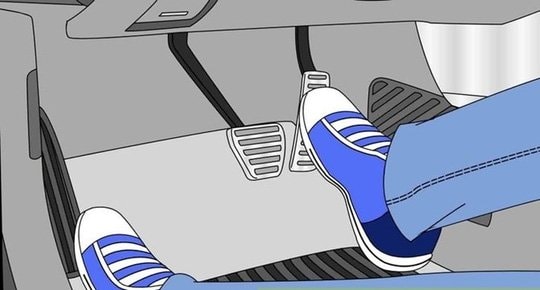 |
| When driving an automatic car, your right foot will perform both the brake and accelerator pedal functions. |
However, this is a bad habit that needs to be eliminated immediately, otherwise it will cause unforeseen consequences. In automatic cars, the accelerator and brake pedals are positioned in line with the right foot, ensuring the most stable seating position. When the driver tries to move their left foot to the brake pedal, that foot is always in an awkward position, making the seating posture uncomfortable. In case of emergency braking, the force applied will be insufficient. Meanwhile, the right foot remains on the accelerator for extended periods. When faced with an unexpected situation requiring braking, the accelerator cannot be released in time, significantly reducing braking effectiveness. The car will continue to move forward even if the driver applies the brakes, leading to loss of control.
Keep your foot resting on the gas pedal.
Because all operations are integrated into a single foot, most mistakes when using automatic cars are related to foot usage, specifically failing to follow the "if not accelerating, then braking" principle, being lazy or forgetting to switch to the brake pedal and leaving it on the accelerator instead. Ideally, if not accelerating, the driver should immediately move their foot to the brake pedal. If the foot remains on the accelerator, in a dangerous situation, the driver will instinctively press the brake pedal, but the car will not stop and may even suddenly lunge forward. This is also one of the main causes of "runaway car" accidents today.
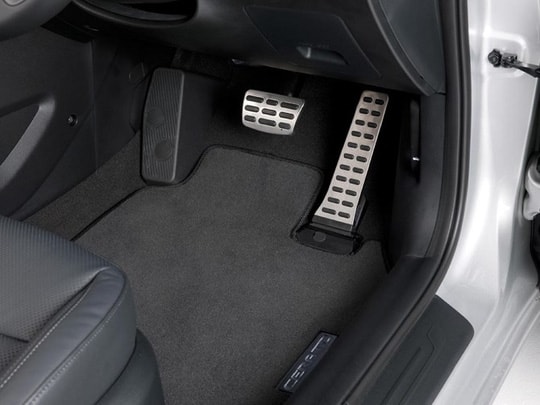 |
| Follow the "no gas, then brake" principle, switching to the brake pedal as soon as you release the gas pedal. |
Do not use the sport mode.
Even with automatic transmissions, there are still sport mode, manual mode, or semi-automatic mode, usually indicated by "+,-" or "M1, M2, L1, L2"... right on the gear lever. Some models are even more convenient with integrated paddle shifters on the steering wheel. When the gear lever is in this mode, the car doesn't automatically shift gears according to speed; instead, the driver shifts gears manually as needed. Once the driver understands the function of each mode, they can set the appropriate gear for each road section, thereby not only minimizing wear and tear but also preventing accidents.
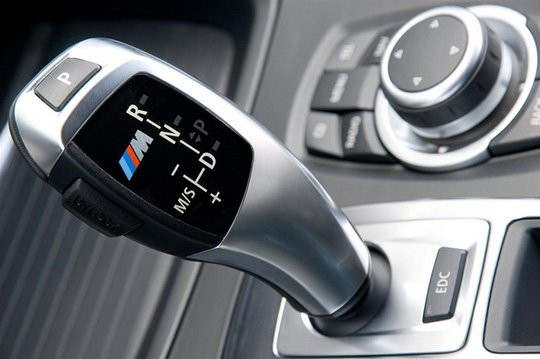 |
| The D+ and D- gears assist the vehicle in moving uphill and downhill safely. |
Specifically, the use of sport mode significantly impacts safety when driving on steep inclines or downhill slopes. When climbing, the vehicle can automatically shift gears to ensure sufficient traction and speed. However, when descending, the vehicle accelerates rapidly due to inertia, and the gearbox shifts to a higher gear, rendering engine braking ineffective. In this case, the driver must manually shift to gears 1, 2, etc., appropriate to the slope and length of the incline to maintain a safe speed. Without using manual gear shifting, the driver is forced to apply the brakes to slow down, but this method is not optimally effective; on the contrary, continuously operating the brakes under harsh conditions can easily cause brake failure or damage the hydraulic system.
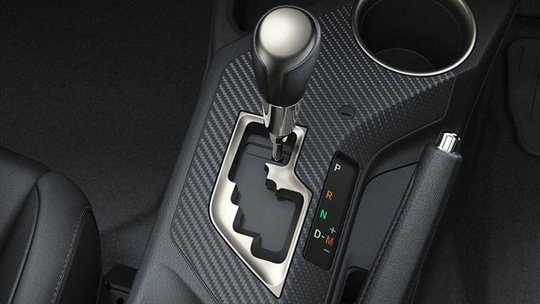 |
| Many drivers have a habit of shifting to neutral (N) when going downhill. |
Furthermore, many drivers have a habit of shifting to neutral (N) when going downhill to let the car coast and save fuel. This is a completely wrong idea, because modern automatic cars are capable of automatically cutting off fuel to the engine when going downhill. Shifting to neutral will inadvertently restart the system, sometimes even costing more. Not to mention, letting the car coast downhill is extremely dangerous; the driver has to constantly apply the brakes, causing them to overheat or wear out quickly, and it's difficult to react in time to unexpected obstacles.
According to VietNamnet


