
Making a fortune from fattening cattle
(Baonghean.vn) - With the goal of increasing the proportion of livestock farming in agriculture to become one of the key sectors, in recent times, the Anh Son district's agricultural sector has been promoting and encouraging people to utilize land potential, especially areas of mixed gardens and low-yield rice fields, to grow grass for fattening cattle in enclosed pens.
Farmers have traditionally been known as hardworking, impoverished individuals who endure hardship under the sun and rain, yet they remain trapped in poverty. This is largely due to the persistent presence of a small-scale, peasant mentality.
Therefore, even within their own "territory," farmers have yet to fully exploit their potential and advantages for breakthroughs. For example, raising cattle is important, but figuring out how to make these animals not only useful for plowing but also generate high economic value is a mindset that needs to be explored. And the farmers of Anh Son district have proven that they can absolutely get rich from raising cattle – livestock that has been closely associated with the people for centuries.
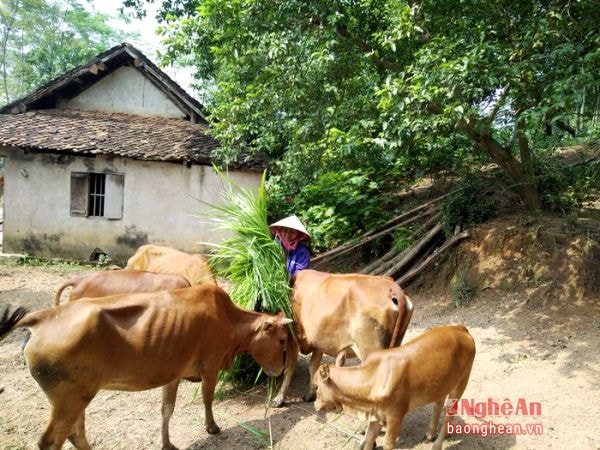 |
| The family of Ms. Tran Thi Tuyen in Hamlet 10, Long Son Commune, has been raising fattened cattle for over 10 years. Each batch consists of only 5-6 cows. They raise two batches per year, and after deducting expenses, they earn a profit of 40-50 million VND. |
Ms. Tran Thi Tuyen's family in Hamlet 10, Long Son Commune, has been raising fattened cattle for over 10 years. "Previously, my family raised cattle free-range, which took a long time and wasn't very profitable. In recent years, my family has raised 5-6 cattle per batch, with two batches per year. After deducting expenses, we earn a profit of 40-50 million VND," Ms. Tuyen affirmed.
According to Ms. Tuyen, although raising cattle is a secondary occupation, it brings high economic efficiency to her family. Cattle are livestock with low risk, easy to raise and care for, and have low feed costs; the profit mainly comes from labor, so they are chosen by farmers. According to Ms. Tuyen's experience, to achieve high results in fattening cattle, the feed source must be abundant. Besides readily available straw and hay, simply planting elephant grass and mixing it with some mixed feeds such as corn bran and rice bran as concentrate feed significantly reduces costs.
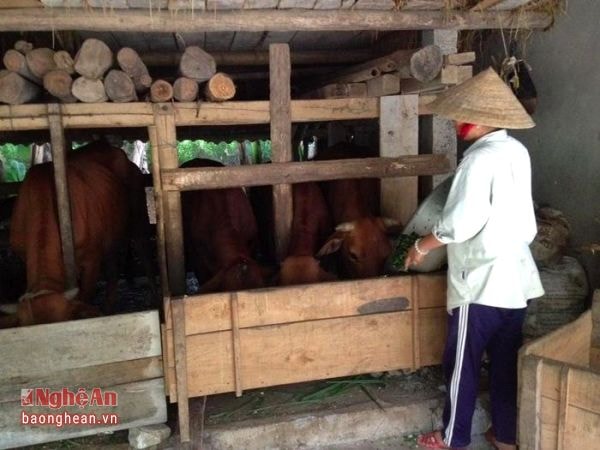 |
| The model of raising cattle in enclosed pens by the family of Ms. Thai Thi Yen in village 19/5, Dinh Son commune. |
For the family of Ms. Thai Thi Yen in village 19/5, they have only invested in raising cattle for the past three years, but it has already yielded clear results. Each month, the family invests about 500,000 VND in feed for each cow. After 6-8 months of raising, each male cow is sold for 18-20 million VND.
Ms. Yen said: "Besides selecting the right breed, the most important aspect of fattening cattle is ensuring they are adequately fed and providing supplemental feeding during the first 1-2 months before sale. Good care during this period results in healthy, beautiful cattle with high weight, making them easier to sell to customers."
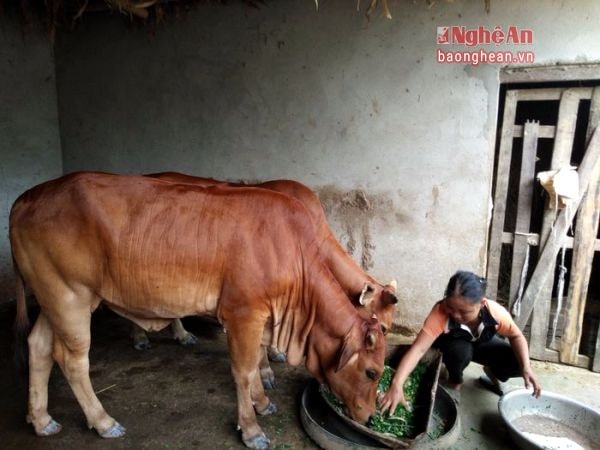 |
| Farmers in Anh Son district started raising cattle for fattening more than 10 years ago. From just a few small-scale households initially, this profession has now spread throughout all communes. |
Mr. Nguyen Dinh Dang, Head of the Agriculture Department of Anh Son District, said: Farmers in Anh Son District started raising cattle for fattening more than 10 years ago. From a few small-scale households initially, this profession has now developed widely in all communes. Currently, the total cattle herd in the district is stable at over 18,350 head. In the first six months of the year, the total output of meat for slaughter was 7,767 tons.
Currently, the entire district has 50 commercial cattle farming models with a scale of 10 or more cows, in addition to hundreds of households raising 5 or more cows, with the largest farms having 30-40 cows. After deducting expenses, farmers can earn a profit of approximately 1.5 million to nearly 2 million VND per cow per month, creating a significant income for local farmers.
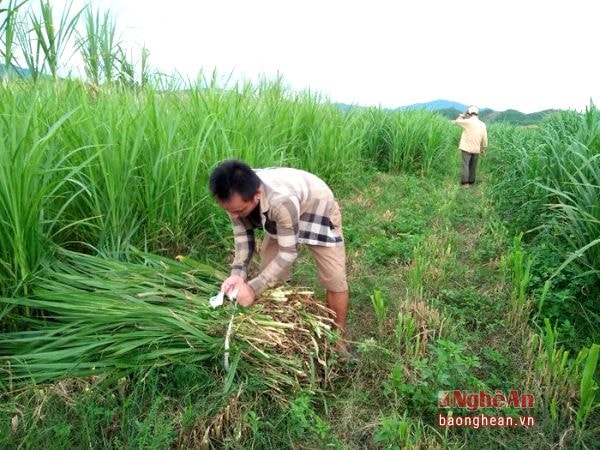 |
| Many households have taken advantage of the land's potential, especially areas of unproductive garden land and low-yield rice fields, to grow grass for raising cattle in enclosed pens for fattening. |
In 2015, Anh Son district established a pilot model of "Converting some areas of low-yield rice and crop cultivation to grass cultivation for livestock feed" in Vinh Son commune, covering an area of 25 hectares. Initially, the pilot model received 25 million VND in support, and the district plans to expand it to other localities with an area of 200 hectares in the near future. The goal is to reach a total buffalo and cattle population of 43,000 head in the district by 2020.
In addition, the district annually directs localities to organize training courses on fattening cattle; at the same time, it establishes demonstration sites and provides preferential loan support to help farmers replicate the model. This livestock farming model is suitable for the actual conditions of a purely agricultural district, avoiding risks for farmers while bringing high economic efficiency and contributing to poverty reduction in the locality.
Thai Hien
| RELATED NEWS |
|---|