
Low-cost organic farming using soilless plants.
(Baonghean.vn) - The whole world, including Vietnam, has been promoting the use of organic fertilizers for clean agricultural production, helping to make the land more fertile, reducing pests and diseases, and ensuring safe agricultural products. With duckweed cultivated in rice fields, if restored, it can be used as organic fertilizer for crops.
The great benefits of duckweed
Agricultural scientists around the world and in Vietnam are very hopeful about the future of duckweed in organic farming today.
Duckweed grows naturally and is abundant in ponds, lakes, swamps, and rice fields throughout Vietnam. More than 30 years ago, Vietnamese farmers didn't have access to as many chemical fertilizers as they do now. Therefore, the Ministry of Agriculture and Rural Development adopted a policy of cultivating duckweed in ponds, lakes, and rice fields to use as fertilizer for crops and green fodder for livestock.
In Nghe An province, prior to 1985, the movement to cultivate duckweed in rice fields flourished, becoming a competitive movement in all agricultural cooperatives, mass organizations, especially among youth and women.
Later, with the adoption of chemical farming practices, the use of chemical fertilizers became widespread and continues to this day. Over time, the use of chemical fertilizers has revealed many adverse consequences, such as: soil degradation, barrenness, and depletion; creating favorable conditions for pests and diseases to thrive, causing pollution of water, soil, and air; and especially the risk of producing agricultural products that are unsafe for human health. Therefore, the trend towards organic farming to protect soil resources, reduce environmental pollution, and create clean products for consumers is inevitable.
To contribute to the promotion of organic agricultural production, duckweed has been and is being encouraged by scientists both worldwide and in Vietnam for use as fertilizer in current agricultural production.
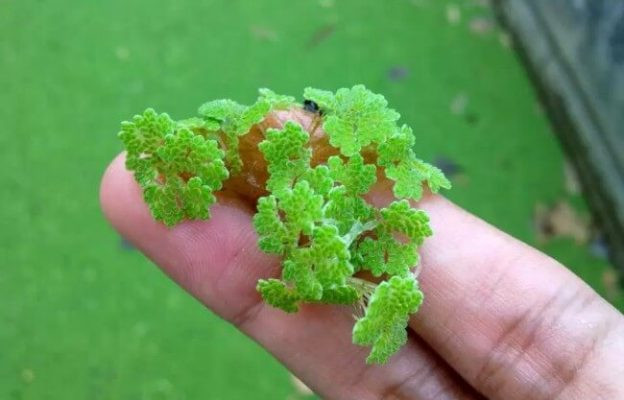
Duckweed (Eichhornia crassipes) floats on the water surface and has a symbiotic relationship with the nitrogen-fixing green algae (cyanobacteria) Anabaena Azolae. The nutrients in duckweed, based on dry matter, include: Protein 25-35%, amino acids 10%, minerals 10-15%, and are rich in omega-3, omega-6, vitamin A, beta-carotene, vitamin B12, and minerals such as calcium (Ca), copper (Cu), iron (Fe), magnesium (Mg), phosphorus (P), and potassium (K).
In particular, duckweed is a very fast-growing plant, capable of doubling its biomass in just 2-3 days if properly cared for. Therefore, cultivating and using duckweed as a bio-organic fertilizer for agricultural production and pig and chicken farming is very beneficial and effective.
Currently, in Minh Luong town, Chau Thanh district, Kien Giang province, Mr. Le Quoc Viet cultivates 2.5 hectares of rice entirely without using chemical fertilizers and without spending money on pesticides.
Mr. Le Quoc Viet simply collects duckweed, propagates it, and releases it into his rice fields, allowing it to reproduce until it completely covers the water surface. When the duckweed matures, it sinks and decomposes into organic fertilizer, providing excellent nutrients for rice growth, resulting in a yield of 65-70 quintals/hectare. After harvest, his family's rice is entirely purchased by Le Gia Company for processing into organic rice for sale on the market.
According to Professor Dr. Mai Van Bo, former Director of the Vietnam Academy of Agricultural Sciences, the current trend in agricultural production is the use of organic fertilizers. For many years, farmers have used a lot of chemical fertilizers because they offer immediate results and are convenient to use. Furthermore, the shortage of labor has led to a sharp decrease in the use of organic fertilizers, or even none at all. As a result, the soil has degraded both organically and nutritionally. Currently, the State and the Ministry of Agriculture and Rural Development are once again recommending that farmers use organic fertilizers.
3 ways to use duckweedeffective
Currently, duckweed is used in several countries around the world, including Vietnam, in three ways. Firstly, in some countries, especially India, they cultivate duckweed using advanced technology in built or earthen tanks lined with bio-textile fabric. The entire duckweed product is harvested, dried, and used as feed for poultry, aquaculture, and pig farming, as this green feed source is rich in protein. Secondly, it is used as a raw material for the pharmaceutical industry to extract Phylamin. Thirdly, it is used to produce high-quality organic fertilizer.
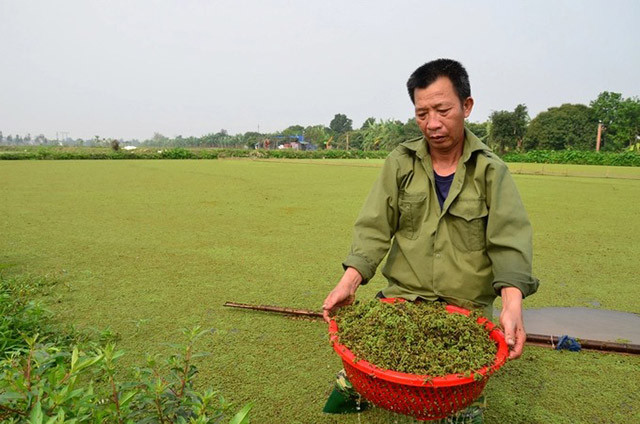
Currently, duckweed can be used as fertilizer by: cultivating it in rice fields as farmers traditionally did. When the duckweed covers the entire field, gather it up and bury it in the soil around the rice plants to decompose and fertilize the rice. If there isn't enough manpower to bury the duckweed, when the plants mature, they will naturally die and sink to the bottom of the field, which is also a good method.
The second method involves cultivating and intensively farming duckweed in ponds, lakes, ditches, etc., to encourage rapid reproduction. Every 2-3 days, the harvested duckweed is composted and used as fertilizer for all types of crops. Using duckweed as fertilizer is a measure and a direction for developing clean agriculture, as it is a very good source of biological green fertilizer for crops, improves soil quality, cleans the environment, and produces clean products.
The biggest concern when cultivating duckweed is leaf-eating insects. Experience from farmers in districts like Yen Thanh, Dien Chau, and Quynh Luu – areas where duckweed is commonly grown in rice fields as fertilizer for the spring rice crop – shows that: When duckweed shows early signs of insect infestation and before releasing it into the rice field, it must undergo a composting process. The composting method is very simple: all the duckweed is gathered into a corner of the field, piled up, and then sealed with mud. After about a day, all the insects that harm the duckweed die due to lack of air, and then the duckweed can be released back into the field. This method eliminates the need for pesticides.
Caring for and nurturing duckweed to promote rapid growth isn't too difficult. To cultivate duckweed, simply sprinkle phosphorus fertilizer and wood ash on the surface of the plant, about every 8-10 days. Doing so will encourage root growth, keep the leaves green, and enhance the plant's ability to synthesize nitrogen (N2) from the atmosphere. Such duckweed plants will serve as a source of fertilizer, providing both organic matter and a significant amount of nitrogen synthesized by the plant itself, making them excellent fertilizer for rice plants.


