
The rattan and bamboo weaving village is in a precarious situation.
(Baonghean) - While businesses exporting rattan and bamboo products are facing product shortages and having to accept order cancellations, many rattan and bamboo weaving villages in the province are struggling to survive, with workers showing little enthusiasm for the craft.
Disillusioned with the job due to low income.
We visited the Dong Phu handicraft village in Khanh Thanh commune (Yen Thanh district) during the agricultural off-season. When asked about the handicraft trade, Ms. Phan Thi Oanh, the village head, shared: "During the off-season, most people involved in handicrafts have to do other work, only I have enough time each day to do this. The craft is truly declining, and the workforce is dwindling."
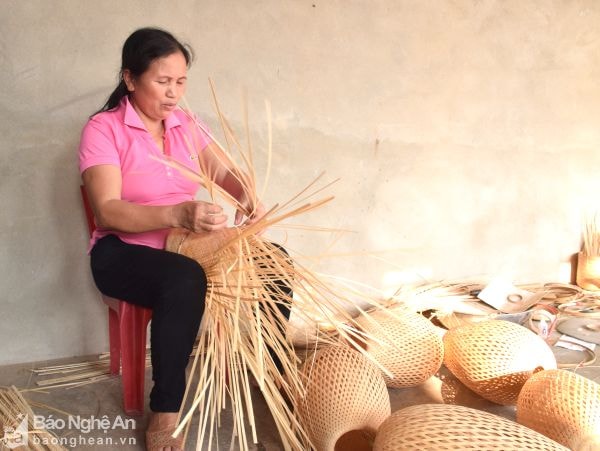 |
| Ms. Phan Thi Oanh, head of the Dong Phu rattan and bamboo weaving export village in Khanh Thanh commune (Yen Thanh district), still sticks to her craft. Photo: Xuan Hoang. |
At Mrs. Oanh's house, in the corner of the garden, is a long-unused machine for spinning bamboo fibers. Having just finished a lantern, Mrs. Oanh added: "When the craft village was recognized as a traditional bamboo weaving village (in 2009), there were 120 households engaged in the craft, but now only 14 remain. The current workforce in bamboo weaving is mainly elderly people with limited health, so the products often don't meet requirements and the output is low. The reason is that in recent years, many garment, brick, and tile companies have appeared in the area. Young workers, who previously earned low incomes from bamboo weaving, have left to work as factory workers, leaving the elderly to cling to the craft."
Regarding income from the bamboo weaving craft, Ms. Oanh stated: 10 kg of raw bamboo is supplied by Duc Phong Co., Ltd. at a price of 55,000 VND. One person can weave 5 lanterns in 2 days, earning 200,000 VND from the company. This means a daily wage is only slightly over 50,000 VND; the average income in the craft village is currently only 1.5 million VND per person per month. Meanwhile, working independently in the local area earns 200,000 VND per day. Another issue is that the local government has not shown sufficient interest in the craft village. Ms. Oanh believes that if the State does not have policies to support the craft, the risk of the bamboo weaving craft disappearing is very high.
The situation in Dong Phu Export Handicraft Village is also a common situation for many handicraft villages throughout the province today.
The province currently has 44 traditional craft villages, employing 2,751 people with an average income of 15.5 million VND per person per year. Surveys show that five of these villages are underperforming: Da Lam (Do Luong), Dong Phu, Bac Vuc, Lien Son, and Thanh Son (Yen Thanh); and eight have ceased operations: Xuan Thinh, Quyet Thang, and Van Nam (Dien Chau), Dong Luyen, Trung Hau, Ngoc Son A and Ngoc Son B, and Son My (Quynh Luu). These craft villages have created jobs for 3,000 local workers. |
We need a "midwife".
Mr. Thai Dai Phong, Director of Duc Phong Co., Ltd., stated: "The company has a significant demand for its electrical and electronic products, with a promising export market. Currently, the company directly exports electrical and electronic products to countries such as the UK, France, Germany, the Netherlands, Sweden, Denmark, the USA, Japan, and South Korea... The main products are lamps, various types of trays, gift boxes, and packaging boxes."
Duc Phong Co., Ltd. currently has 16 craft villages producing goods for the company, but only 350 workers, which is insufficient to meet export order demands, forcing the company to terminate contracts with some markets. Mr. Thai Dai Phong also acknowledged that the income of workers in the craft villages is low. The reasons are that the vast majority of workers are elderly women, performing piecemeal work, resulting in low productivity and insignificant production time.
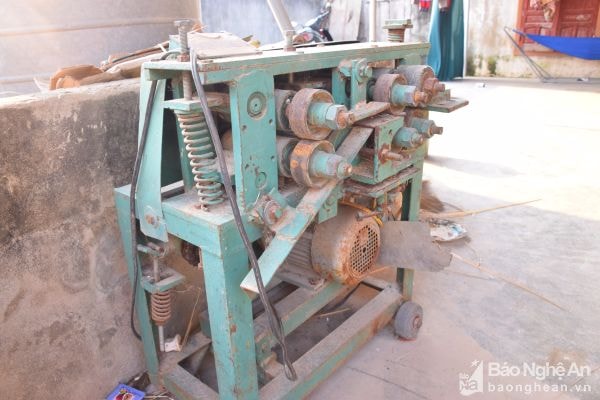 |
| The bamboo splitting machine used for weaving at Dong Phu rattan and bamboo weaving village (Khanh Thanh - Yen Thanh) has been out of use for a long time. Photo: Xuan Hoang |
Regarding the current situation of the "premature death" of traditional bamboo weaving villages, Duc Phong Co., Ltd. stated: Currently, the villages in the province mainly use bamboo and rattan from Quy Chau and Que Phong districts as raw materials. The total area of bamboo and rattan is approximately 29,000 hectares, sufficient to supply the villages for production throughout the year. However, the raw material processing stage lacks standardized machinery. To develop the bamboo weaving craft, local authorities and relevant agencies need to urgently organize the consolidation of these villages, provide new training, and improve the skills of workers in these villages.
To address the current challenges facing the traditional craft villages, the practical approach is to improve the skills of workers, plan raw material areas, focus on quality, design, and labeling, and invest in technology. It is also crucial to strengthen the involvement of local authorities and the coordinating role of various organizations at all levels in implementing the planning and development of the craft.
Local authorities need to focus on directing the proactive establishment of cooperatives, associations, and enterprises in craft villages to act as "support systems" for these villages.
The fundamental challenges in the development of traditional craft villages in Nghe An include: Some local Party committees and authorities have not paid close attention to the development of craft villages and villages with traditional crafts; they have not closely followed the provincial People's Committee's plan for the development of craft villages and villages with traditional crafts. In addition, the scale of craft villages is still small and scattered, investment capital is low, and technology is outdated. The workforce in these craft villages has low skill levels, productivity and quality are not high, there are not many skilled artisans and craftsmen, and incomes are still low. |
Xuan Hoang


